I’ve posted a new short story, Perfect. It’s a bit of a break from the usual darker stuff. Hope you enjoy it.
You can read it here, and for a list of all my other shorts, click here. Let me know what you think.
I’ve posted a new short story, Perfect. It’s a bit of a break from the usual darker stuff. Hope you enjoy it.
You can read it here, and for a list of all my other shorts, click here. Let me know what you think.
Just a short one this week, due to being on holiday recently. A week in the sun, lounging about by a pool—ideal reading time. Some of what I read wasn’t too impressive, but I thought I’d let you know about the best three.
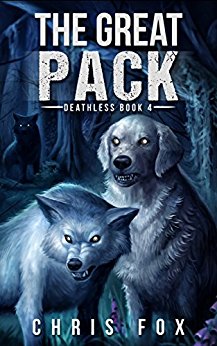 The Great Pack—Chris Fox
In self-publishing circles, Chris Fox is known for his openness in talking about what he’s doing, as well as his data-driven approach to writing. He produced a book on how to write 5000 words per hour (through planning, then using dictation software), detailed his ‘write to market’ strategy (basically, looking at what kinds of books are popular, and writing to please the audience), and is currently doing a ‘trilogy in thirty days’ thing.
I’ve read a lot of his books, and while his Space Opera stuff is enjoyable (that’s the ‘written to market’ stuff), I much prefer his first Deathless series. Somehow, they combine vampires, werewolves, zombies, sci-fi and Egyptian mythology without being disjointed. They’re fast, fun and inventive.
It seems that Fox likes these books, too, because he’s now brought out the fourth in the series, The Great Pack. It takes off where the original three ended, but includes a ‘previously’ section that is helpful on getting up to speed.
And then we’re off. The book is faster than the others, and without the ‘previously’ section I’d have been lost. It twists Fox’s ideas even further, and I really enjoyed it.
Thankfully, he has toned down the action scenes a fraction (if I have one complaint about the previous books, it’s that the fight scenes started to sound like stage directions, and with practically immortal beings, who can survive limbs being ripped off and so on, they soon became pretty ridiculous).
The book almost moves too fast for its own good, though. I noticed this in Fox’s Void Wraith space opera books—description and emotion are pushed way down, and plot takes over. Personally, I’d prefer something that eases up on occasions (and it’s not like The Great Pack is a short book).
But that’s a minor point. The story’s fun, and while it’s not quite as good at the previous Deathless books, it’s a good read. If you like the others, you’ll enjoy The Great Pack. And if you haven’t read the series so far, check out the first one, Vampires Don’t Sparkle, and see what you think.
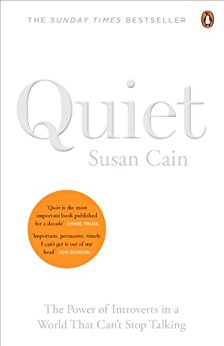 Quiet: The Power Of Introverts In A World That Can’t Stop Talking—Susan Cain
I first heard of this book through J Thorn’s Intronaut podcast, where he talks about being an introvert and how that has played out in his life. Quiet appeared as a Kindle Daily Deal recently, so I snapped it up. The more I read and hear about introversion, the more things in my own life make sense. I don’t know if I’m a ‘proper’ introvert (and there are tests to determine this), but I’m definitely towards that end of the introvert-extrovert spectrum.
As the title suggests, it’s about introversion, which is far more than just ‘being shy’ or ‘being quiet’. Cain’s spent years researching for this book, and has interviewed many people around the world, both introverts and extroverts (and everyone is in one of these camps to some degree). But she can also write, and the book reads like an exploration rather than a dry, academic tone.
There are some surprising facts in this book. Introversion is linked not only to societal pressures, but also to genetics. It is easy to see how western culture seems to favour the extrovert, but introverts, in certain circumstances, make more effective leaders. In the financial chaos over recent years, the traders who have come out on top tend to be more introverted in nature.
But the book also explores how to cope with introversion, and how to fake being an extrovert. There is a whole section on raising introverted children in ways that will help them cope with life. And there are also sections on different cultures, especially how eastern societies tend to favour introversion—think about how somewhere like Japan holds respect in high regard, whereas America is all about making oneself bigger and better in order to get ahead. There are interviews with eastern students studying at western colleges, and the struggles they face.
So, a very interesting book, and well written. As something thought-provoking, it was a great contrast to the rest of my lighter holiday reading. If you’re at all interested in how people think and function, it’s well worth a look.
 Song Of The Space Siren—Barry J Hutchinson
This is the fourth Space Team book, and from what I understand, there are two more to come before the end of the year. Hutchinson seems to bring one out every couple of months, and I recently discovered that there is very little editing involved in his writing process, which makes the quality of these books even more impressive.
Comedy is hard to do well. Pratchett managed it fantastically with his Discworld books. Douglas Adams was great, but the comedy and the bizarre ideas took over, pushing the story to second place. Hutchinson avoids this problem, and he describes his books as space adventure stories with humour, rather than comedy books. The humour comes from the character interactions. It helps, of course, that his main character tends to react to stressful situations by making fun of them.
After reading the first book, I downloaded the rest, but I did wonder if Hutchinson could keep up the high standards of the original Space Team. So far, I’ve been impressed, and I think that rounding the series off at six books will keep things from getting too stretched. As it is, there were a few things in Song Of The Space Siren that didn’t quite work for me (to avoid spoilers, I won’t say what they are), and the growing relationship between a couple of the characters didn’t quite ring true. But these are minor points. The book is still great fun, and I’d recommend it (and the whole series) to anyone who is looking for a space opera adventure with a good dose of humour. I’m already looking forward to early June, when book five comes out.
Looking for a free read?
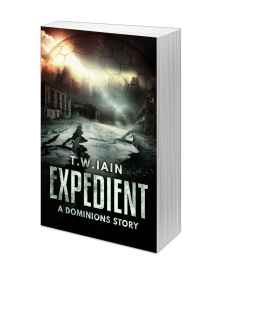
Expedient, the second Dominions novella, is now available through Instafreebie.
Click on the image to go to their page, and get your free copy of Expedient.
Another free short story this week. It’s called Never Only One Side.
After doing a short story consisting of nothing but dialogue a while ago (Allegiance), I thought I’d try something similar, but this time only giving one side of the dialogue (imagine listening in to only one side of a phone call).
I’d love to hear what you think of it. Either add a comment, or contact me.
The more books I read, the more books I want to read. I’m always on the lookout for something new. I’ll check out authors I like, I’ll look at recommendations from others, and I’ll browse stores in genres I enjoy. But occasionally I’ll pick something different. Every now and then I’ll purposely choose to read a book that doesn’t appeal to me.
Before I carry on, I should explain something. I occasionally post book reviews, but I make it a rule to only review books I can be positive about. If I don’t enjoy a book, I’ll simply head on to the next one. I won’t spend my time writing about it. It’s the whole ‘if you can’t say anything nice, don’t say anything at all’ thing. But in this post, I’m going to mention a few books that I didn’t enjoy. Apologies in advance if this upsets anyone. But please remember that this is simply the opinion of one person. I like certain books, and dislike others. I listen to strange music that I know others can’t stand. I like Marmite. My tastes are not necessarily going to correspond with yours. If I don’t like a book, that simply means I don’t like it. It doesn’t mean it’s a bad book. Your opinions may differ.
We all like different stuff. If everyone was the same, life would be so much less interesting.
Getting back to books, the ones I’m going to talk about here are Twilight and Fifty Shades. In both cases, the books have sold fantastically well, and have legions of fans. The interest in these books has led to films, and the authors are (as far as I understand) doing very well for themselves. If I say something negative about them, it’s not going to harm the success of either series, and I doubt the authors are that bothered by what someone like me thinks of them anyway.
I’ve read all the Twilight books and the first two Fifty Shades titles. I’m not a fan of paranormal romance (or whatever genre Twilight is in at the moment), and I’m not big on erotic romance (if that is where Fifty Shades sits—I’ve heard differing opinions). I know I’m not the target audience for either series. I can’t say I enjoyed reading them, but I did finish them.
Why? Why spend time on something I didn’t enjoy? And why, after reading the first book in each series, did I carry on?
There are a couple of reasons.
 Ignorance
The first I will illustrate with something that happened a few times when I was teaching. I’d get into conversations about music, and my tastes were usually very different to those of the students. Sometimes, when I mentioned an artist or band I liked, I’d get negative comment—“That’s rubbish!” (although usually with a few more swear-words thrown in). I’d counter by asking what songs by that particular band the young person had heard, and in practically all cases they hadn’t heard anything. It was simply a name they weren’t familiar with, and so they dismissed it straight away.
Chances are they wouldn’t have enjoyed the music anyway, but they weren’t even prepared to give it a chance.
And that’s so easy to do. As someone who enjoys vampire stories like Dracula and Salem’s Lot, Twilight isn’t a ‘proper’ vampire book, and it would have been easy for me to complain about Meyer’s series. But I would have been making unfounded statements, or simply repeating what others had said. If I wanted to moan about Twilight, I had to know what I was talking about. I couldn’t say it was badly written unless I was prepared to back this statement up with examples I’d come across.
So I choose to read certain books because I want to know what I think of them. I don’t want to regurgitate the thoughts of others.
 Audience
The second reason is connected with target audience. As I said before, I know that neither Twilight or Fifty Shades are aimed at someone like me—middle aged bloke who leans towards inquisitive fiction with a dark edge. Of course there was a good chance I wouldn’t enjoy them.
So why should I even bother reading them?
Again, I’ll bring this back to music. There are loads of different styles of music, although most people tend to listen to only a few types. But the musicians who are producing interesting work are often the ones who push boundaries, and who draw on a wide range of influences. I’ll illustrate what I mean with a story I heard about Randy Rhoads, guitarist with Ozzy Osbourne back in the eighties. When they were touring, Randy would book a local guitar teacher for a lesson wherever they happened to be. He’d invite the teacher up to his hotel room, and spend an hour learning. It didn’t matter what style they taught, because it was all music, and he knew whatever they had to offer would help his own playing. Rock, jazz, classical, folk—as far as he was concerned, anything could be a positive influence.
I feel a similar way about books. There are so many stories out there, and so many different ways of writing. If I stick to a few genres, or even a few authors, I’m limiting myself. I need to read outside my comfort zone. I need to know what else is happening. Even stories I don’t like can be educational. It’s why I have a collection of cowboy stories on my Kindle, and why I’ve downloaded a few romance titles. It’s why I’ll read popular books that don’t appeal to me.
Even if I am not particularly enamoured with the story or the writing, I can still learn from it. I can see why others might enjoy these books, and that can help me think of how others might perceive my own writing.
 Discovery
Now that I think of it, there is another reason for reading outside my preferred genres. There are so many books waiting to be read, and amongst all the ‘rubbish’ there will be uncovered gems. If I only stick to what I know, I could be missing out. So I need to risk something different every now and then. Yes, there is a good chance I won’t enjoy it, and it might be a chore to complete it (because I don’t like leaving a book unfinished). But, occasionally, I’ll come across something I love.
I’ll give a couple of examples of this. I first heard of Louis de Bernieres when Captain Corelli’s Mandolin was released and started getting more attention. It didn’t particularly appeal, but I read it anyway. I though it was okay—well written, even though the story didn’t grab me. I read a few reviews, and a lot of them suggested that his earlier books, his Latin American trilogy, were better. I gave them a go, and I have to agree with these reviewers. I think this trilogy are fantastic. I haven’t picked up Corelli again, but I have re-read all three of his earlier books.
Other examples involve classics, those old books that ‘everyone should read’ (why?). I remember reading both Wuthering Heights and War And Peace because they came in this category, and in both cases I expected to struggle through them. But at least I could say I’d read them.
Yet I loved the books. I’ve re-read both a few times since, and have gone on to read more Tolstoy (although I still think War And Peace is his best). And I’ve read more classics and ‘books everyone should read’—some I’ve enjoyed, some have been a struggle, but I feel better for reading them, because now I know what I think about them.
 So did I waste my time reading Twilight and Fifty Shades? If I read slowly, and took a few months to get through them, I would say yes. If I continually read books I didn’t think I’d enjoy, again I’d say yes. But if I read widely, and step outside my comfort zone every now and them, reading ‘unenjoyable’ books is not a waste of time. Just so long as I know why I am doing it.
I read for enjoyment. I read to get wrapped up in a story. I read to be thrilled and entertained, or maybe to laugh.
But I also read to expand my mind. I want to have my own opinion, rather than simply aping others. I want to understand how different books can appeal to different audiences. I want the opportunity to find those hidden gems.
And even if I find a book that is poorly written, and that I find little to hold my interest, I can still learn what mistakes I need to avoid in my own writing.
If I read with all that in mind, no reading time is truly wasted.
I’ve got a new short story up for you. This one’s called Investigation, because I’ve been meaning to try a mystery thing for a while now. It was fun trying to get the clues, and the motives, all included in under 1000 words. Let me know what you think.
You can read it here, and find all my other short stories here.
 There are two types of fiction books—literary and genre. At least, that is what perceived wisdom seems to say. There are the ‘deep’ novels that win awards, and then there are the exciting, throwaway stories that are pure entertainment. And within the genre field, there are many subcategories, each with its own rules and guidelines, its own expectations and fan-bases.
To make it as a successful author, independent or traditionally published, many say it is best to stick to these rules and expectations. They say you should give the audience what they want. The phrase ‘write to market’ is bandied about. Some use it as a guide to success (if such a thing exists), and others decry it as an affront to artistic integrity. Most people sit somewhere between these two extremes.
But it does seem that more formulaic books find more success. I’ll mention again the Sterling and Stone team (Johnny B Truant, Sean Platt and David Wright). Their most successful project is the seven-book Invasion series, written specifically to appeal to alien invasion fans. Likewise, when Chris Fox very openly wrote his Void Wraith series to fit the space opera market, he enjoyed far more success than he had done with his earlier books.
I don’t write this in any negative way. This kind of success does not mean the book were poorly written. I’ve read both Invasion and Void Wraith, and enjoyed them both.
But I far prefer their other work. Platt and Truant’s Unicorn Western is a lighthearted fantasy/cowboy mashup (although it grows more serious as it goes along), and I love it. Fox’ earlier Deathless books (Vampires Don’t Sparkle, No Mere Zombie and No Such Thing As Werewolves) manage to combine horror creatures, Egyptian mythology and sci-fi in a way I found extremely inventive and entertaining.
Yet the sales figures would suggest that I am in a minority. The more straightforward books sell more, suggesting they have a broader appeal, but I prefer those that push at the boundaries. I like stuff that takes chances. If an author is told a book won’t work, but they write it anyway, I’ll want to read it.
One of my favourite authors is the late Iain Banks. He produced books under two brands — Iain Banks for his ‘literary’ books, and Iain M Banks for sci-fi. But two of his ‘literary’ books were strong on the sci-fi, most noticeably Transition, with characters jumping between alternative realities. And his sci-fi, while being big on ideas, worked so well because of his writing. I’d rate the M Banks books as some of his finest work.
Yet, as I start on my own author journey, I am constantly receiving advice to stick with a particular genre, or a particular style of writing. I should study what works in that field, and apply it to what I’m working on. I should follow the tropes, because otherwise I will upset readers.
There are loads of these tropes. In romance, the couple have to meet at the start of the book. There should be no infidelity, and there should definitely be a happy ending.
And yet, I like Wuthering Heights, a story that has no happy ending. And look at Romeo & Juliet, one of the greatest love stories ever—it ends with the couple killing themselves, each believing the other is dead. There is no happy-ever-after.
Of course, these are love stories, not romances, and I know that if I wanted to write a romance, I would need to have a happy ending. If the story worked better with a tragic close, I’d have to rebrand it.
If I write, and I want readers, popular reasoning says I have to stay within the confines of my chosen genre.
But what of the stuff that falls between the gaps? What of the books that don’t fit squarely in one particular genre?
I think these are the more important books. Yes, many of them will not be ‘popular’, and they will not sell as well as those that meet reader expectations. But, over time, these are the books that may well mean more.
 A couple of years ago I read a book called Clownfellas, by Carlton Mellick III, in which the mafia consisted of clowns, who were a different species (I think). The book was funny and violent, and definitely strange. It didn’t fit in any one category, and I thoroughly enjoyed it.
I recently read Mr Ruins by Michael John Grist. I thought I was going to be reading a sci-fi thriller, but the story delved into mysteries of the mind, and left me with more questions than it answered. And I loved it.
As another example, look at Mervyn Peake’s Gormenghast books. They seem to be fantasy, but there are none of the usual range of creatures, and there is no quest. They also seem to veer from deadly serious to comedic. And yet, they are incredible (I have my reservations about the third book, but I definitely recommend the first two).
Think of Robert Prisig’s Zen And The Art Of Motorcycle Maintenance. Is it a story or a text-book? Is it fact or fiction? It’s both and neither, but it’s a fantastic book. I’ve read it a number of times, and on each re-reading it opens up a little more. It might not be a ‘story’, but it’s a wonderfully involving piece of writing.
Think of Bret Easton Ellis’ American Psycho. There is very little ‘story’ in this book, and the descriptions (and the language used) are as important as anything that ‘happens’, maybe more so. To some people it’s horrific, but to others it’s a comedy. Ellis seems to have something to say, but he doesn’t make this obvious, and again it is a book that repays repeated readings.
And I realise, as I’m writing this, that there will be people who look at that list of books and see only ones they don’t like. They will find Zen boring, and won’t see the point of American Psycho.
That’s fine. I don’t think these books were written for everyone. The authors had a particular story to tell, and a particular way they needed to write. I think they were simply writing what they wanted (or needed) to write, regardless of audience.
So, of course, these books struggle to find a place. Of course they won’t appeal to many, at least not initially. The fact that all these books are well-known is down to how well they are written (although savvy marketing no doubt played a part, and I’m sure the subject matter of American Psycho helped it achieve a certain notoriety).
They are different. They don’t give the reader exactly what might be expected. They don’t fit neatly into a particular box.
And that is why, for some of us, these books are so successful, and have become firm favourites. The very fact that they don’t fit is a part of their appeal. Because, for all this talk of writing to market and of giving the reader what he or she wants and expects, there are many of us who want the unexpected. There are many of us who don’t want a repeat of what we’ve read before. There are many of us who simply want a good read, regardless of genre or tropes or any other standards.
Many books can be entertaining. They can thrill us and excite us, or make us hold our breaths as the characters come up against all manner of difficulties. They can draw us in with their language. But the books that stick are the ones that go beyond. The books that last are the ones that are written because they have to be.
The books that follow all the rules can be entertaining, and can be wonderful reads. But the ones that stick are the ones that go beyond expectations.
The latest short story, ‘Artificial Intelligence‘, is now on the site. Read it here and let me know what you think. And there are more free stories here.
Expedient (A Dominions Story) is now available from all major e-book stores, for the bargain price of 99p/99c.
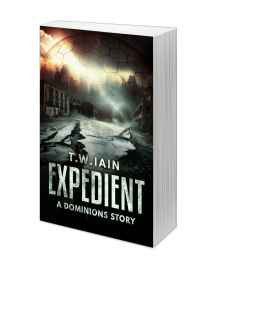 Expedient (A Dominions Story)
There are reasons to kill.
Those who threaten the courier, or threaten Rodin himself—well, they know what to expect. And his one professional hit? The man deserved to die. The world’s better off without him.
But Rodin needs to build his reputation. And that means showing what he’s capable of.
He can kill to exterminate vermin. He can kill to stay alive.
But can he kill for personal gain?
This 25,000 word novella (roughly 100 pages) contains characters from the Dominions series, but can be read as a separate story. If you haven’t tried any of the others yet, this could be a great place to start.
To get Expedient, click here. To find out about other books in the Dominions series, click here.
A few weeks ago, I wrote about a couple of the things that annoyed me in books, and how I’d since discovered that one of these things (the use of the word ‘decimate’ as an alternative to ‘annihilate’) was now, according to every online dictionary I found, not in fact an error.
Today, I’m going to look at another of my pet peeves, and this is another one that I’ve been forced to rethink.
This ‘problem’ shows itself in a sentence like ‘he was one of those people that couldn’t abide poor word-choice.’ Some of you will probably read that and think ‘problem, what problem? Makes total sense.’ But to me, the use of the word ‘that’ rankles.
‘That’ indicates an object—‘the building that collapsed in the storm’, ‘the car that was rusting on the driveway.’ If the ‘object’ is a person, I’d replace ‘that’ with ‘who’—‘he who laughs last, laughs longest’, ‘The Man Who Knew Too Much’.
If we use ‘that’ to refer to a person, they become an object, and to me this feels wrong. Every time I come across a sentence like this I find myself angrily replacing ‘that’ with ‘who’ in my mind, and it drags me out of the story. I tell myself that a good editor should have spotted this. Sometimes it occurs in otherwise well written books, and I can’t fathom how this error slipped through the editing and proofreading.
 But recently I came across something on Twitter that threw some light on this. It showed me that the ‘error’ I’m seeing is not an error to everyone. I only see it as a problem because of my background.
I’m British. It’s all down to my parents. And their parents. We’re British going back quite a few generations. And so I’ve learnt to speak (and read and write) UK English. To me it’s simply English, but I have to set up my computer to work in UK English, so I suppose that is what I need to call the language I use.
This is different from American English. We all know this. But one thing I didn’t know, until recently (thank you Twitter) is that in America, the use of ‘that’ when referring to people is acceptable. So if you’re an American reading this, and you’ve been wondering what the problem is, now you know. I’m British.
That could explain a lot.
However, I don’t think everyone (on either side of the pond—which is a stupid word to use to describe an ocean like the Atlantic) realises this. Some books get slammed in reviews for their spelling, but it is all down to these differences. Color and colour, flavor and flavour.
I came across a great way of describing this, in a note at the start of a book by Issy Brooke. It simply said ‘This book is written in British English. It’s like US English but with more vowels.’ If my own books had a lighter tone, I’d steal this line.
But it’s not only the individual words that are different. Mention fanny packs over here in the UK, and there’s a good chance you’ll be met with a blush or a giggle, because to us the word ‘fanny’ has a very different meaning than it does in America. Then there’s what we put in our cars. Over here, we use petrol or diesel, which are liquids, but over in America these liquids are called gas. And over here, we wear our pants next to our skin, not on show for everyone to see. Maybe Krypton studied Britain, so when Superman landed in America he misunderstood their dressing instructions.
The English language has spread far and wide, and wherever it has been adopted as the main language it has also been adapted. From what I understand, there are differences in the way the language is used in Australian and New Zealand, and there are also Indian versions of English. And even in the UK, it is constantly evolving. There are regional variations, and each generation claims its own variations (which is why ‘sick’ can be good, like ‘wicked’).
I try not to let this bother me. On the whole, I don’t care if someone is talking to their ‘mum’ or their ‘mom’ (of even their ‘mam’). I know that a lift is an elevator, and a boot is a trunk. And now that I know about the whole who/that thing, I’ll put this in the same category of ‘things that aren’t correct according to what I was taught, but that’s my problem, not the writer’s.’
And I like the fact that I have only just learnt that I’ve been wrong, because it reminds me that there are likely to be other things I don’t know. I’ve been learning this language for the whole of my life, and I still don’t know everything. Each new thing I read teaches me something more about words.
The next time I come across something that annoys me in a book, it will drag me out of the story. There’s no avoiding that. But rather than getting annoyed, I should take a moment to question where the error lies—with the author, or with myself. Or maybe it isn’t an error, just a different way of using the language.
After all, how dull would it be if everyone used this thing called the English language in the same way?

