The Freedom Of Pen-Names

fake-30346_640TW Iain is not my real name.

For any of you who have read my ‘about the author’ page, this should come as no surprise. I use a pen-name.

I’m not alone in this. Throughout the history of the written word, people have worked under pseudonyms. Some writers use multiple pen-names.

So why pretend to be someone else? Surely, if I’m proud of my books, I shouldn’t have a problem with them coming out with my real name on the cover. And if I’m embarrassed about them, or I’m worried that they’re not good enough, what am I doing throwing them out into the world?

It’s not that simple. There are many reasons for using a pen-name.

Writing in multiple genres

A lot of writers stick to one genre, occasionally flirting with others but always returning to their core. JRR Tolkien wrote some children’s stories, but they were still set in fantasy worlds, or had elements of the myths that influenced the rest of his work. Robert A Heinlein was prolific, but stayed within the bounds of science fiction. Terry Pratchett wrote comedy, predominantly within a fantasy setting.

But other writers spread themselves wider. Julian Barnes writes literary fiction, but he has also written mysteries, released under the name Dan Kavanagh. When JK Rowling writes her Cormoran Strike books, she does so under the name Robert Galbraith.

There are good reasons for this. If readers are accustomed to a particular type of book from an author, they are not going to be happy if that author releases something too different. Cormoran Strike and Harry Potter are written for very different audiences.

Many authors who write across different genres cultivate different brands, with a pen-name for each one. Even someone like Johnny B Truant, who writes and produces a wide range of books under that name (which is not his real name anyway), uses another pen-name, Aubrey Parker, for his romance titles. Many authors who write clean romance and erotica use different names‌—‌readers wanting a sweet love story are not going to be enamoured by graphic sexual content, and the erotica readers are going to be disappointed if there is nothing physical between the main characters.

So using different names for different genres can help readers identify the books they are more likely to enjoy. It can work to avoid confusion and frustration

Going against prejudices

The Cormoran Strike books highlight another reason for using a pen-name, one that was more common years ago but that still (unfortunately) exists. Rowling’s Harry Potter books are written for children (of all ages), but the Cormoran Strike books are thrillers. This is a genre where, generally speaking, readers are more likely to accept a book written by a male.

There have been cases of female authors using male pen-names in order to gain acceptance throughout the history of the written word. Mary Ann Evans became George Eliot, Amantine Lucile Aurore Dupin became George Sands. Harper Lee, when she released To Kill A Mockingbird, dropped her first name (Nelle), using instead her more ambiguous middle name.

And such prejudices do still exist today, and I came across a book review recently that highlighted this. The book was by an author who used initials rather than a first name, and the reviewer was angry. He seems to have enjoyed the book, but also assumed the author was male. When he found out that this assumption was wrong, he changed his opinion of the book, and his review explained how he felt tricked, and would never have read the thing if he’d know the author was a woman.

I don’t know whether to laugh at the ridiculousness of it, or be concerned that some people think like this.

Of course, many writers use initials rather than a name. Nora Roberts writes detective fiction as JD Robb. Another example is Joanna Penn. She writes books about the indie-publishing business, and is well-known and well-respected as a podcaster and speaker, and a driving force in the whole indie scene. She also writes dark thrillers with supernatural elements, and puts these out as JF Penn. Yes, part of her reason for doing this is to separate her two brands, but I believe she went with initials partly because it makes her books more acceptable to a wider audience.

There are times when male authors lean towards a female pseudonym, especially in romance, as the previously mentioned example of Truant/Parker highlights. I have also heard of a husband-and-wife team who write erotica, but they use her name on the covers, because many erotica readers are more comfortable reading books written by a female.

As a final example of this, when Bloomsbury published the first Harry Potter book, they suggested Rowling use initials, on the basis that boys were less likely to pick up a book written by a woman.

Anonymity

This is, I think, a big reason for using a pen-name, and there are a number of facets to it that are worth considering.

Generally, the job people do comes to define who they are. When someone asks ‘what do you do?’ they mean ‘what job do you do that takes up the main part of your day and provides your main financial support.’ Anything else is considered a hobby, maybe interesting but often frivolous. The job is the important thing.

So some writers, especially those with ‘important jobs’, or those working in a role that brings them into contact with ‘the public’, can use a pen-name to shield the writing part of their life.

For others, there can be tension between their ‘job’ and their ‘writing’. I’m thinking here of those who work with, but also write stories of a more adult nature (such as erotica or hard horror). And some of you reading this will feel awkward at this point. Is it right that someone producing such adult material can also work as, for example, a teacher? Is that even safe?

There’s no reason why it shouldn’t be safe. A teacher might work with children, but they are still an adult. A teacher with children of their own has engaged in activities that are unsuitable for kids. As long as that part of their life does not have a negative effect on their job, there should be no problem. But a teacher writing for a mature audience needs to be careful, and using a pen-name can help greatly. It is not about hiding, but about keeping different parts of their life separate.

This doesn’t only apply to those working with the young or the vulnerable. For many people, it is healthy to have some separation between work and home life. Books, once they are released, are public. Family is private.

Eric Arthur Blair wrote a book describing his early life living in poverty, but he didn’t want this to embarrass his family, so he used the name George Orwell. Out Of Africa was originally credited to Isak Dinesen, although it is now available under the author’s real name of Karen Blixen. It is unclear why she used a pen-name, but one suggestion is that the Blixen family were well-known in Denmark, and she wanted to protect the family name. Or maybe she didn’t want to be seen as cashing in on her family’s credentials.

Maybe this is why Joe Hill writes under that name, and not under his given name of Joseph Hillstrom King. Being the son of Stephen King would definitely garner interest from the public, but it would also pile on the expectations. Using the name Joe Hill helps his books succeed or fail on their own merits.

And, interesting, this is a reason that King himself used a pen-name for some of his books. He wondered if his books were selling because they were good, or because his name was splashed across the cover, and so he produced a series of titles under the name Richard Bachman, with none of the marketing push his ‘King’ novels got. He never answered his own question, though, because after a few years he was ‘outed’ when people spotted how similar in style Bachman was to King (especially in Thinner, which contained a similar supernatural element to his ‘King’ books).

So using the anonymity of a pen-name can protect family, and it can provide a way of proving (or otherwise) an author’s writing. It can also provide a way of escaping expectations, either externally or internally imposed‌—‌important when a writer wants to go wherever the story leads without having to worry about possible repercussions in the ‘real world’.

It sounds better

This one might appear flippant, but the sound (and look) of a name is part of a writer’s brand, and plays a role in marketing and selling books. I’ll give a few examples.

Charles Lutwidge Dobson is a bit of a mouthful, but the name Lewis Carroll rolls of the tongue in the playful manner associated with Alice’s adventures. The name Joe Hill has a far stronger impact than Joseph Hillstrom, especially for a writer of horror and thrillers. Daniel Handler is a fairly forgettable name, but Lemony Skicket grabs the attention and promises something different.

The Harry Potter author has no middle name, but someone obviously thought J Rowling didn’t sound quite right. So she borrowed the first letter of her mother’s name, and became JK Rowling.

Sometimes, the better sounding pen-name can work against prejudices too, especially when readers might be wary of trying a ‘foreign’ author. So Jozef Korzeniowski becomes Joseph Conrad, and Alisa Zonov’yevna Rosenbaum becomes Ayn Rand.

And the look of the name? I recall hearing that ‘Stephen King’ is an ideal name for marketing because of how it looks on the book cover‌—‌longer first name in smaller letters, with the strong second name in larger letters.


Of course, there are many more reasons writers use pen-names, but this post is already too long. And besides, does it really matter? The name is a label, and it is useful for branding and marketing, but after that? When I’m reading a book I don’t think about who the writer is. I don’t look at the cover. I just want a well-told story.

The Problem With Novelisations

There are many ways to tell a story. Two of the most popular are books and films, and although the same story can be told in both formats, each has its own strengths and weaknesses, and it is rare that a single title will work well on both screen and page.

In my experience, if the movie is an adaptation of a novel (or short story), the movie will not work as well. Conversely, if the book is a movie novelisation, the original film will be superior. There are exceptions, where both book and movie stand up on their own (Fight Club, The Princess Bride, Lord Of The Rings, and Trainspotting spring to mind), but generally whichever came first is the stronger telling, and the adaption is a reflection.

StarWarsI read the original Star Wars novel when it came out (way back in 1977). I’m sure I enjoyed it, because I remember reading it a few times. But I re-read it recently, and I was unimpressed‌—‌and I think I know what the problem was.
It follows the film too closely.

One of the criticisms levelled at the Harry Potter books is that JK Rowling doesn’t write novels, but films in prose form. Maybe that’s overly harsh, but the books are very visual, and it is easy to play the films along mentally when reading them. But if Harry Potter is films in prose, Star Wars is little more than a straight description of what appears on the screen.

Yes there are some additional scenes, and occasionally we are in the heads of one of the characters, but generally, the book describes the film, scene by scene. It’s like a fleshed-out script. Yes, reading the book reminded me of the film, but it also made me regret wasting my time ploughing through the words when I could have got a better experience spending two hours with the DVD.

Films are visual, but books need to work harder to evoke similar images. An expression on a character’s face can convey emotion, but to convey the same emotion in words requires more (or different) work. It is not enough to simply describe the images.

Think of the space battles in Star Wars. On the screen, we cut between close-ups of the pilots and wide shots of X-Wing fighters screaming past. There are explosions all around. We hear voices, and laser fire. Everywhere is action and adrenaline-fuelled excitement, and the speed of movement only increases the tension.

In the book, we get paragraphs describing these quick cuts, and they soon become a list of what is happening rather than a narrative of the action. One moment, we’re with Luke, then suddenly we have someone firing a missile from another fighter. Then we’re back with Luke for a moment, before a paragraph describes fighters screaming through the trench on the Death Star. After that, we’re in another cockpit, with sparks surrounding the pilot as he cries out.

The cutaways work on film, but not in the book.

I’ll give another example. At one point in the film, the camera watches R2-D2 following a path on Tattoine, and we get the impression that he (it?) is being watched, and we feel nervous anticipation. In the book, we get a description of this scene, but it conveys next to no emotion.

Why? In the film, we are concerned about the little robot (or at least we are interested in seeing what happens next). We feel for R2. But with a straight description, everything is distant. We are too far removed from what is happening.

For that scene to work in text, I can’t help feeling it would have been better to be in R2’s head, or at least see his point of view. Maybe have a description of the rugged terrain, and the caves along the route, with R2’s sensors picking up life-forms. There’s movement, high up on a cliff, but when R2 turns his head, it’s already gone. But he has his mission, and he needs to carry on, even though he doesn’t like this inhospitable terrain. And there are all the stories he’s heard, and the information in his data banks, of the creatures that roam this desert planet.

See what I mean? In text, we need to be closer to the characters’ emotions. We need more than a description of what is happening. A cool scene in a film might grab us, and a brief glance at a character is often all that is needed to convey emotion, but in a book we often need something more internal.

The book is a ‘novelisation of the film’, and so maybe the author (credited as George Lucas, but I believe Alan Dean Foster did the actual writing) was limited to what he could do. Or maybe the book was rushed, being pushed through to release at the same time as the film. After all, Star Wars was the movie where merchandising really took off, and the ‘book of the film’ perhaps should be seen in light of that.

Back in the seventies, the only way to see the film was at a cinema, until it was released on video three years later, and on television a couple of years after that. Fans didn’t have the opportunity of on-demand viewing, but the merchandise surrounding a film kept it fresh. The action figures enabled fans to reenact their favourite scenes. And maybe the book’s main purpose was to be a reminder of the film, and the way the movie played out in my head as I read the book should be seen as a mark of its success.

I can’t help thinking it could have been a great novel, though. The story itself is a classic, taking the Hero’s Journey and placing it in an exciting new setting, with alien worlds to explore and a cast of interesting characters. And these characters have conflicting motives that change over time. The story has an incredible scope, from the bickering robots to the world-destroying space-station, from Luke being ripped from his quiet home life to Leia’s political machinations, from Solo’s ‘get what you can’ attitude to the battle of ideologies between Empire and Rebellion. Love and death, war and peace, survival and friendship‌—‌Star Wars touches on them all.

Surely this deserves more than a bulked-out movie script.

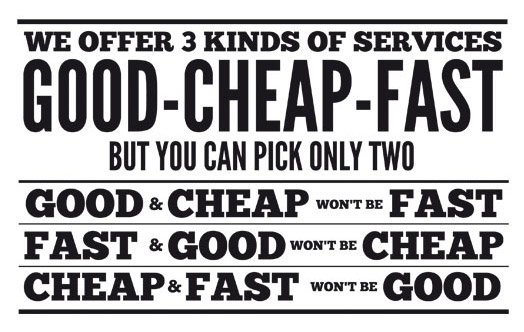
Fast, cheap and good – but only two at a time

There’s this thing called the Designer’s Holy Triangle. The three sides of the triangle are labelled fast, cheap and good‌—‌but it is only possible to use two at a time. According to this idea, you cannot have something that is high quality and at a reasonable price if you also want it quickly.

good-cheap-fast sign

The Problem

I read a collaborative book recently that made me relate this to writing. The authors worked very fast on this book, going from idea to finished project in something like a month. The writing itself took five days (or so I believe), and editing about another week.

It’s an enjoyable book. It’s fairly short, fast paced, and held my interest the whole way through. But something bothered me as I read it.

It could have been so much better. I’m no expert, but I spotted so many minor adjustments that would have made the writing stronger. Some of the phrasing felt clumsy. The characters’ actions didn’t always ring true. And too often it fell into ‘describing what was happening’ instead of giving me a well-written scene.

In my view, the book could have done with at least one more editing pass, possibly more. The problems weren’t major, but they were enough to drag it down to ‘meh’ when it could have been ‘wow!’

Supply And Demand

But fast, at least in indie publishing, is often seen as a necessity. According to some, if you don’t release a book each month you’ll be left behind. People talk of Amazon’s 30-day cliff, after which a book doesn’t get as much organic publicity, so you need a new book out to keep the interest up. Readers, hungry for more, contact authors to ask when the next in a series is out, and authors feel pressurised to keep their stories coming.

There is a strong argument in favour of this workrate‌—‌supply and demand. It’s giving the readers what they want, or at least what they say they want. And there are writers who consistently produce a book a month. There are those who have turned writing into an industry. And this can apply to traditionally-published authors as well. Apparently, Lee Childs’ books are polished first drafts. James Patterson uses collaboration to create a constant stream of new product. And authors like Stephen King and Brandon Sanderson are capable of writing thick tomes in months rather than years.

But there are many who argue that a book should take at least a year to write, and moving any quicker makes you a hack. They argue that a book written too fast will automatically be rubbish. They say that real quality takes time.

There is some validity in this. Writing a decent book or story is far more involved than simply putting down the words, and a rush job is more likely to have rough edges. But I don’t think it necessarily holds that a book written fast is any worse than one written over a longer time period.

laptop-820274_640Everyone is different. Every writer works in their own way. Some are able to achieve a flow state, and the words fly from their fingers. Some use dictation to work at 5000 words per hour on their first drafts. There are those who plan meticulously before they start writing, and so there is not as much structural work required later (and I believe this is Lee Child’s method). And others are simply capable of putting in ten hours of work on their books every single day.
Then there are authors who agonise over every word they type, and who will spend a couple of hours honing each sentence. There are those who seek perfection in every phrase, and who will discard pages as they go.

A book a year might be a guideline, or an average, but how many people are average?

But, as I said before, there is pressure on the independently published author to churn the books out. And with this pressure, I believe there are too many writers who are skimping on editing.

I’m not talking about typos, or about hiring a developmental and a copy editor. Yes, these things can clearly help (especially having other, expert eyes looking at the book). But from what I have read, many writers could do with spending more time on self-editing.

I don’t class myself as an expert, and I know I have so much more to learn about writing, but I’ve lost track of the number of times I’ve spotted an easy way to improve a book. I’ll notice repeated words, and come up with alternatives. I’ll think about how the story could be restructured to have a stronger impact on the reader. I’ll cringe at unwieldy dialogue, imagine how someone would actually say something similar, and wonder why the writer didn’t put that down instead.

Yet these books sell as they are. Reading the reviews, many people love them. So maybe I’m in a minority here. If these stories have an avid and eager audience, who loses out with these ‘could be better’ books?

Minimal Viable Product

Short-term, it looks like the only losers are those who spend longer on their books. Without the constant ‘here I am again’ factor of regular releases over the year, each new book needs more of a marketing boost, and slow writers can easily slip from even their fans’ minds.

But long-term, things aren’t as clear.

There’s a concept called ‘minimal viable product’. If you’re producing something for public consumption, be that an object (physical or electronic) or a service, you work out what the basic model is, release this, and then work on refining it as you build an audience or customer base. There’s a lot to be said for this, and with digital products it is easy to make minor adjustments over time. Think of all the software and apps that are released and then constantly updated as they are tweaked and improved. And these improvements are based on real-time customer feedback. The first release no longer needs to be a perfect product.

But does this work with books? How many of the fast writers go back and refine already published works? Generally, by the time feedback comes in on one book, they’re already onto the next, or the one after that. Returning to an old product would slow their momentum. And so, in the majority of cases, the ‘minimal viable product’ is also the final product.

Again, if people are happy with this, where’s the problem?

Expectations

I’d argue that the problem involves expectations of quality.

Imagine someone who is budget-conscious. They want to cut their food bill. One suggested way of doing this is to buy slightly less expensive products‌—‌not jumping straight to the budget range, but simply moving down a notch. The difference won’t be massive, and over time you’ll become accustomed to the less expensive brand. And then, you can down-grade again.

This saves money. And it also gets you accustomed to lower quality.

food-686922_1280But in books (in fact, in any art), this becomes problematic. Good art has a long-lasting appeal. Well-written books can be re-read countless times and still feel fresh. Classics last forever.

Popcorn is great for a few minutes, but it goes stale far too quickly.

If someone wants to write a book for the particular moment, that’s fine. But I think that most writers want their work to have some kind of a shelf-life. Even in indie-publishing circles, where fast is encouraged, part of the reason for this is to build up a library. Those older books become catalogue, and the aim is to continue selling them. An old book is always new to someone discovering it for the first time. But for a book to last, it has to be of a decent quality.

And yes, I have already argued that fast writing can produce quality books. But there is a difference between ‘good’ and ‘great’, and maybe this is where that extra work comes in.
I’m reminded here of the 80/20 rule (at least, one of the ways of understanding it). This states that 80% of the work comes from 20% of the effort‌—‌or, to put it another way, getting the final 20% of something done will take 80% of the time. People use this to argue that it is more time- and cost-effective to work to 80%, and that the returns for reaching closer to 100% are simply not worth it.

80% is pretty good. An 80% story will be enjoyable. It will be of good quality. I’m quite happy reading 80% books, although I’ll probably only read them once.

Perfection Is The Enemy Of Done (And Done Is The Enemy Of Perfection)

Another phrase I’ve heard‌—‌‘perfection is the enemy of done’. Spend too long refining a book, and you’ll never be finished. How many perfect books are there in the world? How many classics can any one writer produce?

I’m aiming for the middle ground. I know my own writing won’t be perfect, but I’, working on it being as good as I can make it. And, for me, that means more than writing a first draft and then doing some quick cosmetic editing. It means looking at the story structure. It means throwing away sections that don’t work. It means re-writing huge chunks.

I don’t want to go years between releases. But neither do I want to bring out books too quickly if they are not the best I can do.

And when I’m reading? If I read a good book, I’ll want more from that author. But I’d rather wait for ‘wow’ than settle for ‘meh’.

What I learned from reading ‘Tube Riders’

TubeRiders_series

I recently read the Tube Riders trilogy by Chris Ward, and I loved the books. It’s great when I come across an author who blows me away like this‌‌—‌it makes reading all those ‘so-so’ books (and worse) worth it all when you find a true gem.

I posted a short review on Goodreads (you can check it out here), but that looks at the trilogy from a reader’s perspective. However, while reading the books, there was so much I picked up on as a writer. As well as being enjoyable, entertaining reads, they were also instructive. Below are a few of the things that stood out.

Characters

I love the way the characters were written in these books. They are all three-dimensional, and they all change over time. When their is dialogue, they have distinctive voices. And they also all have their faults as well as their strengths.

An obvious example is the character of Stitch. He is one of the Tube Riders, which makes him one of the heroes, but he has a nasty side, and at times he comes across as very selfish. Or maybe he’s so used to having to look out for himself that others are secondary‌—‌after painting him as a slightly unsavoury character, we get a glimpse of the hardness of his life. It’s easy to understand why he’s wary of anyone new, and maybe we can understand why someone like Stitch would use violence to solve his problems.

Yet he is also loyal, and throughout the books you kind of know he will come through for the others in the end.

Then there are the baddies.

In the first book, one of the agents after the Tube Riders is Clayton. He wants to capture them, so he’s clearly a baddie. But he’s working for the government because he believes that is the right thing to do. And, as that first book progresses, he comes up against other government agents, and we see how not all ‘baddies’ are the same. Clayton is not mindlessly following orders‌—‌he genuinely wants to do what he believes to be right. And this brings him into conflict with other government agents, even though they are ‘on the same side’.

More interesting is the Governor. He’s the main villain of the trilogy, but the way he is written it is clear that he also believes in what he is doing. He is not afraid of making hard decisions, and is willing to make sacrifices (of others) for the greater good. And we get glimpses of his true motivations, which make us question our assumptions, at least for a while. Is he really evil, or just misguided? As the trilogy progresses, and he seems to become more unhinged, there was a part of me that wanted him to make the right decision, and to turn his back on his wrongdoing. Even up to the end, he has the potential for redemption.

I’m not going to say how he ends up‌—‌you’ll have to read the books to find out.

Nobody Is Safe

The protagonists in these books are young, but they are in a tough situation. Their world is nasty, and they take risks in part because of this. Death is in the air, even in their hobby of tube riding (jumping and ‘riding’ moving trains before leaping off to safety). In the first chapter, we hear of those who have died doing this.

But the heroes won’t die, right? They all need to survive to the end, don’t they?

In many books, that would be true. But Chris Ward does something near the start of Tube Riders that lets us know that nobody is safe.

I’m going to give a little of the story away, so if you want to read the books without spoilers, skip down to the next section. But this is something that happens near the start, so it’s not like I’m giving any of the main plot points away.

The Tube Riders have rivals, in the form of the Train Jumpers. Instead of leaping onto moving trains, they jump from platform to platform in front of trains, aiming to get as close as they can. The Train Jumpers hate the Tube Riders. And if that sound like petty, childish behaviour, remember that these characters are teens and young adults‌—‌acting childish is in their nature.

One of the Tube Riders feels dissatisfied with his gang, and he goes to the Train Jumpers, betraying his old gang. It’s a bit of a shock, so soon into the story. It makes us question the loyalty of all the Tube Riders‌—‌if one of them can defect, so could others.

Then something worse happens. The Jumpers seem to accept him, and as an initiation he has to join them in a jump. Yet this is a set-up. He is pushed as he is about to jump, and he falls under the train.

He’s only in the book for a few chapters, but he was one of the Tube Riders. He was one of the heroes. And now he’s dead. The stakes are raised for all the others‌—‌if one of the Tube Riders can die, none of them are safe.

This sets up more deaths as the books progress, and those deaths underline the overall uncertainty. It’s the same thing George RR Martin pulled in his Game Of Thrones books‌—‌kill off a main character, then nobody is safe.

The reader is no longer assured a happy ending.

A Trilogy Of Complete Stories

I was impressed with the structure of this trilogy. The story unfolds, with more and more intrigue and questions blossoming in the first book. Obviously, not all of these questions can be answered in a single book. You know, as a reader, that things will only be resolved at the end of the third book.

Yet there is no major cliffhanger between books. In each part of the trilogy, there is an arc, with its own satisfying conclusion.

This is so different to many other series I’ve read. Often, an ending seems in sight, but the author swerves at the very last moment, and leaves the main character in jeopardy. Sometimes, I’ll reach the end of a book, and it feels incomplete, like the author has simply chopped up a larger story.

This annoys me. Yes, leave questions unanswered. But I expect a book to end. I expect the author to craft a good story with a satisfying payoff at the end, even if I know there is more to come.

Chris Ward, as I have said above, manages to pull this off. If I read these books individually, over a year or so as they were released, I would not feel let down. I would close each one with a good feeling while still be anticipating the next one.

How does he manage this? By focusing on the main arc of that story. In the first book, the Tube Riders are trying to escape. Yes, we learn more about the Governor, and there are hints at what he is planning. There are characters who we just know have more of a part to play later on. But the escape is important, and when this arc is completed (spoiler alert‌—‌they escape), the book is finished.

As a trilogy, the conclusion works, although there is scope for more books (as you would expect with such an interesting world and a rich cast of characters). I understand that the author does not intend to write more sequels, but has not ruled out other stories set in the same world (in fact, there is a fourth book, filling in some of the time between the second and third in the trilogy. I’ll let you know what I think of this when I’ve read it).

The Writing Itself

I love the writing in these books.

We see events through different characters, and the prose in each character’s section has their voice, putting us in their heads wonderfully. As an example, when we are with Stitch, there is far more cursing in the descriptions, fitting his character. The Governor is colder, with less emotion in what he sees.

The dialogue feels so natural. I’ve already mentioned how characters have their own voices, but there was something else about the dialogue that impressed me. Often, rather than writing loads of history or backstory, authors will use dialogue to give the reader this information. However, this often feels unnatural and stilted. Not so in these books. The info-dumps are a natural part of the conversations, and we learn what the characters are learning.

There is a great deal of action in these books. This is promised from the very first scene, with the Tube Riders partaking of their potentially lethal hobby. Later there are chases, fights on the tops of moving trains,beatings, and loads of other exciting stuff.

I’ve read far too many books where the action reads like a description of a film‌—‌blow-by-blow fights, or sequences that simply have too much detail. And writing like that becomes tiresome very fast.

Chris Ward doesn’t fall into this trap. In every action scene, we stay with a main character, and experience it through their senses, filtered through their emotions. We might never see the bigger picture, but the chaos surrounding a scared individual fighting for their lives had far more impact, getting the adrenaline flowing and the heart pumping. And there is a reason for every action scene. We learn, through the fights, more about the characters, or about the world around them.

The action is not added simply to make the books more interesting. It is integral to the story, and the development of the characters.

TubeRiders_ChrisWardSo, there you have a few of the things I picked up on while reading the Tube Riders trilogy. As you can no doubt tell, I was impressed. I’m going to be following Chris Ward from now on, reading more of his books (and his newsletters — he asks some interesting questions). He’s my kind of author‌—‌exciting, entertaining, and instructive.

If this has piqued your interest, check out his books here. The first book in the Tube Riders trilogy is free, so you have no excuse!

New anthology now live

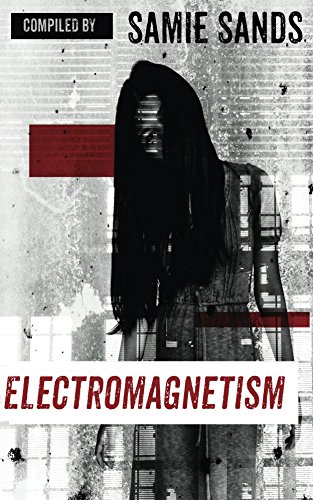
Electromagnetism

Special news for those who like a scare with their technology.

I’ve got a short story in a new anthology, Electromagnetism, compiled by Samie Sands. It’s normally priced at 99p/c, but over the next couple of days it should be available for free through Amazon, so what have you got to lose (apart from a few sleepless nights)?

It’s also available in paperback (click here).

Download (or buy) the book, to read my story, Touch, along with ten other stories. At the moment, Touch is not available anywhere else.


E-book from Amazon.co.uk / Amazon.com

Paperback from Amazon.co.uk / Amazon.com

The indie-author’s ability to grow up in public

steps-1081909_640It’s interesting how different arts view the development of talent. In the visual arts, it is common for a painter’s early years to be regarded as training, or as an apprenticeship period. It is often later works that are more highly valued. Then there are actors who mature with age, performing with more gravitas and filling larger roles. The ones who relied on their looks fall by the wayside, but the ones who worked at their craft and developed their acting skills earn increasing respect.
Music is a little different. In some circles (’art’ music as opposed to ‘popular’ music, if you care for such distinctions), it is expected that a musician will improve with age. But in more popular circles, the instant impact is all-important. A band who do not have a massive hit with their first song are deemed failures, and it is common for record companies to drop bands if their debut does not live up to a certain sales-related standard. Sometimes, only breaking the top ten, rather than reaching number one, is seen as a failure.

It was not always this way, though. Fifty years ago, record companies were more likely to see a new signing as an investment. The first couple of albums might not be that successful, but they lay the groundwork for the third and fourth. If these more mature works didn’t catch the public’s attention, only then were the bands let go.

The perfect debut

Then we have books. There are so many examples of the authors who appeared to explode with a debut success, but struggled to find similar success with subsequent books. Think of Alex Garland‌—‍his debut, The Beach, was a popular hit, but how many people have read, or even heard of, The Tesseract (or The Coma)? Then there’s someone like Joseph Heller, who was never able to match the commercial success of Catch 22 (and even used his experiences of this as the basis for one of his later books, Portrait Of An Artist As An Old Man).

But viewed logically this makes no sense at all. Writing is a skill, and it takes time and practice to develop it. Surely, the more someone writes, and the more intention they place on improving their craft, the better their writing will be. It seems evident that later books should be far superior to earlier ones.

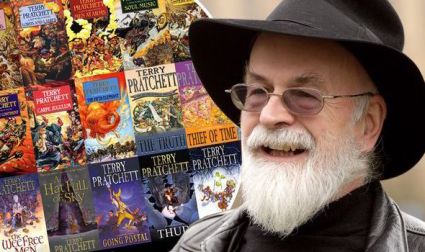
Terry_PratchettTerry Pratchett is a case in point. He wrote a few books before starting on the Discworld series, but they are not a patch on his later works. Even with the Discworld series itself, it took him quite a few books before he got into his stride. The Colour Of Magic and The Light Fantastic are still Pratchett, but nowhere near as good as many of the later ones.
Yet it seems that publishing companies are still searching for that impressive debut. They are still after the runaway success by the unknown author. It takes time and, more importantly, money to nurture a talent, so it makes far more business sense to have a success from the very start. When the public are always after novelty (while also looking for familiarity, but that’s a whole other issue), ‘another’ book by a mediocre author doesn’t stand a chance of being noticed.

As a side-note, I’m not placing blame on the publishers. They are in business, and they are doing what they need to do in order to survive. As much as they care about the artistic side of books, the bottom line will always be profit.

Many authors get dropped, and the publishing companies lose money on these authors. But some shine through. There are the runaway successes, the rags-to-riches stories that capture the imagination of the public as much as the written words themselves. And this is what the publishing companies appear to be searching for.

Maybe this puts too much pressure on the successful debut author, thrust into this strange world of being touted as a genius, even if the advance has already been spent, and the endless promotion gives little time for working on the next book. Maybe that is, at least in part, why so many struggle with the second book, and the third. Maybe too many are finding it impossible to reach the heights others have elevated them to.

But in independent publishing the story is different.

The debut as a starting point

I read loads of books by independently published authors now (and it is not always clear from the writing‌—‍I have read excellent books that authors have published themselves, as well as clunkers published by the big houses), and it has been interesting to see how some authors have developed over the years. I’ve read many of the Sean Platt/Johnny B Truant books, and there’s such a clear improvement in their writing. Unicorn Western is great fun, but the character interplay in last year’s Devil May Care is writing of a far higher standard.

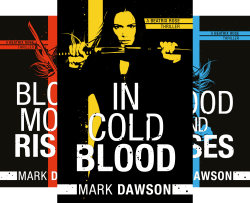
BeatrixRose_seriesAnother example is Mark Dawson. A well-known name in independent publishing due to his marketing strategies, he has been writing thrillers for years, and did in fact start off in traditional publishing. I’ve read quite a few of his books over the last few years. I got some of his earlier ones for free, and although the stories rattled along at a good pace, I didn’t initially think they were anything special. Not bad, but not excellent either.

Then I went to his more recent Beatrix Rose books, and it felt like his writing had stepped up a level. There was more depth to the characters, and Beatrix’ personal journey was well integrated into the external plot. The writing itself was smoother‌—‍those odd passages that sounded clunky had now disappeared. Now, I’m eager to read more.

I wonder if Mark Dawson would have reached this level of writing if he hadn’t gone the independent-publishing route. I can’t help thinking he’d be spending his time querying agents and editors, and building up a string of rejection letters, rather than working on his writing. I don’t know how long his earlier books took him to write, but it’s probably a fair assumption that, now that he has total control over his career, he is able to finish books far quicker. If one book isn’t as good as he might like (although I’m sure each book is the best he can make it at the time), there will still be readers who will enjoy it. Some might pick up on ‘poor writing’, but many more will simply enjoy the story, and be contacting Mark to ask when the next book will be out. And he’ll be working on that next book, using what he has learnt to make sure the new work is better than what he’s produced before.

And this, maybe, is how it should be. Yes, there will be those outliers who produce a near-perfect debut, and struggle to reach that height again. But for most authors, writing is a constant process of learning. However successful (whatever that means) those first few books are, the later ones should naturally be an improvement.

This is something I need to keep in mind for my own writing.

editing-1756958_640Recently I formatted a PDF version of my first Dominions novel, and I was almost embarrassed by some of the sentences I saw. I had to stop myself from going through it line by line, because I knew I’d find so much‌—‍too much‌—‍I could improve. In the last two years, just through the process of writing more and working at my craft, I’ve grown as a writer.
I could go back and make that first book better, but then I’d be tempted to ‘fix’ the others as well. But how productive would that be? If I kept these files to myself, tinkering away until they were perfect, they’d never see the light of day.

And I’m not sure that readers want ‘perfect’ anyway. They want a good story. They want a bit of escapism. Just look at how well certain ‘poorly written’ books do.

So far more sensible to write the best book I can at the moment, put it out for anyone who wants to read it, and then concentrate on the next one. That one won’t be perfect, but it will be a step closer. And in the meantime, there are readers who will enjoy these books.

The best way to improve as a writer is to write.

The Price Of Free

Free books. What could be the problem? Everyone loves free, right?

I’ve been thinking about this recently, both from a reader’s perspective and an author’s. And I’m not too sure what I think.

I download free books. If I find something on Amazon that looks interesting, and it’s free, I’ll grab it. A few months ago I got a few books through Instafreebie, and now not a day goes past without at least a couple of e-mails informing me about more Instafreebie giveaways. I’ve lost track of how many free books I’ve downloaded. It must be in the hundreds.

And I’ve even read some of them.

For new authors, it is hard to get noticed. Most people aren’t prepared to shell out for something new. So giving something away for free‌—‌a ‘try before you buy’ strategy‌—‌can help increase visibility.

Author Nick Stephenson’s strategy is to have the first book in his series free, then offer the second free to anyone who signs up to his newsletter.

Does this make sense? He’s spent time and money to produce those two books, and he’s not getting anything in return for them, right?

Not quite. If enough people get that first book, some are likely to sign up to his newsletter in order to get the second. And of those, some will buy his subsequent books. And the readers who only get the freebies? They probably wouldn’t have bought his books anyway, so these are not lost sales. This is e-books we’re talking about, not physical products. Once the original file is created, there is no cost in replicating it.

Although I see the logic in this, and although I have downloaded far too many freebies myself, a part of me doesn’t like this model. I’ve considered it for my own books, but have resisted giving any of my novels away so far (although I do have a novella out through Instafreebie‌—‌check out Expedient by clicking here — and yes, that was a shameless plug).

There are a few reasons for my unease with this model.

Unrealistic Expectations

arrow-964733_640

I heard a story about an author who was contacted by a reader. This reader praised the author’s books, saying that she’d downloaded and read all of them. But she also said she’d returned the books to Amazon, taking a refund. Other authors had books for free, so this reader didn’t see why she should have to pay for books.

Yes, it is possible to read an e-book and then return it for a refund. Amazon probably don’t like this, but allowing customers to return unwanted goods makes sense from a customer service perspective. And many people who do this probably don’t see it as anything more than a mild inconvenience. After all, Amazon can afford it.

Of course they can. They record both the sale and the return, and no money passes on to the author. Amazon doesn’t lose out. The author does.

But that’s another issue, and isn’t why I mention this reader. What I want to focus on is the expectation that books should be free.

This is becoming more prevalent, especially with subscription services (which feel like getting something for nothing, because it’s easy to forget the monthly fee when you don’t have to pay for each individual ‘purchase’). The same kind of expectation happened with music, when mp3s became so prevalent. It was easy to download a whole album, and as there was no physical object, it was fine, right? Walking into a shop and taking a CD (or a book) is clearly wrong, but downloading something? That’s‌…‌not a thing. So it doesn’t really exist. So it’s not a problem.

I’m sure you can see problems with this. In the case of both music and books, there is a cost in producing those downloadable files. With books, this involves formatting, buying a cover, and paying for editing. There are also other costs around the business of producing and promoting books, like web-site upkeep and advertising/marketing. And then there is the time it takes to write the thing in the first place. Is it really fair to expect someone to spend hours writing a book and then give it away for free?

But once one author gives a book away, that sets a precedent. Others feel they should follow, and then readers come to expect free books. And when the amount of free books available would take over a lifetime to read, why should a reader pay for a book?

Thankfully, most readers still appreciate the work that goes into writing, and they are willing to pay for their entertainment. But the more widespread free becomes, the harder it will be to convince readers to pay.

Maybe, in the long-term, subscription services will be the way forward. But again, this causes problems. Which books are available in which subscription service? Kindle Unlimited is the biggest at the moment (I’ve heard it said that, if Amazon is the largest book store in the world, then Kindle Unlimited is the second largest), but for independent authors it is only available if you go exclusive to Amazon. Where does this leave those who use Kobo or iBooks? Where does that leave those who don’t have, and don’t want to have, a Kindle or Kindle app?

But I’m getting sidetracked. Back to other problems with free.

Perceptions of Quality

editing-1756958_640There is a saying‌—‌‘you get what you pay for.’ Now, I’ve read some fantastic free books, both out-of-copyright classics and books by new authors, so the correlation between cost and quality is not rigid. But there is a great deal of poorly-written free stuff out there. And this, combined with the (thankfully lessening) idea that only traditionally published authors are good writers, has led to a certain attitude towards free books‌—‌that they can’t be much good.

This leads to a subconscious problem. If we read a free book, there is a part of us that doesn’t expect much. If it was any good, it would cost money, right? So we expect the free book to have problems. We almost seek out those typos and grammatical errors that mark it out as sub-par. We’re on the lookout for poor dialogue and plot holes.

Look hard enough for something, and you usually find it.

This shouldn’t be the case, but it is. If there are two books that have the same problems (a few spelling mistakes, a few dodgy plot points), we are far more willing to forgive them if we have paid for the book, and praise its good points. If the book is free, the problems confirm our suspicions that it was badly written, and the good points slip by us.

If the author has a solid reputation (and therefore doesn’t need to give books away), they must be good, and if their writing is hard to get into, the fault must lie with us‌—‌maybe we’re not intelligent or educated enough to appreciate what they are doing with their words. Conversely, anyone who is starting out and who has to practically throw their books at potential readers‌—‌well, they’re desperate. Of course their books won’t be up to much.

Quantity

tablet-1632909_1280Another problem I can see with free is one of quantity. As I mentioned before, there are more free books available than anyone can read in a lifetime. Through projects like Gutenberg, older classics are available to all. ‘First in series free’ is such a popular business model that there are a glut of books in every genre that can be downloaded without any cost.
My Kindle has books I downloaded years ago that I have yet to read. It’s too tempting, when a book looks half-interesting but has no cost, to click on the download button. My in-box is becoming clogged with updates from authors whose mailing lists I have signed up to in order to get free books, and many of these contain links to other offers (the Instafreebie model, to be successful, involves a great deal of cross-promotion). I try to resist, but so many of these books look interesting, and I end up with even more freebie.

The saying that the cream always rises to the top might be true, but it takes time, and with so much material out there, it’s taking longer and longer. I’m wary of spending too much on a new book now, because I start to question when I’ll get round to reading it. There’s a risk that any book I pay for will become lost in this sea of free.

I know not everyone thinks this way. I have heard of people who never consider a book unless it is over a certain price. But I also know there are those who actively seek out free books. And with so many available, why not? Why ever buy a book again?

Of course, the ‘first in series free’ model hopes that readers enjoy the book enough to buy the rest of the series. But I sometimes find myself enjoying a book, telling myself I’ll check out others by that author, but then I’ll move on to another free book, and that first one will slip from my mind.

—————-

problemSo I have problems with the free model. But I still download free books. Sometimes, when I enjoy a book, I’ll buy more by the author, so I know that free can work as a marketing strategy. And authors like Nick Stephenson have boosted their writing careers through this strategy.
Maybe whenever I download free books I’m becoming part of the problem. Maybe I’m helping perpetuate a situation that will slowly become more damaging for authors.

Or maybe it is a situation that is inevitable. When digital files take up so little memory space now, and can be shared and spread across the world in seconds, maybe the idea of paying for such products is becoming a relic of a physical past. Maybe those of us who create digital work need to look at a different way of funding. Maybe we should start thinking of art as a service, and seek funding not for the product but for the entertainment and enjoyment it brings. Maybe the way forward is sites like Patreon, or subscription models.

I don’t know. The only thing I can be certain of is that things will always change.

Holiday Reading

Just a short one this week, due to being on holiday recently. A week in the sun, lounging about by a pool‌—‌ideal reading time. Some of what I read wasn’t too impressive, but I thought I’d let you know about the best three.

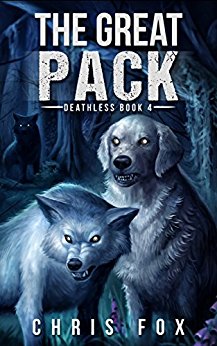
GreatPack_ChrisFoxThe Great Pack‌—‌Chris Fox

In self-publishing circles, Chris Fox is known for his openness in talking about what he’s doing, as well as his data-driven approach to writing. He produced a book on how to write 5000 words per hour (through planning, then using dictation software), detailed his ‘write to market’ strategy (basically, looking at what kinds of books are popular, and writing to please the audience), and is currently doing a ‘trilogy in thirty days’ thing.

I’ve read a lot of his books, and while his Space Opera stuff is enjoyable (that’s the ‘written to market’ stuff), I much prefer his first Deathless series. Somehow, they combine vampires, werewolves, zombies, sci-fi and Egyptian mythology without being disjointed. They’re fast, fun and inventive.

It seems that Fox likes these books, too, because he’s now brought out the fourth in the series, The Great Pack. It takes off where the original three ended, but includes a ‘previously’ section that is helpful on getting up to speed.

And then we’re off. The book is faster than the others, and without the ‘previously’ section I’d have been lost. It twists Fox’s ideas even further, and I really enjoyed it.

Thankfully, he has toned down the action scenes a fraction (if I have one complaint about the previous books, it’s that the fight scenes started to sound like stage directions, and with practically immortal beings, who can survive limbs being ripped off and so on, they soon became pretty ridiculous).

The book almost moves too fast for its own good, though. I noticed this in Fox’s Void Wraith space opera books‌—‌description and emotion are pushed way down, and plot takes over. Personally, I’d prefer something that eases up on occasions (and it’s not like The Great Pack is a short book).

But that’s a minor point. The story’s fun, and while it’s not quite as good at the previous Deathless books, it’s a good read. If you like the others, you’ll enjoy The Great Pack. And if you haven’t read the series so far, check out the first one, Vampires Don’t Sparkle, and see what you think.

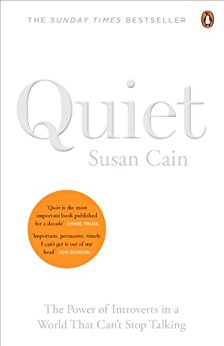
Quiet_SusanCainQuiet: The Power Of Introverts In A World That Can’t Stop Talking‌—‌Susan Cain

I first heard of this book through J Thorn’s Intronaut podcast, where he talks about being an introvert and how that has played out in his life. Quiet appeared as a Kindle Daily Deal recently, so I snapped it up. The more I read and hear about introversion, the more things in my own life make sense. I don’t know if I’m a ‘proper’ introvert (and there are tests to determine this), but I’m definitely towards that end of the introvert-extrovert spectrum.

As the title suggests, it’s about introversion, which is far more than just ‘being shy’ or ‘being quiet’. Cain’s spent years researching for this book, and has interviewed many people around the world, both introverts and extroverts (and everyone is in one of these camps to some degree). But she can also write, and the book reads like an exploration rather than a dry, academic tone.

There are some surprising facts in this book. Introversion is linked not only to societal pressures, but also to genetics. It is easy to see how western culture seems to favour the extrovert, but introverts, in certain circumstances, make more effective leaders. In the financial chaos over recent years, the traders who have come out on top tend to be more introverted in nature.

But the book also explores how to cope with introversion, and how to fake being an extrovert. There is a whole section on raising introverted children in ways that will help them cope with life. And there are also sections on different cultures, especially how eastern societies tend to favour introversion‌—‌think about how somewhere like Japan holds respect in high regard, whereas America is all about making oneself bigger and better in order to get ahead. There are interviews with eastern students studying at western colleges, and the struggles they face.

So, a very interesting book, and well written. As something thought-provoking, it was a great contrast to the rest of my lighter holiday reading. If you’re at all interested in how people think and function, it’s well worth a look.

SongOfTheSpaceSiren_BarryJHutchinsonSong Of The Space Siren‌—‌Barry J Hutchinson

This is the fourth Space Team book, and from what I understand, there are two more to come before the end of the year. Hutchinson seems to bring one out every couple of months, and I recently discovered that there is very little editing involved in his writing process, which makes the quality of these books even more impressive.

Comedy is hard to do well. Pratchett managed it fantastically with his Discworld books. Douglas Adams was great, but the comedy and the bizarre ideas took over, pushing the story to second place. Hutchinson avoids this problem, and he describes his books as space adventure stories with humour, rather than comedy books. The humour comes from the character interactions. It helps, of course, that his main character tends to react to stressful situations by making fun of them.

After reading the first book, I downloaded the rest, but I did wonder if Hutchinson could keep up the high standards of the original Space Team. So far, I’ve been impressed, and I think that rounding the series off at six books will keep things from getting too stretched. As it is, there were a few things in Song Of The Space Siren that didn’t quite work for me (to avoid spoilers, I won’t say what they are), and the growing relationship between a couple of the characters didn’t quite ring true. But these are minor points. The book is still great fun, and I’d recommend it (and the whole series) to anyone who is looking for a space opera adventure with a good dose of humour. I’m already looking forward to early June, when book five comes out.

‘That book looks terrible … I think I’ll read it.’

The more books I read, the more books I want to read. I’m always on the lookout for something new. I’ll check out authors I like, I’ll look at recommendations from others, and I’ll browse stores in genres I enjoy. But occasionally I’ll pick something different. Every now and then I’ll purposely choose to read a book that doesn’t appeal to me.

Before I carry on, I should explain something. I occasionally post book reviews, but I make it a rule to only review books I can be positive about. If I don’t enjoy a book, I’ll simply head on to the next one. I won’t spend my time writing about it. It’s the whole ‘if you can’t say anything nice, don’t say anything at all’ thing. But in this post, I’m going to mention a few books that I didn’t enjoy. Apologies in advance if this upsets anyone. But please remember that this is simply the opinion of one person. I like certain books, and dislike others. I listen to strange music that I know others can’t stand. I like Marmite. My tastes are not necessarily going to correspond with yours. If I don’t like a book, that simply means I don’t like it. It doesn’t mean it’s a bad book. Your opinions may differ.

We all like different stuff. If everyone was the same, life would be so much less interesting.

Getting back to books, the ones I’m going to talk about here are Twilight and Fifty Shades. In both cases, the books have sold fantastically well, and have legions of fans. The interest in these books has led to films, and the authors are (as far as I understand) doing very well for themselves. If I say something negative about them, it’s not going to harm the success of either series, and I doubt the authors are that bothered by what someone like me thinks of them anyway.

I’ve read all the Twilight books and the first two Fifty Shades titles. I’m not a fan of paranormal romance (or whatever genre Twilight is in at the moment), and I’m not big on erotic romance (if that is where Fifty Shades sits‌—‌I’ve heard differing opinions). I know I’m not the target audience for either series. I can’t say I enjoyed reading them, but I did finish them.

Why? Why spend time on something I didn’t enjoy? And why, after reading the first book in each series, did I carry on?

There are a couple of reasons.

ignorance-1993615_1280Ignorance

The first I will illustrate with something that happened a few times when I was teaching. I’d get into conversations about music, and my tastes were usually very different to those of the students. Sometimes, when I mentioned an artist or band I liked, I’d get negative comment‌—‌“That’s rubbish!” (although usually with a few more swear-words thrown in). I’d counter by asking what songs by that particular band the young person had heard, and in practically all cases they hadn’t heard anything. It was simply a name they weren’t familiar with, and so they dismissed it straight away.

Chances are they wouldn’t have enjoyed the music anyway, but they weren’t even prepared to give it a chance.

And that’s so easy to do. As someone who enjoys vampire stories like Dracula and Salem’s Lot, Twilight isn’t a ‘proper’ vampire book, and it would have been easy for me to complain about Meyer’s series. But I would have been making unfounded statements, or simply repeating what others had said. If I wanted to moan about Twilight, I had to know what I was talking about. I couldn’t say it was badly written unless I was prepared to back this statement up with examples I’d come across.

So I choose to read certain books because I want to know what I think of them. I don’t want to regurgitate the thoughts of others.

international-conference-1597529_1280Audience

The second reason is connected with target audience. As I said before, I know that neither Twilight or Fifty Shades are aimed at someone like me‌—‌middle aged bloke who leans towards inquisitive fiction with a dark edge. Of course there was a good chance I wouldn’t enjoy them.

So why should I even bother reading them?

Again, I’ll bring this back to music. There are loads of different styles of music, although most people tend to listen to only a few types. But the musicians who are producing interesting work are often the ones who push boundaries, and who draw on a wide range of influences. I’ll illustrate what I mean with a story I heard about Randy Rhoads, guitarist with Ozzy Osbourne back in the eighties. When they were touring, Randy would book a local guitar teacher for a lesson wherever they happened to be. He’d invite the teacher up to his hotel room, and spend an hour learning. It didn’t matter what style they taught, because it was all music, and he knew whatever they had to offer would help his own playing. Rock, jazz, classical, folk‌—‌as far as he was concerned, anything could be a positive influence.

I feel a similar way about books. There are so many stories out there, and so many different ways of writing. If I stick to a few genres, or even a few authors, I’m limiting myself. I need to read outside my comfort zone. I need to know what else is happening. Even stories I don’t like can be educational. It’s why I have a collection of cowboy stories on my Kindle, and why I’ve downloaded a few romance titles. It’s why I’ll read popular books that don’t appeal to me.

Even if I am not particularly enamoured with the story or the writing, I can still learn from it. I can see why others might enjoy these books, and that can help me think of how others might perceive my own writing.

binoculars-1209011_1280Discovery

Now that I think of it, there is another reason for reading outside my preferred genres. There are so many books waiting to be read, and amongst all the ‘rubbish’ there will be uncovered gems. If I only stick to what I know, I could be missing out. So I need to risk something different every now and then. Yes, there is a good chance I won’t enjoy it, and it might be a chore to complete it (because I don’t like leaving a book unfinished). But, occasionally, I’ll come across something I love.

I’ll give a couple of examples of this. I first heard of Louis de Bernieres when Captain Corelli’s Mandolin was released and started getting more attention. It didn’t particularly appeal, but I read it anyway. I though it was okay‌—‌well written, even though the story didn’t grab me. I read a few reviews, and a lot of them suggested that his earlier books, his Latin American trilogy, were better. I gave them a go, and I have to agree with these reviewers. I think this trilogy are fantastic. I haven’t picked up Corelli again, but I have re-read all three of his earlier books.

Other examples involve classics, those old books that ‘everyone should read’ (why?). I remember reading both Wuthering Heights and War And Peace because they came in this category, and in both cases I expected to struggle through them. But at least I could say I’d read them.

Yet I loved the books. I’ve re-read both a few times since, and have gone on to read more Tolstoy (although I still think War And Peace is his best). And I’ve read more classics and ‘books everyone should read’‌—‌some I’ve enjoyed, some have been a struggle, but I feel better for reading them, because now I know what I think about them.

problemSo did I waste my time reading Twilight and Fifty Shades? If I read slowly, and took a few months to get through them, I would say yes. If I continually read books I didn’t think I’d enjoy, again I’d say yes. But if I read widely, and step outside my comfort zone every now and them, reading ‘unenjoyable’ books is not a waste of time. Just so long as I know why I am doing it.

I read for enjoyment. I read to get wrapped up in a story. I read to be thrilled and entertained, or maybe to laugh.

But I also read to expand my mind. I want to have my own opinion, rather than simply aping others. I want to understand how different books can appeal to different audiences. I want the opportunity to find those hidden gems.

And even if I find a book that is poorly written, and that I find little to hold my interest, I can still learn what mistakes I need to avoid in my own writing.

If I read with all that in mind, no reading time is truly wasted.

The Books That Don’t Fit

light-bulbs-1125016_1280There are two types of fiction books‌—‌literary and genre. At least, that is what perceived wisdom seems to say. There are the ‘deep’ novels that win awards, and then there are the exciting, throwaway stories that are pure entertainment. And within the genre field, there are many subcategories, each with its own rules and guidelines, its own expectations and fan-bases.

To make it as a successful author, independent or traditionally published, many say it is best to stick to these rules and expectations. They say you should give the audience what they want. The phrase ‘write to market’ is bandied about. Some use it as a guide to success (if such a thing exists), and others decry it as an affront to artistic integrity. Most people sit somewhere between these two extremes.

But it does seem that more formulaic books find more success. I’ll mention again the Sterling and Stone team (Johnny B Truant, Sean Platt and David Wright). Their most successful project is the seven-book Invasion series, written specifically to appeal to alien invasion fans. Likewise, when Chris Fox very openly wrote his Void Wraith series to fit the space opera market, he enjoyed far more success than he had done with his earlier books.

I don’t write this in any negative way. This kind of success does not mean the book were poorly written. I’ve read both Invasion and Void Wraith, and enjoyed them both.

But I far prefer their other work. Platt and Truant’s Unicorn Western is a lighthearted fantasy/cowboy mashup (although it grows more serious as it goes along), and I love it. Fox’ earlier Deathless books (Vampires Don’t Sparkle, No Mere Zombie and No Such Thing As Werewolves) manage to combine horror creatures, Egyptian mythology and sci-fi in a way I found extremely inventive and entertaining.

Yet the sales figures would suggest that I am in a minority. The more straightforward books sell more, suggesting they have a broader appeal, but I prefer those that push at the boundaries. I like stuff that takes chances. If an author is told a book won’t work, but they write it anyway, I’ll want to read it.

One of my favourite authors is the late Iain Banks. He produced books under two brands — Iain Banks for his ‘literary’ books, and Iain M Banks for sci-fi. But two of his ‘literary’ books were strong on the sci-fi, most noticeably Transition, with characters jumping between alternative realities. And his sci-fi, while being big on ideas, worked so well because of his writing. I’d rate the M Banks books as some of his finest work.

Yet, as I start on my own author journey, I am constantly receiving advice to stick with a particular genre, or a particular style of writing. I should study what works in that field, and apply it to what I’m working on. I should follow the tropes, because otherwise I will upset readers.

There are loads of these tropes. In romance, the couple have to meet at the start of the book. There should be no infidelity, and there should definitely be a happy ending.

And yet, I like Wuthering Heights, a story that has no happy ending. And look at Romeo & Juliet, one of the greatest love stories ever‌—‌it ends with the couple killing themselves, each believing the other is dead. There is no happy-ever-after.

Of course, these are love stories, not romances, and I know that if I wanted to write a romance, I would need to have a happy ending. If the story worked better with a tragic close, I’d have to rebrand it.

If I write, and I want readers, popular reasoning says I have to stay within the confines of my chosen genre.

But what of the stuff that falls between the gaps? What of the books that don’t fit squarely in one particular genre?

I think these are the more important books. Yes, many of them will not be ‘popular’, and they will not sell as well as those that meet reader expectations. But, over time, these are the books that may well mean more.

Clownfellas_CarltonMellickIIIA couple of years ago I read a book called Clownfellas, by Carlton Mellick III, in which the mafia consisted of clowns, who were a different species (I think). The book was funny and violent, and definitely strange. It didn’t fit in any one category, and I thoroughly enjoyed it.

I recently read Mr Ruins by Michael John Grist. I thought I was going to be reading a sci-fi thriller, but the story delved into mysteries of the mind, and left me with more questions than it answered. And I loved it.

As another example, look at Mervyn Peake’s Gormenghast books. They seem to be fantasy, but there are none of the usual range of creatures, and there is no quest. They also seem to veer from deadly serious to comedic. And yet, they are incredible (I have my reservations about the third book, but I definitely recommend the first two).

Think of Robert Prisig’s Zen And The Art Of Motorcycle Maintenance. Is it a story or a text-book? Is it fact or fiction? It’s both and neither, but it’s a fantastic book. I’ve read it a number of times, and on each re-reading it opens up a little more. It might not be a ‘story’, but it’s a wonderfully involving piece of writing.

Think of Bret Easton Ellis’ American Psycho. There is very little ‘story’ in this book, and the descriptions (and the language used) are as important as anything that ‘happens’, maybe more so. To some people it’s horrific, but to others it’s a comedy. Ellis seems to have something to say, but he doesn’t make this obvious, and again it is a book that repays repeated readings.

And I realise, as I’m writing this, that there will be people who look at that list of books and see only ones they don’t like. They will find Zen boring, and won’t see the point of American Psycho.

That’s fine. I don’t think these books were written for everyone. The authors had a particular story to tell, and a particular way they needed to write. I think they were simply writing what they wanted (or needed) to write, regardless of audience.

So, of course, these books struggle to find a place. Of course they won’t appeal to many, at least not initially. The fact that all these books are well-known is down to how well they are written (although savvy marketing no doubt played a part, and I’m sure the subject matter of American Psycho helped it achieve a certain notoriety).

They are different. They don’t give the reader exactly what might be expected. They don’t fit neatly into a particular box.

And that is why, for some of us, these books are so successful, and have become firm favourites. The very fact that they don’t fit is a part of their appeal. Because, for all this talk of writing to market and of giving the reader what he or she wants and expects, there are many of us who want the unexpected. There are many of us who don’t want a repeat of what we’ve read before. There are many of us who simply want a good read, regardless of genre or tropes or any other standards.

Many books can be entertaining. They can thrill us and excite us, or make us hold our breaths as the characters come up against all manner of difficulties. They can draw us in with their language. But the books that stick are the ones that go beyond. The books that last are the ones that are written because they have to be.

The books that follow all the rules can be entertaining, and can be wonderful reads. But the ones that stick are the ones that go beyond expectations.