Short stories are back! New story ‘The Campaign’ free to read now.

After a break for the summer, I’m back into posting free short stories. I wrote quite a few first drafts while on holiday, so I have plenty to be working on over the next few months.

The first of these is The Campaign. I found myself wondering how holidays might change as virtual reality becomes increasingly realistic. Of course, there would be advantages‌—‌no need for hours spent at airports or on stuffy coaches, the ability to tailor the holiday to individual tastes, and so on. But there would be problems, too. As with any technological advance, there would be those who wished to disrupt it.

This story came from those thoughts, and you can read it here. As always, I’d love to hear your comments.

The Importance of Reading Part 1: Slow Down!


Reading is one of the greatest ways of spending time.

Okay, so I’m biased. I’ve always loved reading, and now that I’m writing seriously, I’m continually being reminded of the joys of reading. But I’m also learning more about the importance of reading.

I don’t meant the importance of being able to read. Of course it’s important to be able to decode written language. Without reading skills, we would be unable to understand instructions or warning messages, and our communication with others would be limited. Where once reading was the reserve of the wealthy educated, today being unable to read is something that causes shame.

reading-2557256_1280But there’s more to reading than simply understanding the words. Reading is an active pursuit‌—‌when we read, we decipher lines to discover the words, and then we analyse the flow of those words to uncover meaning. Reading is a journey, and we have to partake in it. The words mark a course, and we, the reader, have to put in the leg-work to reach the destination.

Maybe this is why other forms of story entertainment hold a greater pull. TV and films can be experienced far more passively, social media (in which our ‘friends’ contribute to stories played out in real time) plays out in smaller chunks that are easily digestible. Gaming is active, but in a different way to reading‌—‌the immersive element does not rely on our own imagination so much.

Yet reading is still incredibly popular, and I think this is fantastic. I believe that reading is not only enjoyable, but also incredibly important.

I posted recently about an episode of The Allusionist podcast that highlighted the mental health benefits of reading, but this is only one facet. Reading does so many things for us as readers.

Over the next few posts, I want to explore some of the reasons why I believe reading is so important.

I could have put all these reasons in one post. I could have come up with a list, or a series of images or something. But I’m going to take my time over this. I want to take things slowly.

And that dovetails nicely into my first reason:

Reading gives us the opportunity to slow down.

people-692005_1280Most people’s lives are hectic. Technology is wonderful, but it’s a double-edges sword. When technology started changing the way people worked, there were those who anticipated a time when a single person could do the work of twenty others, and in a fraction of the time. They envisaged a world where work took a few hours a day, and then we lived a life of luxury.
Yeah, right! Technology enables us to do more, and so our bosses‌—‌and their bosses, and so on‌—‌expect more out of us. We work long hours‌—‌yes, we can get far more done with technology, but so can everyone else. To stay ahead, we have to do even more.

And when we get home, there’s the constant bombardment of stimuli.

I can remember when there were three channels to choose from on TV, and they all shut down late at night. We had one television in the house‌—‌if you didn’t want to watch what others did, you went off to do something else.

Now, we have countless channels. Then there are subscription on-demand services. We have access to instant videos on YouTube. We have social media. We have real-time video communication. We’re inundated with messages.

If this is all too much, we do have the option of turning all our devices off, but this is hard for many to do‌—‌there’s always the fear of missing something ‘important’. And even if we do manage a digital detox, we can’t escape unless we hide in our own homes. Adverts bombard us in the high street, and music calls to us. Some adverts play videos, which are even more eye-catching. Everywhere we turn, there are images and voices scrambling for our attention.

I don’t think constant stimulation like this is healthy. We need time to slow down. However much we enjoy (and get a thrill from) this, we all benefit from moments of calm.

Reading can give us that time.

tranquility-2233620_1280It demands long periods of our attention, away from distractions. This might mean finding a quiet spot at home, or it might mean training ourselves to ignore the clamour around us (for instance, shutting off from the bustle of the morning commute).

Then, we need to give time up for reading. Rather than blasting through thirty-second videos, or flicking between different social media accounts, reading requires concerted effort over a number of minutes, maybe even hours.

And as we read, we are drawn into the story (or the journey of discovery if we are reading non-fiction). The noise around us fades away as the words take over. We step out of time and enter a new world. Our bodies rest as our imagination takes us to other places.

Reading enables us not only to slow down, but to disengage, to escape the rush of our lives. Reading gives us moments of calm. It can help us sleep‌—‌many studies have highlighted how good sleep is easier to achieve after winding down, and that staring at screens keeps our minds too active. It can give us the opportunity to take a breath and unwind.

But this is only one reason why reading is important. I’ll comment on more reasons later. Until then, enjoy the calm that reading can bring.

Book recommendations from this summer


Summer holidays are wonderful reading time. When it’s so hot that you don’t feel like moving, what can be better than lounging about with a book is ideal (and with e-readers, you don’t even need to physically turn pages). It’s an opportunity to catch up on some of those ‘must read’ books that have been on the ‘to-be-read’ list for far too long, or to dive into a new read.

A couple of weeks ago, I wrote about how reading was such a popular activity around hotel pools (and you can read that here). This week, I thought I’d share a few of my favourite reads from this summer.

PerdidoStreetStation_ChinaMievillePerdido Street Station‌—‌China Mieville

China Mieville is one of those authors where I’m almost embarrassed by how few of his books I’ve actually read. A couple of years ago I read King Rat (can recall enjoying it a lot), and earlier this year I read his short novel The Last Days Of New Paris (which left me feeling like I wanted to explore the world he created in far more detail).

So I’m long overdue a read of his first New Crobzun novel. I started it expecting to be impressed‌‌—‌‌and I wasn’t disappointed.

The world-building is incredible, not only in the setting but also in the characters‌—‌insect/human hybrids, bird-men and strange mutants. It’s all wonderfully imaginative, but when it’s combined with Mieville’s prose it’s an encompassing experience.

Some of the negative reviews of this book on Amazon complain that the story is slow to start, and while there is some justification in this comment, I think it’s necessary‌—‌to care about characters so strange in such an unfamiliar place, Mieville has to take us in hand and show us these wonders first. And when the story does get going, it’s a roller-coaster of a ride.

I’m not sure how to describe this book‌—‌it’s second-world fantasy, but there are nods towards sci-fi along with strong horror elements‌—‌but I think that’s a good thing. This book feels unique, and while that means it might not be to everybody’s taste, it’s a book I’d highly recommend.

And I really should read more of Mieville’s work before the year is up.

Artemis_AndyWeirArtemis‌—‌Andy Weir

Andy Weir, of course, came to fame with The Martian, which I greatly enjoyed. But I was wary of reading his second novel‌—‌The Martian felt like it could have been a one-off, and I didn’t want my enjoyment to be tainted by a disappointing follow-up.

I needn’t have bothered, because Artemis is just as good as The Martian. It’s not a sequel‌—‌it’s not even the same kind of book. Artemis is a fast-paced thriller set on a colonised base on the moon, with a spiky, sassy main character, gangsters, smuggling, and a bit of politics and business intrigue. There’s murder and fights too.

But what it does share with The Martian is science. I can’t comment on the accuracy of it, but it all sounds plausible‌—‌and in a novel, that’s good enough for me. The characters solve problems using physics, but science also causes many of their problems.

Oh, and like his protagonist in The Martian, the characters in Artemis do tend to swear quite a bit. Don’t know if Weir’s going to release a ‘child-friendly’ version of this, like he did with The Martian (personally I don’t see why he should), but unless you’re put off by ‘bad language’, this is another book I’d recommend‌—‌exciting and intelligent.

I’m already looking forward to whatever Weir comes out with next.

Obscura_JoeHartObscura‌—‌Joe Hart

I first heard of Joe Hart when I was writing Dark Glass. At the time, I was toying with calling my series Dominion, but when I did a search in Amazon I noticed a book called The Last Girl, a Dystopian story with the subtitle The Dominion Trilogy, Book 1. I checked out the author name, and discovered that Joe Hart had beaten me to my preferred series name.

His is a trilogy, though, whereas mine is longer. I added an ‘s’, and branded my books as Dominions. I’m sure he doesn’t mind‌—‌especially as his trilogy has done very well.

That’s not surprising, because they are good reads. So when I saw his new one on Amazon, I bought it.

Obscura isn’t Dystopian. In fact, it’s hard to describe. We have a protagonist who is searching for a cure to the version of dementia that destroyed her husband and now affects their daughter, so there are elements of medical thriller. But she’d addicted to painkillers, and as the book progresses it becomes a psychological thriller. Oh, and much of it happens in the near future, in space, so it’s also a sci-fi adventure.

If that sounds like it should be a mess, it isn’t. Hart weaves the story together brilliantly‌—‌a plot filled with misdirection and intrigue, but always remaining focused on the characters, especially the protagonist’s inner turmoil. It’s the kind of book where anything could happen, and I highly recommend it.

So another author goes on the ‘must read more’ list.


There were other books I enjoyed (the first three John Milton thrillers by Mark Dawson were fast-paced, enjoyable reads, and The King Of Space Must Die by Barry J Hutchison kept to the same high standards as the rest of the Space Team series but brought it all to a satisfying close), but I don’t have time to go into details here.

My ‘to-be-read’ list is still as long as ever, but I’m always on the lookout for more titles to add to it‌‌—‌‌any suggestions greatly appreciated.


The Power Of Words now on pre-release

PowerOfWordsCoverThe Power Of Words, an anthology of stories centred on the First Amendment, is now available for pre-order at 99c/99p. Four futuristic, apocalyptic and fantasy stories by four authors‌—‌myself, Richard T. Drake, Heidi Angell and M.L.S. Weech.

The e-book will be released on 1st October, with paperback and audio versions also available around that time.

Pre-order The Power Of Words from Amazon (.com/.uk /.au)

Reading is good for your mental health

I got into listening to podcasts a few years ago, roughly when I started writing seriously. Initially, it was a way of learning about this whole writing and indie-publishing thing‌—‌The Creative Penn (amazing to consider that Joanna Penn has been putting this podcast out for over nine years now), The Self-Publishing Podcast (now re-branded as The Story Studio), and the sadly no longer running Rocking Self-Publishing.

Over the years, I’ve expanded the list of podcasts I listen to on a regular basis (and when I find a new one, I’ll usually listen to their whole back-list too). Many focus on writing and publishing, and this is my main way of keeping up to date with what is happening, as well as continually learning. But I also listen for the enjoyment, and I’ve branched out into other podcasts.

AllusionistLogoOne of these is Helen Zaltzman’s The Allusionist. She brands it as ‘a podcast about language’, and that pretty much sums it up. She’s done episodes on the Rosetta Stone, how one area of Argentina speaks Welsh, messages on dating apps, letter-writing, the BBC shipping forecast, swearing, eponyms‌‌…‌‌the list goes on.

But I thought I’d single out the latest episode, because it deals with reading. I’ve always considered reading to be far more than simply a way of being entertained, but this episode (A Novel Remedy) looks at some of the mental health benefits of reading. Reading can help cure or alleviate psychological problems. Helen talks to a clinical psychologist who uses novel-reading with her patients. She also explores why murder mysteries written by the likes of Agatha Christie and Dorothy L. Sayers were so popular‌—‌and so helpful to the mental state of readers‌—‌in the years after the First World War.

It’s a very interesting listen, and you can find it here. And if you’re interested in language and words, I’d recommend you pop over to The Allusionist’s website and give some of the other episodes a listen.

Reading is alive and well

As a method of taking in entertainment, reading has a lot of competition‌—‌music, film, TV, video games, as well as the plethora of entertainment available on-line. These are all arguably more immediate than reading. With the possible exception of video games, reading is the only one that cannot be consumed passively‌—‌it requires effort, in concentrating on the words and making sense of the sentences. And it takes timeva three-minute song, a ninety-minute film, or a five-hour novel.

Sometimes, it feels that reading is becoming a lost art. Libraries are struggling here in the UK, and many have closed. High-street bookstores are disappearing too.

pool-2217508_1280

But reading is far from dead, and this was brought home to me recently on holiday. It started at the airport, and then on the plane‌—‌with hours of time to fill, passengers turned to books. And at the hotel, the popularity of reading became even more obvious.

We spent quite a bit of time by the pool, and I’d often glance around to see what others were doing. Many were sunbathing, with eyes shut. Some were talking. Others swam. And a high number of holidaymakers were reading. Whenever I counted up, there were more people reading than there were in the pool.

Let that sink in for a moment‌—‌at a hotel pool, reading was a more popular activity than swimming.

I took a surreptitious look at what people were reading. The books ranged wide. I saw Stephen King, but also China Mieville. Judging by the covers, there were thrillers and romance alongside contemporary/literary fiction. A few looked like biographies. Someone even produced a book of sheet music and read this, humming to himself.

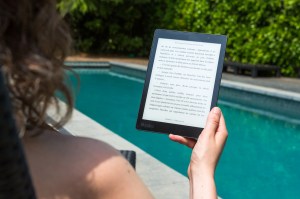
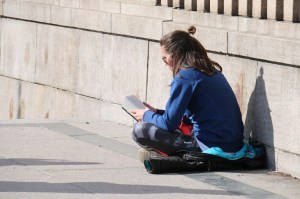
woman-3550357_1280Then there were the electronic readers. I’m assuming that many were Kindles, although I did see one Kobo (and that made me feel good‌—‌as much as I love my Kindle, it’s good to know that Amazon does still have competition).

And then there were the phones.

Of course, that phones are capable of so much more than displaying e-books. Some people round the pool wore headphones and held their phones in landscape mode, and I assume they were watching videos. Others tapped away, presumably either on games or social media apps and sites‌—‌although maybe they were writing.

But a large number of phone-users held their devices in portrait mode and tapped only occasionally‌—‌the same behaviours as those using e-readers. I have to assume that these people were reading on their phones.

Not all this reading was solitary, either. At one point, a couple sat on a couple of loungers and both produced books. After reading for a few minutes, he passed his book over to her, pointing to a particular passage. She read this, and made some comment on it.

I wondered if they’d swap books as their holiday progressed, and if they’d spend time in the evenings discussing what they’d read.

But holidays are not everyday life. Some people might say this is not evidence that reading is popular. Those who read by the pool might read nothing else for the rest of the year.

This could be true‌—‌but doesn’t that make reading something special? These people were on holiday, taking time out of their normal routines. They chose to relax in the sun by a pool, and as part of that relaxation they chose to read. Books might not be something they turn to every day, but they are reserved for special occasions. They are a way to unwind, to forget the day-to-day troubles. If someone only reads on holiday, that shows how they value reading as an exclusive activity.

Maybe those on the plane and at the airport read because they had too much time trapped in one place‌—‌but they still chose to read. Just like those who read on their daily commute to and from work, they chose to consume books to pass the time. They chose to take their entertainment in written form.

And maybe some of those holiday-makers (many of them?) were like me‌—‌using time by the pool as an opportunity to indulge in one of their favourite activities.

Using short stories to try something new


I love reading novels, but occasionally I’ll get an anthology of short stories. I’m usually drawn to a particular title by one or two authors who I enjoy, but there are always stories by others I’m unfamiliar with. These anthologies are fantastic opportunities to try new writers without committing to hours of reading a novel would take.

I’ve submitted short stories to anthologies (and there’s one coming out in October that I’m very excited about), and a large draw is having new readers discover my work. Hopefully, a few readers will enjoy my stories enough to check out (and buy) my novels.

But there is another benefit to writing short stories, and that is the opportunity it presents to experiment. I want to improve as a writer, and that means pushing myself outside my comfort zone. That might mean trying a new genre, or it might mean trying a new style of writing. Clearly, writing complete novels for this kind of experimentation/developmental process would take too long, so I use short stories.

I’d like to highlight some of these stories here. Some have been more successful than others, but all of them have helped me improve.

And, as before, the comments below may contain spoilers, so you can always click on the title of each story to read it first.

Old Bones Burn Strong

I’ve always enjoyed fantasy. When I first read Lord Of The Rings, I’d go to my room as soon as I was home from school and spend what felt like a few hours simply reading. I remember being excited when I found Stephen R Donaldson’s Gilden Fire (the ‘lost’ chapter from one of his Thomas Covenant books) in a second-hand shop. I used to spend hours designing Dungeons And Dragons worlds, and creating new monsters.

So I wanted to try writing fantasy. I couldn’t figure out how to write a full-on epic as a short story (although I’m sure it is possible), so I came up with something smaller in scale, maybe a scene that could come from a larger story. Hopefully it stands up on its own, though.

Of course, as with science fiction, fantasy can be more of a setting than a genre, so this is also simply a story of an old man doing what he can to protect those he loves.

The Rendezvous

Another genre I read from time to time is thriller, and I wondered if I could manage an espionage story in under a thousand words. It took a lot of work, especially in editing‌—‌I needed to include the scene itself, but also hint at everything that had gone before.

Like many of my short stories, this started from an image‌—‌a man sitting outside, drinking a coffee, waiting for someone. The coffee instantly intrigued me, and I always knew there was something sinister about it. (A thought’s just come to me‌—‌maybe I should have had the man picking up the cup with his left hand, playing on the fact that the word ‘sinister’ is Latin for ‘on the left side’.)

The story, like so many others, developed as I wrote it, and required a great deal of editing. This was a fun puzzle, though‌—‌keeping enough happening in the scene itself to tell its own story, but also including enough hints and references to make the larger story understandable. Overall I’m pretty pleased with how it turned out.

Perfect

My stories tend to be dark. There’s usually death involved, or at least pain. So I challenged myself to write something ‘gentle’‌—‌a story where nobody died, with no dark undercurrents.

I wouldn’t call this romance, but it might be close. I recall wanting the dialogue to give the idea that this couple know each other well, and I think I got close to that.

Maybe I didn’t totally escape darkness‌—‌after all, the idea of the perfect moment does imply that other moments are less than perfect. But there is more happiness than pain in this story.

Never Only One Side

I’d already written a story using nothing but dialogue (Allegiance), but I wanted to see how far I could take this idea. I wanted a whole story that was only one side of a conversation.

A monologue would have been easier, but that’s usually one person talking to themselves. I wanted another character on the other side, someone who responded to the story’s main character, but who we never directly hear. The part of the conversation we ‘hear’ had to be realistic, while at the same time the story had to hold together.

On re-reading, it’s not as clear as I’d first thought. And I did cheat by having a second voice at the end (although it is through the same phone the main character used, so maybe I’m bending the rules rather than breaking them).

The Illusion Of Control

Stories are normally written in either third person (he did this, she did that) or first person (I did this). But there’s also second person (you did this, you did that).

This isn’t used much, except in ‘choose your own adventure’ books. It’s hard to write a story and convince the reader that they are the main character. Normally, books don’t address the reader at all (’breaking the fourth wall’), and second-person can feel like this the whole time.

But just because something’s hard, that doesn’t mean it shouldn’t be attempted, and I’ve wanted to write a second-person story for a while now.

I still haven’t managed it, but The Illusion Of Control is close. It seems to be second person at the start, but I cheat. About half-way through, it should become clear that the reader is not the main character, but that the story’s main character (or, at least, narrator) is talking to the reader. The character (and I suppose I can use that word for an AI) is monologuing, so this story is actually in first person.

The content of this story was influenced by Surviving AI: The Promise And Peril Of Artificial Intelligence by Calum Chace (well worth a read), and while I’m intrigued by the ideas I brought into The Illusion Of Control, I’m not convinced it works as a story. I’ll probably return to these ideas, though (I already have something in mind).

And I still want to write a second-person story.


Five short stories where I pushed myself to try something different, some more successful than others. I hope you found them entertaining. If you have any comments, on these or other stories I’ve written, I’d love to hear from you‌—‌simply add a comment below.

Why I enjoy writing horror shorts

I’ve enjoyed reading horror for as long as I can remember. As a teenager, along with sci-fi and fantasy, I would devour anything by James Herbert and Stephen King. So when I started writing, it was obvious that I’d try my hand at horror.

My Shadows series combines horror and sci-fi, but most of the horror I’ve written has been as short stories. There’s something about that size of story that works well in the genre. Think of Lovecraft, or Poe—‌loads of creepy shorts. And even though I read mainly novels as a teenager, I have fond memories of reading King’s short-story collections, like Skeleton Crew. I can’t recall the names of the stories, but there are tales that I still remember clearly, decades later.

I think it’s because horror is more effective if it is not explained. A good horror tale will drop hints, and let our imagination fill in the gaps—‌and our own minds know what scares us far better than a writer does. That’s why films like Jaws and Alien, where the monster is not seen until some way into the film, and even then only in part, are far more effective horrors than their sequels (although to be fair, the rest of the Alien films don’t pretend to be horrors so much as action/sci-fi stories).

I’d like to point you to a few of my own horror stories now, with a few words of introduction. There may be spoilers, though, so follow the links (click the titles) to read the stories first.

Escape

This was the first short to appear on the website that was written in first-person, and I think that point of view works well for horror. It draws us in to the main character, and helps us experience what they are going through.

Escape was influenced by Terry Pratchett. In one of his books (I can’t recall which), a wizard tries to build a death-proof box. He sets up various spells or whatever to ward of the presence of Death, and then he climbs in, only to hear a dark voice saying DARK IN HERE, ISN’T IT? Only then does he realise that a death-proof box isn’t going to work without air-holes.

Pratchett tells that story far better, and it’s played for laughs. Escape takes a darker turn.

Invitation To Dinner

Horror works well when the scary other-world aspects are at odds to an otherwise normal setting. Going back to Alien, although it is set on a space-ship, the characters are miners, and it is easy for us to relate to them as they sit around moaning about the company—‌they’re just regular workers, like us. Yes, they’re on a space-ship, but it’s a run-down workplace and home. It’s not that much different to places we know.

Then into this every-day setting comes something totally unexpected.

With Invitation To Dinner, I wanted things to appear very normal at the start, almost to the point of being boring. But, hopefully, various phrases stick out, indicating that all is not as it seems, until the horror presents itself at the end.

It’s Not Murder If They’re No Longer Human

This story came about from a bit of free-writing, where I started with a single idea and wrote whatever came to mind. That idea was an image of someone stepping into a room, exhausted, with blood dripping from their fingers.

The story developed as I wrote, and grew tighter as I rewrote and edited (and this took a while, as the original draft was well over twice the length of the finished story). I purposely left things vague—‌is the main character deluded? Are those he’s killed aliens or zombies?—‌mainly to let the reader use their imaginations. But I also like the idea of someone doing what they know (or believe) to be the right thing, but knowing that others will recoil in horror at their actions and see them as a monster.

The Offering

This is another story, like Invitation To Dinner, where the horror only appears at the end, and even then it’s subtle. But in this story, I didn’t want the main characters to realise they were facing horrors—‌to them, what happens is normal. And maybe (I purposely don’t give their ages, but hopefully they come across as fairly young) it is normal, which only makes what happens more horrific.

Crossing

This is my first attempt at a ghost story, but I include it in this post about horror because the two genres are related (or maybe ghost stories are a sub-genre or horror). But I wanted to present this story not from the point of view of someone seeing a ghost, but from the ghost himself.

I remember a story I read (or maybe it was read to us at school), where a group of children in the time of the second world war (I think) found themselves in a strange house, full of futuristic marvels. Three other children appeared, and looked at them with fascination and also fear.

I can’t recall much about the plot, but I do know that the original three children had somehow gone into the future, and the children they saw were reacting as if they were seeing ghosts‌—‌three children from the past who suddenly appeared in their own house.

I like this idea of someone realising they are a ghost, and this is what I set out to do in crossing. It was tough to write (or, more accurately, tough to edit)—‌a long period of time has to pass in the story, and the main character has to realise what is happening slowly. I needed to give clues without necessarily giving everything away. But I’m pleased with how it turned out.

It might not be as horrific as the other shorts I’ve mentioned above, but hopefully it gives the reader a small shudder when they realise what’s going on.


I’m sure I’ll write more horror shorts in the future (I think I have a couple in early drafts already), and I hope you enjoyed these ones.

How I used short stories to explore characters

In stories, characters are as important (or maybe more important) than plot. They help the reader relate to the story-world, and they bring emotion to the work. Without characters, the story is just a bunch of stuff that happens.

So the writer has to know the characters. Many writers will make notes on all kinds of information that never appears in the novel, but it informs the portrayal of that character, making them more rounded, and more interesting to the reader.

There are lots of ways of doing this. Some writers have character questionnaires. Others ‘interview’ their characters, or write short passages in that character’s voice. And short stories can help too.

I’ve used all these techniques to give myself a better understanding of my characters, and today I’d like to point you to some of my short stories that helped me when I was writing the characters in the Dominions books. I’ve made some notes on these below. Some of these notes might include spoilers, but you can always read the story by clicking on the link/name of each one.

Rodin / A Lesson In Death

Despite being a cold, calculating killer, I always knew there was more to Rodin (mainly wrapped up in his forgotten past). To him, the perfect job was one where only the target dies, with minimal fuss and suffering. He planned to give as little chance as innocent people getting caught up in each contract.

But things have a tendency to go wrong, and there would always be times when Rodin was forced to kill to cover his tracks.

And then a question came to me‌—‌what would he do if he was disturbed, mid-killing, by a child. His cold, logical side would say that the child had to die, and he’d justify this by telling himself that everyone dies eventually, and that maybe he would be saving the child from future suffering.

But would he be able to go through with that, or would another part of his character stop him?

I didn’t know which way he’d go, so I wrote this story to find out.

Genna / Influential Friends

From the moment I wrote Genna in Dark Glass, she was one of my favourite characters. She has strength, but its the kind that can be supple, bending round situations. And she has to be people-smart too‌‌—‌after all, she runs a district where everyone is out for themselves. She has to know how to play people.

She doesn’t have much time on the page in Dark Glass (although she is a far more important character in Riled Dogs, and will have a larger part to play in Dominions VI), but I wanted to know more about her. I wanted to see a part of a normal day for Genna.

I knew that a normal day would involve meetings, and that everyone she met would have their own agenda. I also knew that she’d use one of the most important weapons she has‌—‌information.

Jimny / The Customer Is Always Right

I like Jimny. He’s appeared in early drafts of every Dominions book so far, but I have been forced to cut him from all but Dark Glass and the mailing list exclusive novella Control (although he does appear, unnamed, in Expedient).

As with Genna, he is only seen when he is helping Rodin. But I wanted to explore his everyday life. I wanted to know what drove him. I knew he found pleasure in serving others, but I didn’t know which gave him more satisfaction‌—‌providing food and drink, or providing information.

The Customer Is Always Right allowed me to see this. It also (in a longer, earlier draft) told me some things about his father. But that story will have to wait.

Maybe when I write the next couple of Dominions novels, because he will return. I’m certain of that.

Sertio / Clay

When I started writing the book that would become Dark Glass, I was making the story up as I went. I was also writing from multiple viewpoints, and one of these was that of Sertio, the sculptor.

This early draft never got beyond about ten thousand words, and much that I wrote then never made it into the proper version of the first Dominions book. But, through writing those early sections, I learnt a great deal about Sertio.

There are hints in Dark Glass, behind his flamboyance, but I though it would be interesting to write a short with Sertio as the central character. Already knowing some of the secrets of his past, I wanted to explore how he created his art, and discover what drove him.

This story doesn’t explain his past, but it does give an insight into his creative process (or maybe creative impetus). The idea of striving for perfection in art is not uncommon, but perfection is an aspiration, not a goal that can ever be achieved. Maybe this is where some of Sertio’s deeper melancholy comes from‌—‌the understanding that he will never achieve what he desires. Or maybe the need to keep on trying is a way of coping with his inner demons.

Shorack / Blood Bind

In Riled Dogs, Shorack is introduced as a strong character, leading his family to success in the dangerous world of the districts, but it isn’t long before he’s struggling. He needs the support of others, and comes across as, ultimately, rather weak.

That is his arc in Riled Dogs, but I wanted to know about his strength prior to that. I wanted to see him making tough decisions. I wanted to explore how he could lead a family that was as much a cut-throat business as a flesh-and-blood society.

And maybe he will regain his strength, in the Dominions books that are already in early planning.


So, five characters from the Dominions books, and five opportunities to dive into their characters a little more. I hope you enjoy these snapshots of their everyday lives (especially if you have read the Dominions books). And, as always, I’d love to hear any comments you have.

A look back at some of my older stories

There never seems to be enough time…

For the last couple of years, I’ve posted either a short story on this site every two weeks. It’s been fun (and often challenging), but I think it’s time to take a break. I’m working on the third Shadows novel, and I need to do more on the marketing/business side of writing and publishing. Add in other work and family, and I need to consider how to use my time and energy most effectively‌—‌and so the short stories will be put on hold for a while.

But I still want to keep posting here, so over the next few weeks I’m going to write about some of the older stories‌—‌a little background information and so on. This does mean that these posts might contain spoilers‌—‌but you can always click on the links (titles) to read the stories first.

I’ll start with some of my favourites.

Waiting

I think this is the story I’m proudest of. It’s also one of the few I’ve written that deal with reality.

It’s hard to escape the seemingly increasing news reports of a lone person killing many innocent victims, either with a ‘proper’ weapon (and school shootings spring to mind here) or utilising something like a vehicle as a weapon. And, of course, we’re shocked by what happens. We watch the images on TV and internet, and we hear about the lives lost. We ask how something like this could ever happen.

And then we go about our lives. Because, really, what else can we do?

But for some people, this isn’t an option. Maybe they were there, and they struggle to come to terms with what they experienced and witnessed. Or maybe they lost loved ones, and every waking moment is now a reminder that their family member or friend is no longer around. These are the real victims‌—‌the ones who survive, only to repeatedly face the tragedy as they struggle to come to terms with what has happened.

I have never been in a situation like this, and I doubt I can fully imagine what it must be like. But Waiting is an attempt to do that. And it’s a way to remind myself that, for every incident like this, the number of people it affects is far larger than those present.

…if you only walk long enough

This was fun to write, so having a title that quotes Lewis Carrol made perfect sense. It was also tricky‌—‌there’s a lot that happens, and editing it all down to under a thousand words took some time. Having each section start and end mid-sentence helped here‌—‌it’s surprising how much we fill in the blanks when we read.

There’s also a nod to Stephen King’s Dark Tower series. For all the flack he gets for the endings of his books (and I have to agree that many of them leave me pretty non-plussed), I did like how that series (spoiler alert) ended with the realisation that it was cyclic.

I though this could work well for a sort-of-horror short, with someone trapped in a loop but not realising it. I hope it works, and I’m pleased with how this story turned out.

Missing

This was one of the first shorts I wrote for this website, but it’s still one of my favourites. It started with an image‌—‌an old man, standing on his back step at dusk, calling for his cat. That was all I had, and I started writing whatever came to mind.

I’ve done this kind of discovery writing for a few stories, and it’s always interesting to see where they go. With this one, the discovery of what had happened to his wife was a surprise, and hopefully it works as a surprise for the reader too.

Unspoken

I went for a kind of retro sci-fi vibe with this, like Terry Gilliam’s Brazil (one of my favourite films). But the story itself was influenced by Ray Bradbury’s Fahrenheit 451. I only got round to reading this book recently (I know, I know‌—‌but there are so many books to read!), and I found myself wondering how book burning would work in the digital age. It’s easy to grab paper copies and destroy them, but with the internet, digital files can be everywhere, and they can be replicated over and over. If books were to be ‘burned’ now, there would not be bonfires in the streets, but simply data being replaced with a string of zeroes.


So, a few of my favourites. Next week, I’ll tell you about some of the stories that link in to my Dominions series, and how writing those shorts helped me discover more about the characters in those books.

But before then, there are over fifty stories free to read here, and, as always, I’d love to hear what you think.