Douglas Adams has many great characters in Hitch-Hiker’s Guide To The Galaxy, but one of my favourites only exists for about a page—the sperm whale that is suddenly called into existence a few miles above the planet of Magrathea. Of course, the ending is fairly predictable.
“Hey! What’s this thing suddenly coming towards me very fast? Very very fast. So big and flat and round, it needs a big wide sounding name like…ow…ound…round…ground! That’s it! That’s a good name—ground! I wonder if it will be friends with me?”
I remember reading interviews with Adams where he explained how this whale came about. In cop shows on TV at that time there would often be chase scenes with both heroes and villains firing guns. Naturally, the villains were never the best of shots, and innocent bystanders would end up dying. What annoyed Adams about this was how nobody on-screen appeared to care—there was nobody to cry over this loss of life, or even say ‘Hey! I was going to play tennis with that guy this afternoon!’ (apologies if I’ve got the quote wrong—I’m going from memory here). In short, these characters were only there for one purpose—to be killed.
So Adams decided to write a character whose only role was to die, and make sure the reader cared about them.
I think it’s safe to say he achieved this.
But this points to the importance of characters in stories. Often, stories are viewed as primarily plots (the stuff that happens), with characters simply being the ones this stuff happens to. But in a good story, the plot is driven by the characters—initially through their reactions to events (like the thoughts going through Adams’ whale’s head), and then through their actions (although the whale’s meeting with the ground prevents anything in this example). Story is not so much the events as the characters’ reactions and actions. In fact, I believe we can go a stage further—characters are story.
 To illustrate this, I want to compare a couple of books—Arthur C Clarke’s Rendezvous With Rama and Andy Weir’s The Martian. Both are hard sci-fi, and as such both dive into scientific details. Both give the reader a sense of place through their scientific world-building.
Rendezvous… is about a team of astronauts investigating a huge alien artifact that has entered the solar system. We follow this team as they uncover various mysteries, learning more and more. Occasionally, things go wrong, but the team are professionally competent, and they soon solve any issues.
This is one problem I had with the book—there’s very little tension. Yes, there are the constant questions about Rama, but the whole ‘story’ is more like a narrative documentary than an adventure into the unknown. The characters (and I can’t remember their names, nor anything distinguishing about any of them) are simply tools through which Clarke can describe this fantastic world he has created.
Now compare this with The Martian. Mark Watney is stranded on Mars, and right from the start we’re with him as he struggles to survive. We ride with his ups and downs, feeling the tension of his struggles and the release as he solves problems. Yes, there’s science and maths in his solutions, and he’s competent and professional, but we relate to him as a person. What might have been a guide to survival on Mars becomes, through the character of Watney, a story of survival in a hostile environment.
Story comes to us through character, not through situations or environments.
Think of any successful book, and chances are you think of the characters driving the story.
The battle for Middle Earth is huge, too big for the average person to hold, and so Tolkien tells his story through the struggles of a few characters, primarily the hobbits. The fight between good and evil is made personal in Frodo’s struggle with the power of the Ring. Sam, his stout friend, gives us hope because he’s someone we can relate to—not particularly skilled, terrified much of the time, but with a firm belief in what is right, and a drive to do what he can to help Frodo. The story exists not in the vast sweeping history but in the struggles of these characters.
There are many other examples, of course. The conflict in JK Rowling’s wizarding world is brought to us initially through a young boy’s introduction to his own abilities as a wizard, and continues through his struggles both with his power and his develop into a young man, culminating in his confrontation with Voldemort. In the Hunger Games books, a whole world’s struggles are made real through the constant battling of Katniss Evergreen. Dune’s political intrigues are grounded in Paul Artreides, and his understanding of exactly who (what) he is. The battle against the Empire is shown through Luke Skywalker. The wonders of Douglas Adams’ bizarre universe are shown through the hapless character of Arthur Dent, confused and often wanting to simply have a lie down and a nice cup of tea. The fight against thieves in an office block is made personal through the character of John Mclane (and, to a certain extend, through Alan Rickman’s character—not a common thief but an exceptional one).
Without these characters, would these stories be the same? Would the stories really exist? Maybe they could be told in other ways, but they’d still need engaging characters. Maybe without Harry Potter, we’d have Neville Longbottom’s fight with Voldemort. Without Arthur Dent, maybe Hitch-Hiker’s Guide To The Galaxy would be Trillian’s story. We can’t know for sure. But we can say that, without characters, these stories would simply be stuff that happens.
Because characters don’t inhabit stories, they are stories.
 Rather than giving loads of information, it goes for an immersive experience. This approach allows visitors to experience these times and places, giving a more ‘real’ understanding of day-to-day life as it once was.
 Take historical fiction. The characters in the story should be used to the time period they are in, but as readers we might not be familiar with, for example, some of the social ‘rules’. So when, for example, a character removes their hat, this might mean nothing to us, but to the characters in the story it could be a sign of disrespect, and will colour their actions toward this character.

 One measure of worth is money, so how much do we pay for books? In the UK, a paperback is generally between five and ten pounds, and a hardback around twenty. E-book pricing varies considerably—there are the free or 99p books, right up to about twenty pounds.
 Think about what it takes to turn a story into a book. There is all the work the author puts in—planning, research, writing, re-writing and editing. There are external editors and proofreaders. This goes for all books, electronic and physical.
 Books, as a means of conveying a story, have a value in the words themselves, and the artistry and craft that are displayed in the writing. What we value in a book is the experience of reading.
 Which gives us another issue to consider—everyone is different. One person’s life-changing entertainment will be wasted hours to another. The same books could be considered a thrilling roller-coaster ride or a hideous excuse for gratuitous violence and bad language. A thrilling tale might be gratuitous violence and bad language to someone else. One person might value well-crafted prose, but another might find more of value in a finely-tuned story. One person might get swept up in rich descriptions, and another might be drawn into snappy, sarcastic dialogue.
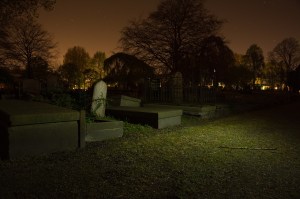 Summer is over. Nights are stretching out, and days are growing colder. Leaves are falling from the trees.
 In American Werewolf, we start on the Yorkshire Moors (slightly creepy because it’s night-time, but still relatively ‘normal’), and then go to London. It is relatively easy to imagine a monster stalking a dark, misty moorland, but surely not in a modern city.
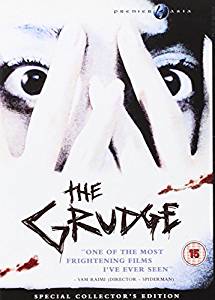 This is a classic case of ‘less is more’, and I’d like to give another example. In the original version of The Grudge, there is a scene with the main character having a shower, and a hand appears, rubbing her hair. There is no indication where this hand comes from — it’s suddenly there, touching her. She’s in the shower (an enclosed space) and she’s naked (and vulnerable), and suddenly there’s something else in there with her.
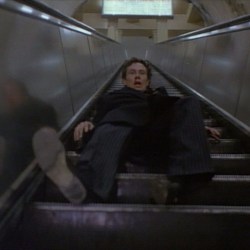 I’ll give another example, from one of the most memorable sequences in American Werewolf. We see a commuter stepping off a tube train. The train disappears into the tunnel, leaving him alone on a platform. He hears a noise, but he thinks nothing of it, and he carries on his way. The noise repeats, and he calls out, telling whoever it is that he doesn’t find this funny in the slightest. But there is definitely something around. He starts to get nervous. He walks faster, and then he starts to run.
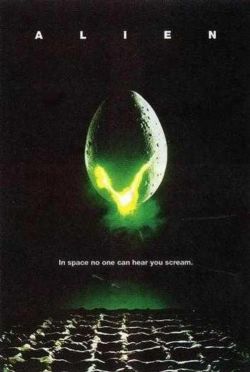 Alien saves the false ending for the final moments of the film. Ripley sets the Nostromo to self-destruct, then races to reach the escape pod (after finding the ship’s cat, of course). There are sirens blaring, and lights flashing, and the alien is somewhere on the ship. It’s a great sequence, and when she finally seals herself into the escape pod and ejects, and the Nostromo explodes, we feel her relief.
 Maybe. But the idea doesn’t make the story. It could be turned into something amazing, or end up run-of-the-mill, or even terrible. It could be a success, but it could just as easily be a failure.
 But even that only goes so far. Imagine two writers have the same initial idea, and map out identical story outlines. They have the same characters and settings. But the finished stories would be different. One might be heavy on poetic descriptions, where the other is filled with fast-paced dialogue. One might have a gritty edge, and the other might go for a softer, more family-friendly approach. One might stress the outer struggle of the characters while the other focused on their internal dilemmas.
 I first read William Kotzwinkle’s novelisation of ET: The Extra-Terrestrial when it came out, back in 1982. I remember enjoying it, and I can also recall thinking that it felt like a ‘grown-up book’. It had some rude words in it, and for a young boy this was a definite plus-point.
 So, there you have a few of the things I picked up on while reading the Tube Riders trilogy. As you can no doubt tell, I was impressed. I’m going to be following Chris Ward from now on, reading more of his books (and his newsletters — he asks some interesting questions). He’s my kind of author—exciting, entertaining, and instructive.
 Ignorance
 Audience
 Discovery
 So did I waste my time reading Twilight and Fifty Shades? If I read slowly, and took a few months to get through them, I would say yes. If I continually read books I didn’t think I’d enjoy, again I’d say yes. But if I read widely, and step outside my comfort zone every now and them, reading ‘unenjoyable’ books is not a waste of time. Just so long as I know why I am doing it.
 There are two types of fiction books—literary and genre. At least, that is what perceived wisdom seems to say. There are the ‘deep’ novels that win awards, and then there are the exciting, throwaway stories that are pure entertainment. And within the genre field, there are many subcategories, each with its own rules and guidelines, its own expectations and fan-bases.
 A couple of years ago I read a book called Clownfellas, by Carlton Mellick III, in which the mafia consisted of clowns, who were a different species (I think). The book was funny and violent, and definitely strange. It didn’t fit in any one category, and I thoroughly enjoyed it.
 These three books are connected by the fact that they all deal with topics that could be considered religious conspiracy theories. They all use biblical passages and other quotes to back up some fairly far-out ideas.
 Of course, once you realise this, it’s easy to question everyone—especially those who talk or write well. So maybe that poorly written book with the wild theories is closer to the truth, and Umberto Eco is simply having a clever laugh at the gullible masses. Maybe we should trust those who come across as less skilled or less intelligent, because they can’t lie as subtly or be as creative with their words.
 TW Iain