New short story – ‘They Need To Learn’

Another short story for you. After a serious one last time (Waiting), this time I’ve gone for something lighter (you’ll understand when you get to the end). It’s called They Need To Learn, and you can read it here.

I’ve got over thirty short stories on the site now, so if this one piques your interest, try a few others. The full list can be found here.

I’m also working on an e-book of the first twenty stories‌—‌ideal if reading web-pages isn’t your thing.  Hopefully, that should be out in a few days (maybe even by the time you read this).

And, as always, I’d love to hear what people thought of this story, or any of the others. Add a comment on the page, or send me an e-mail.

Enjoy reading.

The Problem With Accents

I listened to a free audiobook of Dracula a while back. The narrators were all volunteers, and each took a separate chapter. Of course, the quality varied‌—‌some went for a drawn-out reading to heighten the dread, others went with a more conversational tone. There were some interesting mispronunciations, too, which might be down to a 19th century book by an English novelist being read by American narrators‌—‌language changes over time and place, after all.

Then there were the accents. Most of the narrators read in a single voice, but some used accents for occasional characters. This was most usually Van Helsing, and I believe his lines are written with a hint of his Eastern-European pronunciation.

The main characters in the book are ‘educated’, and all speak with proper diction (with the exception of Van Helsing), but they occasional encounter ‘locals’, who would naturally speak in dialect (mainly in the sections set around Whitby, so we’re talking Yorkshire accents here). For one of these, Stoker writes the dialogue as the character would speak.

nosferatu-1-615x349The narrator for this chapter did his best, and I don’t mean to mock him. I know I could do no better with, say, a Texas accent. I don’t even know if the narrator had ever heard a Yorkshire accent before attempting to read Stoker’s text. But the accent he narrated in didn’t work. You know Dick Van Dyke’s ‘cockney’ accent in Mary Poppins? Imagine that combined with the occasional Scottish twang, and you’ll have a rough idea what this Yorkshire character sounded like.

Again, I want to stress that this was a free audiobook, narrated by volunteers. They all did a far better job than I could do.

But it got me thinking about accents in books.

The standard advice for writing is to be careful with accents. If you have to ‘write accents’, don’t overdo it. The aim is to convey a flavour of the voice, but the text always has to be understandable. Add too much authenticity, and things go wrong.

This might sound counter-intuitive, but spoken and written language are two different things. Just listen to how people normally talk, and then imagine this written down. How many times do people ‘umm’ and ‘ahh’? How many sentences are left unfinished? How much is repeated? Even when people are telling a story of what happened to them, their words will not translate perfectly to text.

“So, like, I says to him, um, ‘you want this or not?’, right, and he’s all like ‘I don’t know’, and so, um, I say ‘but it’s your favourite’, and he’s still, like, unsure, um, so, like, I don’t know, is he winding me up or I don’t know, why doesn’t he want it, I don’t know.”

You get the idea.

So the advice with accents is to be sparing.

“Aye, they came up from the South, like they allus do.”
“You talkin’ to me, son?”

The odd word, the occasional missed letter. It helps give a flavour of the accent while still being readable.

Too much can be hard to read, and I think this is down to how we are taught to read, and the way our brain decodes the written word. Initially, we learn letters, and use these letters to make up words and parts of words. We learn that ‘ough’ is sounded ‘oooh’ in words like ‘through, and ‘ohh’ in words like ‘though’. Gradually, out brain starts to decipher these combinations automatically, and we no longer have to sound out individual letters and sort them into groups. Instead, we glance at a word and instantly understand it. This is when we really start reading.

But with words written in accent, we have to go back a step. The words look wrong, and our brains have to resort to mentally sounding a letter at a time. The odd dropped letter (walkin’, ‘ope), especially when signalled with an apostrophe, isn’t too bad. Bu’ a rendrin ah th’slurrd word a slip aht in t’heat o’normal torkin is allus a buggr t’unnerstan’. Even with apostrophes.

That’s why too much ‘accent’ in writing is a problem.

But there are authors who use this to great effect.Trainspotting_IrvineWelsh
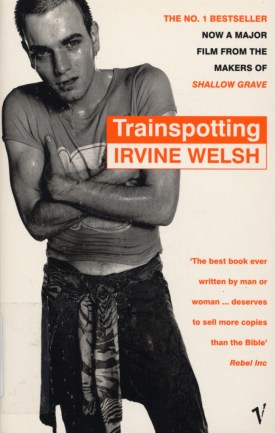
One obvious example is Irvine Welsh, especially in Trainspotting. The story is set in Scotland, and is told through a series of incidents from different characters’ points of view. At first, it is hard to read. Welsh doesn’t only render the dialogue in accents, but also the prose. At first glance, a page can look like it is written in a different language entirely.

But with a little perseverance, it becomes easier to understand. And the language fits the story. We’re in the heads of these characters, and Welsh uses the accented language to see the world through their perspective. It makes the book far more immersive than it would have been if he’d ‘written properly.’

FeersumEndjinn_IainMBanksAnother book comes to mind here, and although it’s not written ‘in accent’, it is still relevant. That book is Iain M Banks’ Feersum Enjin. Take a little time over that title, and you’ll get an idea where I’m going with this.

(I haven’t read this book for a good few years, so apologies for being a little hazy here.)

The story is split between a number of viewpoint characters. One of these is written almost phonetically (and this is shown in the title‌—‌Fearsome Engine, while being ‘correct’, just doesn’t work as well.) Banks also uses ‘text-speak’, using numbers and symbols to replace letters (so ‘into’ becomes ‘in2’, and ‘at’ becomes ‘@’).

Here’s the first line from this character’s sections, to give you a taste of it:

Woak up. Got dresd. Had brekfast. Spoke wif Ergate thi ant who sed itz juss been wurk wurk wurk 4 u lately master Bascule, Y doant u 1/2 a holiday? & I agreed & that woz how we decided we otter go 2 c Mr Zoliparia in this I-ball ov thi gargoyle Rosbirth.

(Incidentally, that was a pain to copy out. I’m used to typing, so deliberately mis-spelling things slowly me down.)

Why does Banks use this style of writing? Again, it is down to character. This character is young, with a naive outlook on life. The language reflects this, unhindered by convention and free to view things in an intuitive and original manner. Language is used to provide insight into the character.

And, as with the Scottish dialogue Welsh uses, it does become easier to read as you go along.

There are those who say that all writing should be like this. Every so often there are rumblings about written language being too tied up with rules that, on the face of it, make no sense, and that words should be spelt out as they are sounded.

I’m not going to get into a major discussion on this, but I will point out one of the major problems with this approach to spelling, and it comes back to accents. A word like ‘out’ might be spelt ‘auwt’, or maybe ‘owt’. But ‘owt’, in some parts of the country, is a word that means ‘anything’ (as in ‘you doing owt today?’). So if we came across a word spelt ‘owt’, what is the meaning of it? We’d need to decipher the surrounding words, using context to gain meaning. But if we see the word ‘out’, we know what it is because we have been taught that this combination of letters reflects a certain concept.

And this is the problem with phonetic spelling. Spoken language varies from country to country and from region to region, even when the language is ostensibly the same. The English language is spoken in many flavours across the world. If written English reflected that, its universality would be greatly reduced.

This is the thing to remember with writing accents‌—‌we write to be understood. If the accent gives an insight into the character or the setting, or brings a scene to life, then it has its place, if used carefully, like a dash of seasoning. But overuse creates a barrier, like heavy seasoning can mask other flavours. And then, the reader is pulled out of the story, just as I was listening to that strange accent in Dracula.

AllusionistLogoNote: I listen to a lot of podcasts. One of them, The Allusionist, is all about words and language, and it just so happens that the latest episode is all about accents. You can give it a listen here.
 

Does Writing Spoil Reading?

knowledge-1052010_1280I had a good friend who studied English at A-level. I was a little envious of that, until he told me that it pretty much put him off reading for pleasure. Whenever he read, he’d start analysing the sentences, and searching the subtext. He’d find himself comparing that book to others. Reading became an exercise, one that he no longer wanted to do. He said it took him years before he could pick up a book and simply enjoy it.
Of course, there’s nothing wrong with analysing and studying literature. But reading, at least reading fiction, is primarily a leisure activity. It should be fun, even while being scary or confusing or thought-provoking. It should be a pleasurable experience. Reading fiction should not be a chore.

I understood what my friend meant, at least in theory. But now, I’m starting to appreciate what he meant on a different level.

I’ve been writing seriously for a while now, and I’m constantly working to improve my craft. Obviously, that involves lots of writing, but reading is important too. There are all the ‘how to’ books, but becoming a critical reader of fiction is also extremely helpful.

I don’t use ‘critical’ in a negative way here, although there are increasingly times when I spot ‘mistakes’ in books I read, and find myself thinking of ways to improve the writing. Learning from the ‘mistakes’ of others is always useful, but learning how to do things ‘right’ is equally important. I’ll read a passage, then re-read it in an attempt to figure out how the author was using language.

TomorrowGene_PlattTruantI’ll give you an example from something I’ve read recently‌‌—‌The Tomorrow Gene by Sean Platt and Johnny B Truant. It’s another of their ‘big idea speculative thriller’ books. They always push the envelope with their books, and it’s been interesting to watch their development as writers.

The main character in this book is called Ephraim. It’s not a name I’m familiar with, and I’d imagine there are many others who are unsure how to pronounce it. The authors must have been aware of this potential difficulty, and so they include these lines of dialogue in an early scene:

“How do you prefer to be addressed? As Mr. Todd? Or as‌…” She peeked again at the tablet. “Eff-ryum?”
“It’s pronounced EEE-frum.” Then, unnecessarily, “It’s biblical.”

I read that, and had to stop. It impressed me. It’s a great way of telling the reader how to pronounce the name. It’s providing information through dialogue, in a way that feel natural and unforced. Even the added ‘it’s biblical’ comment isn’t random‌‌‌—‌‌it tells us that Ephraim has been asked about his strange name so often that explaining it becomes automatic. We gain insight into the character while being told, subtly, how to pronounce a tricky word.

If I wasn’t interested in writing, I doubt I would have dwelt on this. I might have realised what was happening, but it would have been a passing moment. I doubt the lines would have impressed me in quite the same way, and I’m pretty sure they wouldn’t have pulled me out of the story.

Johnny and Sean intended their craft to be invisible, and for the reader to remain in the story, but I had totally the opposite reaction.

I was analysing rather than simply enjoying, and I now understood, on a different level, how my friend had problems simply enjoying reading.

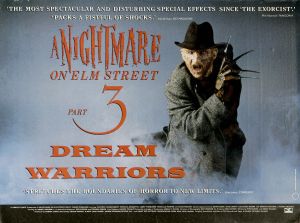
nightmare_on_elm_street_3_poster_02This isn’t the first time I’ve experienced something like this. I can recall, years ago, watching the third Nightmare On Elm Street film in a cinema. There is one scene where one character has tendons pulled from their hands and feet, turning them into a puppet. When this came on screen, there were definite sounds of discomfort around me, but I can clearly remember thinking ‘how did they do that and make it look so good?’
I used to watch a lot of DVDs (remember them?), and if I had the choice, I’d always go for the ‘special edition’ with all the behind-the-scenes footage and ‘making of’ features. I’d re-watch the film, maybe with the director’s commentary, and I’d find so many little things I hadn’t noticed first time round. Knowing how a particular sequence was created, and the camera tricks it used, added another layer to my enjoyment of the film.

Maybe there’s always been a part of me that is interested in what is happening behind the camera, or beneath the page. Maybe that’s why I found Stephen King’s Danse Macabre so interesting, and can still recall his explanation of how he slows the pace just before a scary moment in his books. And maybe that’s why being an avid reader has not been enough, and I have to write.

As I learn more about the craft of writing, I spot more and more examples (both good and bad) in books. In some ways, this means that I have lost a certain innocence in reading‌‌—‌I can’t experience the thrill of the story in quite the same way as someone who is able to read purely for pleasure. But it does not meant that reading is no longer enjoyable for me. I simply come to the story from a different angle, and see different things in the writing. Not better or worse, but simply different.

EdenExperiment_PlattTruantBut back to The Tomorrow Gene. The authors run an occasional podcast, called Backstory, where they go behind the writing of one of their books (and they refer to these are their ‘DVD extras’, so it’s no surprise that they interest me). They posted one recently that talked about the whole Tomorrow Gene trilogy, even though they’d only released the first book. I believe they did this by accident, because a few days later they’d taken this podcast down‌—‌but I’d already downloaded it, so I gave it a listen.

Maybe I shouldn’t have done so, because they discuss certain plot twists that occur in the second and third books. But I’ve listened to it now, and I can’t un-listen (although the books deal with mind and memory manipulation, so maybe one day…)

I’ve since read The Eden Project, the second book, and I found it better than the first. Yes, I felt like I knew more than I should have done, but it was still a great read, and I’m looking forward to the release of the third book. Knowing what’s coming hasn’t spoilt the books for me. If anything, I’m looking forward to finding out how the authors build up to, and then reveal, their big surprises.

So does writing spoil reading?

No. It adds another layer of understanding, and another angle of approach. It opens up more levels of appreciation.

As someone who is writing more and more, reading is now both a learning experience and a leisure activity. Depending on the book, I now have more scope for immersing myself in the writing.

And if reading is making me a better writer, then writing is also making me a better reader.

Why Ideas Are Not (That) Important

I’ve got an idea for a story. It’s great. It’s got this wonderful twist, one that turns everything on it’s head. See, what happens is….

But I don’t want to tell you. Not yet. See, you might take it and use it yourself. Then it wouldn’t be anything special when I write it. I don’t want to let this idea go. It’s that good.

Okay. I’m excited. I’ll tell you. See, it’s set in our world, but there’s an alien race living amongst us. They have been for years.

What do you mean, it’s been done before? I haven’t got to the good bit yet. See, this hero character stumbles upon the truth, and it looks like this alien race are trying to take us over. They do stuff like rig elections, and make sure there are all these dodgy additives in food.

Okay, okay, so that’s been done before. But you still haven’t let me get to the proper bit yet. There’s this twist.

You going to shut up and let me finish?

Thank you.

So this hero’s being guided by some secret organisation, and they’re trying to fight these aliens. They don’t want to be taken over. But our hero, he stumbles upon something. And it changes everything.

See, these aliens know that humans are dying out. They’ve known for years. And they came down, not to take us over, but to help us. Instead of wanting to destroy us, they are trying to save us.

Neat twist, right?

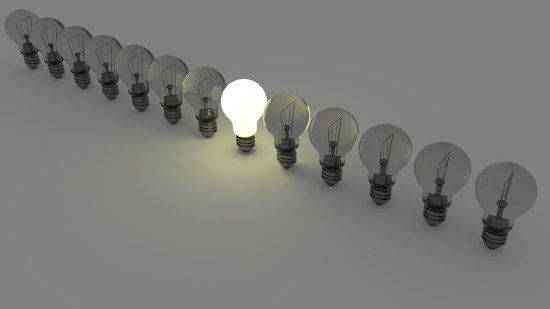
light-bulbs-1125016_1280Maybe. But the idea doesn’t make the story. It could be turned into something amazing, or end up run-of-the-mill, or even terrible. It could be a success, but it could just as easily be a failure.

Why? Because ideas are not important.

Okay, that’s an over-generalisation. Obviously, it is important to have an idea before writing, or before creating anything. You need to know, or at least have an inkling, where the story is going. You need to have a starting point, be that an interesting character, some event, or simply a concept (what if we used scent as our main means of communication? Oh, The Simpsons got there first – ‘Smell ya later!’).

But the idea in itself is nowhere near as important as the execution.

Don’t believe me? Think of any story you like — book, film, TV show, doesn’t matter. Now boil the story down to a single sentence, the idea around which everything else hangs.

Here’s one. Young person forced to leave home and fight, eventually triumphing over evil.

Sound familiar? It’s Star Wars, right? Or maybe (if you take ‘person’ to mean ‘person-like being’) it’s Lord Of The Rings. Or countless other stories.

Now think of a concept for a story. Try this one. The world is an illusion.

Cool-sounding concept. It’s The Matrix.

Or is it The Wizard Of Oz, where everything turns out to be a dream? Maybe it’s The Truman Show.

Three very different stories, but they could have come from the same initial idea.

The initial idea isn’t that important. It’s what you do with it that matters.

light-2674160_1280But even that only goes so far. Imagine two writers have the same initial idea, and map out identical story outlines. They have the same characters and settings. But the finished stories would be different. One might be heavy on poetic descriptions, where the other is filled with fast-paced dialogue. One might have a gritty edge, and the other might go for a softer, more family-friendly approach. One might stress the outer struggle of the characters while the other focused on their internal dilemmas.
Same ideas, different outcomes.

There is something else to consider when thinking about ideas. And that is the sheer abundance of them.

Don’t believe me? Coming up with ideas is easy. Look around yourself, or think about the things around you. Pick two different objects. Now combine them.

I’m going to pick a train set and an exercise bike for this example, as they are both things that are (sometimes) in our conservatory. My first thought on combining these is this; the power from the exercise bike is fed to the train set. While I pedal, the train runs. When I stop, the train stops.

Not a great idea, but let’s run with it. Imagine this train set is somehow a real railway system. When I pedal, I enable real trains to run. Obviously, that would take more than one person using an exercise bike. So there’s a whole bank of us, all pedalling furiously, so that the trains run on time. Our hard work enables all those business bods to get to work.

We can’t afford to stop, because then the transport network grinds to a halt. It’s not only about commuters. There are goods to transport as well. And, in this imaginary world, rail is the major transportation system. So those of us pedalling like mad are truly keeping the world running.

It’s a sweatshop.

This idea has legs (like the ones pedalling round and round). It raised so many questions. Are we pedalling through choice, or because we are forced to? Who is overseeing the pedal stations? What happens when the cyclists revolt? What happens when someone realises that pedal power could be used for other purposes?

Another example, again from our conservatory. There’s a plant in a pot on a table, and another in a pot on the floor. Which one is superior? The one on the table possibly has a ‘higher’ starting position, but the one on the floor is larger, and takes up more overall space. They are at different sides of the room. Is this because they can’t stand to be near each other?

So now my mind’s going off in all kinds of directions. Plants are intelligent. Maybe they have the ability to move themselves. Maybe the plants have been planning a takeover, rebelling against their treatment at the hands of humans. Eventually, they will start selective breeding programs, producing humans with more pleasing features, or ones that grow quicker. Maybe they will find a way of breeding humans through budding. Then some mad plant scientist will create a hybrid, part plant and part human. Fauna sapiens or something.

Sounds like it might end up as a comedy, but again that depends on the execution. Compare Day of the Triffids to Little Shop of Horrors.

See? I came up with a cool idea, and others have already beaten me to it. But that doesn’t matter, because the idea is only the starting point.

It’s what I do with it that is important. And that’s when the real work starts.

‘Life Story’ – new short story

Life Story is a new short, free to read here.

Everyone tells stories. When you tell someone what you’ve done that day, it’s a story. When you relate a tale from your childhood, you’re a storyteller. But stories always have an angle. And sometimes, the stories we tell are fabrications.

But any story, once told, is alive.

You are the story you tell.

Read Life Story here, and check out more free shorts here. And, as usual, I’d love to know what you think.

What do you read?

What do you read?

I’ve never been a fan of that question, and my standard response is to say ‘I read books.’ Yes, this answer is glib, and it’s also inaccurate, or at least incomplete. Ignoring the whole issue of what a book is (is it a physical thing, or are we ready to accept mobi and epub files as books?), I read other things. There are posts and articles online, and magazines. When I get a new CD I’ll read through the accompanying booklet. And I’m one of those strange people who actually reads instructions when they get something new.

But when people ask what you read, that isn’t what they want to hear. Usually, they mean to ask ‘what kind of fiction do you like to read?’

I find this really hard to answer.

Loads of books!

I could say I enjoy speculative fiction, but many are unfamiliar with that term. This means I have to explain that it is fiction that stretches the imagination, often in alternative settings. It encompasses fantasy and science fiction, as well as horror. But this includes a plethora of sub-genres, and there are many books in this wide-open field that I have not enjoyed. To be honest, some high fantasy bores me, and hard military sci-fi often veers towards a gung-ho attitude I struggle with. And while I am drawn towards darker fiction, I appreciate the occasional blast of humour, and a light-weight ‘fun’ read can be an excellent mental palate-cleanser.

But I enjoy other types of fiction too. I picked up one of Bernard Cornwell’s Sharpe books a few months ago, and greatly enjoyed it. James Clavell’s Shogun is another recent read that impressed me, especially in the way the romance is handled. Then there are all the fantastic classics. Wuthering Heights is a favourite, and I enjoy Thomas Hardy’s novels. And there are the ‘literary’ authors on my list of favourites; Iain Banks, Cormac McCarthy, Douglas Coupland, Chuck Palahniuk.

Then there are newer authors, ones I have come across because of the e-book revolution. Chris Ward, Barry Hutchinson, Sean Platt & Johnny B Truant, Mark Dawson, Rick Gualtieri. These are authors whose writing I enjoy, and who tell good stories. What particular flavour of story, what genre, isn’t important to me, because I trust them to entertain me. Maybe they’ll make me laugh, or maybe they’ll make me think. They might take me on an exhilarating thrill ride, or they might make me shiver with dread.

I think I’m drawn to characters more than plot, but I’ve read Colin Dexter’s Inspector Morse books a few times, and it is the mystery in each that draws me in. I might say story is important, but American Psycho is wonderful because of the way Bret Easton Ellis uses language, and the way he writes such a compelling but nasty character with only the barest of linear structures. The story is secondary (at best) to the character, and the ideas behind the writing are more important than the narrative drive.

I enjoyed Umberto Eco’s The Name Of The Rose, but I’m not sure if this was because of the mystery, or the amount of information it contained, or the challenge of reading something that made me think. Or maybe it was because the book is one of those ‘must read’ books, and I wanted to know what I thought of it.

So you see my problem with the question ‘what do you read’. I read different books for different things. I am drawn in by exciting stories just as much as well-crafted sentences or wonderfully-drawn characters. Sometimes I want a roller-coaster read, other times I want to drift into a new world. Sometimes I want to be challenged, other times I want popcorn. I can forgive clumsy prose if the story pulls me along, but I also appreciate artistic use of language.

Every book is unique. Every book that appeals to me does so for its own reason, and each book I read gives me something new.

So maybe saying ‘I read books’ isn’t such a flippant answer after all.