If I don’t like a book that others love, am I wrong?

bad-review-2813741_640This happens quite often: I start reading a book, and within a few pages I find myself thrown out of the story. Maybe there are too many grammatical errors, or the story doesn’t make sense, or possibly the writing is bland and uninspiring. I’ve read too many books in need of an edit, and sympathise with those who moan at the amateur nature of independently-published books.

But I don’t like to give up on books, so I plough through to the end, inwardly moaning about the hours of my time I’m wasting.

feedback-2800867_640Then I’ll pop on to Amazon or Goodreads, interested to read what others thought of the book. And I’ll be confronted with pages of five-star reviews. They’ll praise the exciting story (that I considered tedious and predictable), or the wonderful characters (that I found to be cardboard cut-out cliches). These reviews talk of the enjoyment they got from the story, and how much they’re looking forward to that author’s next book.

This happens often enough that I wonder if I missed something, or if my judgement on books is awry.

But it isn’t. What I think of a particular book is what I think of it. It’s my personal opinion.

There is no right or wrong here. Everyone is different. What I look for in a good book will not necessarily correspond with others’ idea of an enjoyable read.

Other people will have different opinions.

Some readers can’t get past more than a handful of grammar issues, but others don’t even notice the mistakes. Some readers are turned off by bland descriptions, while others are enraptured with the dialogue in the very same book. Some people enjoy the richness of the language, while to others the words are nothing more than a way of getting the story across.

Everyone is different, in both their preferences and what they expect from a book. An author like Dan Brown is often frowned upon by those who prefer more intellectual books (whatever they are), but he has far more readers than any of the year’s Booker nominees. James Joyce’s works are considered classics by some, and undreadable nonsense by others. Some people relate to Twilight‘s Bella, and others find her a nonentity.

This doesn’t only happen in books, of course. A new art-house film might receive outstanding reviews from film critics, but it will never come close to making as much money as the latest big-budget effects-driven spectacular. The latest pop music sensation will easily outsell a band that is pushing the boundaries of music. Sometimes, a musician might straddle both ‘popular’ and ‘experimental’ music, but they are rare indeed. Bjork continues to produce challenging music, but she is no longer the ‘popular’ artist she was when she had hits with tracks such as ‘It’s Oh So Quiet’ or ‘Human Behaviour’.

So if her older music was more popular, is it better than her latest stuff?

That’s not a sensible question. It’s different. Each album is what it is. Just as each book by each author is what it is. As every author is individual, so is every reader. Every reader is seeking something different from a book.
pair-707505_640So no, I’m not in the wrong if I don’t enjoy a book that others view as a classic. I might not have the same opinion as the majority of others, but that doesn’t mean I’m wrong. Just different.

And that is why reviews can only ever be guidelines. For all the importance placed on them, especially in the independent-publishing field, they are not fact. A load of good reviews might mean that the book is popular, but they are still only the opinions of individuals.

Of course, reviews have their uses. If a review favourably compares a book to one of your favourites, of it that reviewer has given positive reviews to other books you like, then you might want to check the book out. If the reviews talk about plot twists, or evocative language, or snappy, sarcastic dialogue, and you enjoy these things, then it’s more likely that you will agree with their opinion of the book.

Negative reviews can be ‘positive’ in guiding a reader to a book too. If you enjoy violence and lots of swearing in your books, and a negative review decries the coarse language and gore-filled descriptions, this might be the book for you. If the reviewer moans that the sappy relationship gets in the way of the mystery, but you like romance stories, that could be a good sign.

So is there a lesson in this? If there is, it is probably to take reviews with a pinch of salt. Read them, yes. Take note of the thoughts of others. But don’t take their word as anything other than their personal opinions. Understand that when you read the book, you are doing so for yourself, not for them. Remember that you can think for yourself, and you can reach your own conclusions.

If you disagree with a review, it’s not a case of right and wrong, just a difference of opinion.

My Reading Year 2017

Another year over. Where does the time go (and all those usual cliches)? But this is a good opportunity to reflect and to look forward, and in that spirit I thought I’d look back at some of my reading highlights of 2017.

I started keeping a log of all the books I read at the start of the year, and that tells me I read roughly 25 non-fiction books (mainly about writing and publishing), 25 novellas and 80 novels (and quite a few short stories, either on their own or in anthologies). They have been both traditionally published and independently published (with the latter probably in the majority, simply because I started using Instafreebie earlier in the year), and span a range of genres (some of which are not what I would normally read).
So, some highlights.

The new-to-me author who has been around for ages

It’s often said that even an old book is new to someone who has not yet read it, and I’ve read quite a few older books for the first time this year. This includes Old Man’s War by John Scalzi (which I enjoyed, although it felt a little rushed), A Falcon Flies by Wilbur Smith (not the kind of thing I’d normally read, but I’m definitely interested in reading more) and Sharpe’s Tiger by Bernard Cornwell (which was a great read, even though I don’t often go for historical war novels. I think it worked for me because it focused on the character of Sharpe rather than the historical details). But the one that impressed me the most was Brandon Sanderson’s first Mistborn novel, The Final Empire.

FinalEmpireMistborn1_BrandonSandersonI’ve heard Sanderson talk on the Writing Excuses podcast, so I expected something well written, and I was not disappointed. It’s long (pushing a thousand pages if I remember correctly), but never felt long-winded. Often, by the time I’m three-quarters through a book (of any length), I’m already thinking of what I want to read next, but I never reached that point with Mistborn.

I loved the magic system, and the way it worked almost like a science, with a clear set of rules. Again, I’ve heard Sanderson mention how he believes all magic systems need rules, and reading this novel showed me exactly what he means.

I already have more in this series on my to-be-read list, and can see Sanderson becoming one of my favourite authors.

The sci-fi/comedy that continues to work

Most combinations that include comedy fail. The humour might be annoying or puerile, and often the story takes a back-seat in the set-up to the next joke. Even something like the Hitch-Hiker’s Guide To The Galaxy series (which I love, despite what I am about to say) often feels like a series of cool, funny moments shoe-horned into a story-arc (possibly because this was how Douglas Adams wrote it, having no idea where it was headed).

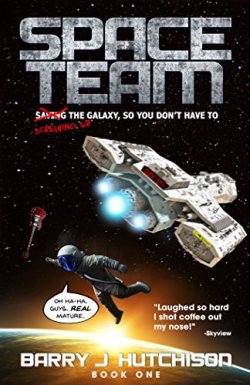
But it can be done. Terry Pratchett did it expertly in many of the Discworld books, and Harry Harrison did a good job with his Bill The Galactic Hero books. And now, Barry Hutchison has written a series that strike just the right balance between humour and story.

SpaceTeam_BarryJHutchinsonHe released the first Space Team book back in 2016, but is now up to number seven (and has a spin-off with another couple of novels), and I don’t know how he puts out consistently good books so fast. The stories stand up on their own, with the humour based around the characters and the situations, but the stories stand up on their own too. The characters have also grown over the series, with ‘throw-away’ back-story helping to develop the characters even more.

If you like Douglas Adams, I’d recommend Space Team (and the first book is only 99p/99c, so what have you got to lose?)

The story-studio that continues to impress

I’ve been following the books (and writing careers) of the Sterling And Stone team for a few years now. They continually push the boundaries of independent publishing, and are unafraid to try new (or old) ideas. They started their author careers with serialised fiction, and have written sci-fi, horror, thriller, literary (and, under pen-names, children’s fiction and romance). They will write an unashamedly commercial series like Invasion, but also write books simply because they want to, like Crash.

DevilMayCare_PlattTruantThe three authors on the team usually write in pairs, so you either get a Sean Platt/Johnny B Truant book, or a Sean Platt/David Wright book. So far, I’ve enjoyed the ideas more in the former, but get a kick out of the darker writing of the latter.

This year, they’ve produced three things that have impressed me. First, the Platt/Truant literary book Devil May Care. It’s a kind of road trip book, with two story-lines that are related (and I won’t spoil things by saying how they connect, although I think I figured it out a good while before the authors intended). It doesn’t quite work for me, but I admire how Platt and Truant constantly push their writing in different directions‌—‌and there are moments, especially nearer the beginning, that contain some of the finest writing they have produced to date.

TomorrowGene_PlattTruantThey also published The Tomorrow Gene trilogy of sci-fi/thrillers, based around cloning. They billed this as the spiritual follow-up to their Invasion series, and it is clear that they were aiming for something commercial. But the ideas are definitely not dumbed-down, and these are intelligent reads. Also, each book has a different feel. The first begins fairly languidly, which suits the story perfectly, and the unsettling elements are allowed to creep in at their own pace. The second is incredibly fast-moving, with loads of action. The third deals more with conspiracies and lies, and is a more psychological book. Yet all three work well together.

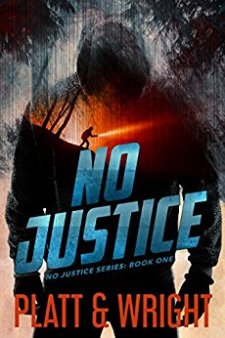
NoJustice_PlattWrightAnd finally, there is the Platt/Wright book No Justice. It is a very dark book, very unsettling, but this is a strength of their writing. The protagonist, the guy we’re supposed to be rooting for, is a vigilante, and he does some things that push the reader’s empathy. Yet this adds to the tension‌—‌you’re never sure if he’s going to go too far and become a full-on villain. Also, giving point-of-view scenes from the antagonist (a paedophile who kidnaps and later kills children) is a brave move, with disturbing moments where he justifies his abhorrent actions.

These books aren’t for everyone, but if you like to be challenged by what you read, and are not afraid of being unsettled, I’d recommend them.

The Dystopian series that taught me how to do it

TubeRiders_ChrisWardAlong with Barry Hutchison, I’ve found another new favourite author this year in Chris Ward. He wrote the Tube Rider trilogy, and I loved the books. They are based in a future UK that is separated from the rest of Europe (these books were written before the Brexit vote, but now they feel worryingly possible), and the main characters are youngsters who ‘tube ride’ for kicks (grabbing hold of moving underground trains and hanging off the side). Of course, they see things they aren’t supposed to, and the story soon has them fleeing for their lives.

I love how Ward deals with the characters. None of them are perfect, and sometimes even the good characters do the wrong thing, occasionally for purely selfish reasons. He sets up the notion of ‘nobody is guaranteed to be a hero’ early on by having one of the gang betray the rest and then die‌—‌which also sets up the expectation that nobody is guaranteed to survive. The villains are very believable, with clear, logical reasons for their actions, and all have the possibility of redemption (whether that happens or not is a different matter, and I’m not going to give any spoilers). And the world Ward creates is frighteningly realistic and plausible.

For more of my thoughts on the Tube Riders series, click here.

I intend to read more of Ward’s books over 2018, including his new YA series, Endinfinium (starting with Benjamin Forrest And The School At The End Of The World).

Revisiting old books‌—‌not always a good move

I’ll re-read old books every now and then, but some of the ones I’ve returned to this year have left me questioning how I rated them so highly. I suppose I was more impressionable as a teenager when I first read James Herbert’s The Rats and the sequel, Lair, but now the prose feels somewhat clunky, and the stories don’t interest me as much. Robert R McCammon’s Baal read like a series of separate but connected stories, and Dean Koontz’s Watchers had story arcs that I felt could have been ignored for much of the time. I can’t help wondering how much of this ‘padding’ was at the request of the publisher, to make the book a certain length.

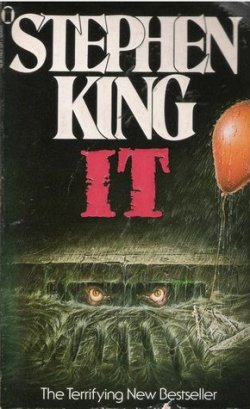
It_StephenKingI also re-read Stephen King’s It. I can’t recall what I thought of it when I read it when it first came out, but I’m in two minds now. There are parts I love, but overall it felt too long and repetitive. Some of the creepy horror is excellent, though, and King is a master writer. One of those books where the parts are more impressive than the whole, and it hasn’t put me off re-visiting more of King’s books (or reading his newer novels).

The novelisation of the original Star Wars film was a disappointment (I’ve written about this in a previous post, which you can read here), but I did enjoy listening to the audio-book of the ET novelisation (and you can read more of my thoughts on this here). I read this years ago, and I’m sure I didn’t get a lot of the subtext when I was younger, especially the mother’s thoughts.

A perfect shorter story

AllQuietOnTheWesternFold_JamieBrindleI’ll finish with a shorter work I really enjoyed — All Quiet In The Western Fold by Jamie Brindle. Imagine stories exist as living, breathing characters, in a wild west kind of setting. Stories are becoming sick, though, and the new sheriff has to investigate.

If that sound a bit strange, it is. But it is so well written, and manages to be serious and playful at the same time. For example, take this description:

High Sheriff Grok was a huge fat story, with thick wads of excess characterisation around his jowls and a pair of ugly similes that hung like ammo belts around his chest.

It’s a joy to read stuff like this, but the story itself is also intriguing, and makes me want to read more by Brindle. In fact, I have some of his books on my to-be-read list.


I have a lot of books on this list — far too many. Next year I need to stop downloading so much and get through more of the list (hard to do‌—‌I’ve already added a few more books over the holidays).

So, what else for next year? I’ve already mentioned wanting to read more from the authors above, but I also want to get back into some of the classics. A couple of years back I set myself the challenge of getting through all of Balzac’s Comedie Humaine (something like a hundred titles ranging from shorts to 500-page novels), and I don’t think I read any in 2017.

I’m also wanting to discover more new (to me) authors, so if you have any recommendations, I’d love to hear them. I prefer darker, more thoughtful stuff, but I’m open to just about anything (I’ve even read Fifty Shades, although I’m sure I shouldn’t have been laughing quite so much).

So, here’s to a good year of reading in 2018.


What is a book worth?

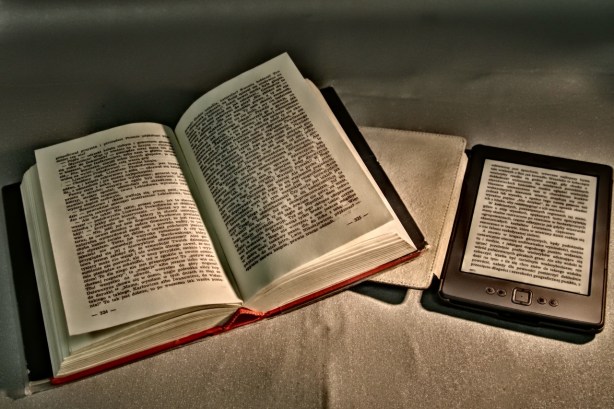
That’s a very ambiguous question. To narrow it down a bit, I’ll only consider fiction here, and will define a book as an object containing a text version of a story. Generally, this is either a physical book (paperback or hardback) or an electronic version (audiobooks have another layer of performance, so I’m discounting them for this discussion.)

reading-1249273_1280One measure of worth is money, so how much do we pay for books? In the UK, a paperback is generally between five and ten pounds, and a hardback around twenty. E-book pricing varies considerably‌—‌there are the free or 99p books, right up to about twenty pounds.

Why the difference in prices? So let’s consider what we are actually paying for.

When we buy a paperback or hardback, we exchange money for a physical object. Yes, we can read it, but we can also display it on our shelves. We can admire it as a thing in itself.

But with an e-book, we received a string of zeros and ones that are stored on a hard-drive somewhere. Our computers (phones, e-readers or whatever we use) translate this information into the words we read and the pictures we see. But ultimately, it’s just data.
It’s the same story in both versions‌—‌the only difference is in the means of delivery. Any difference in price should therefore reflect the costs involved in creating and distributing these different versions.

write-593333_640Think about what it takes to turn a story into a book. There is all the work the author puts in‌—‌planning, research, writing, re-writing and editing. There are external editors and proofreaders. This goes for all books, electronic and physical.
But after this, things diverge. For a physical book, the pages are formatted, then proof-read (in the original sense of the term‌—‌checking the proof copy, and not just looking for spelling and grammatical errors). These pages are then sent to the printer, who creates the physical book itself from materials the printing company purchases. The book is bound, with a cover that includes front, back and spine. The book is stored and, when requested, shipped to stores. These stores have their own overheads to cover‌—‌rent on the building, wages for staff, store furniture and power etc. This is true for both bricks-and-mortar and on-line sellers.

And all this, apart from the creation of the original proofs, needs to be repeated for each book sold.

Now consider an e-book. Once the text is completed, it is formatted, and a cover designed. These files are then uploaded to a seller, be that an independent website or a company like Amazon or Kobo. The seller requires a server etc., but the costs are far less than for the storage of a physical object. And there is no need to create a new e-book for each sale made‌—‌the original is simply copied digitally.

From the above, it seems pretty clear to me that the cost of bringing an e-book to a reader is far lower than getting a physical book in their hands, and for this reason alone it makes sense that paper books should be priced higher.

Yet this is not always the case. I often see e-books priced the same as paperbacks (normally by traditional publishers). I have seen e-books priced the same as a hardback, even though the paperback is under half that amount. And I can see no possible justification for this.


But that is only part of the question I first posed. This is price as a reflection of the manufacturing cost. This is the price of the book as an object.

once-upon-a-time-719174_1280Books, as a means of conveying a story, have a value in the words themselves, and the artistry and craft that are displayed in the writing. What we value in a book is the experience of reading.
And this is where things become far harder to quantify. How much would you pay for entertainment?

We could consider time. If we are willing to pay, say, ten pounds to watch a two-hour film, should a novel that takes five hours be worth over twenty pounds? If that were the case, a book like War And Peace might be over a hundred pounds. I can imagine someone paying that much for a rare edition, but I’ve seen paperback copies for around £0.99.

But it would be wrong to assume there is a correlation between quantity and quality. Is Stephen King’s It worth five times the value of Animal Farm? Much as I enjoy both books, I wouldn’t agree with this statement. In fact, many smaller books outclass longer stories. To me, The Hitch-Hiker’s Guide To The Galaxy and Fight Club are far more enjoyable than, say, George RR Martin’s Game Of Thrones / Song of Ice And Fire books. And I know that sentence will upset some people, but that’s just me and my reading tastes.


light-bulbs-1125016_1280Which gives us another issue to consider‌—‌everyone is different. One person’s life-changing entertainment will be wasted hours to another. The same books could be considered a thrilling roller-coaster ride or a hideous excuse for gratuitous violence and bad language. A thrilling tale might be gratuitous violence and bad language to someone else. One person might value well-crafted prose, but another might find more of value in a finely-tuned story. One person might get swept up in rich descriptions, and another might be drawn into snappy, sarcastic dialogue.
In other words, two people will consider the same book to have different worth. I might baulk at buying the next book Martin release, even if it was on special offer, but others will gladly spend twenty pounds on the hardback version, then buy another copy when that one wears out. To them, the book is worth far more than it is to me.

Because value is about more than money. What we pay for something, and it’s value, are not always connected. Some of the best books I have read‌—‌the books that I value‌—‌did not cost me a great deal, but there are other ways I can pay the author, and other ways I can demonstrate how much I believe that book is worth. Some of my new-found favourite authors can rely on me to keep buying their books. I can tell others what I think, and I can write reviews (or mention books and authors when I’m writing here). Some fans draw art based on their most valued books, or write fan-fiction. Some buy electronic, physical and audio versions. Others frequent author websites, or follow the author on social media.


So the question ‘how much is a book worth’ now encompasses more than money. It involves time and effort. A good book is worth our undivided attention for a number of hours. A good book is worth thinking about, and maybe revisiting.

It has been said that any object is only worth what someone will pay for it, but this needs to be extended. A story is worth the money you pay for it, the time you spend reading it, and the effort you expend in thinking about it.

What is a book worth? Ultimately, it depends on both the reader and the book.

Whose voice do you hear when you read?

When you read, do you hear the words in your head? And if you do, whose voice do you hear?

For me, the voice I hear is fairly nondescript, a bit like the one I hear when I talk. To me, it has no accent and no distinguishing features. But sometimes, another voice takes over.

Most of the time this is because of films. When I re-read Fight Club after seeing the film, I could hear Ed Norton narrating it (and I could also picture him, Brad Pitt and the rest of the cast‌—‌great book, great film). When I read Hitch-Hiker’s Guide To The Galaxy I hear the voices from the original radio show in the dialogue, and Peter Jones (who played ‘the book’ in both radio and TV versions) for the rest. Even in the later books, it is Peter Jones’ voice that is reading the words to me.

This makes sense. If the film (TV show/radio show/whatever) is done well and complements the book, they almost merge to become one thing. If they are different, or if they don’t connect so much in my mind, then I revert to my generic voice. So, when I read Daphne du Maurier’s story The Birds, it is so different to the Hitchcock film that there is no cross-over. Similarly, although there have been some TV adaptations of Terry Pratchet’s books, they haven’t been as good as the books, so I don’t automatically connect them in the same way.

Most of the time, the voice-from-the-film effect works well for me. But sometimes, hearing different voices can be a distraction.

group-1825503_1280I’m a fan of the Sterling & Stone guys‌—‌Sean Platt, Johnny B Truant and David Wright. Not all of their books work perfectly for me, but they’re never afraid to try something different, and their books are always work reading. And when they’re good, they’re fantastic. Yesterday’s Gone, overall, was wonderful. Crash was a gem of a book. I love Unicorn Western, and The Beam is constantly intriguing. And their Tomorrow’s Gene trilogy is a current favourite of mine.

They also produce a weekly podcasts. Although they generally stick to the topic in these shows, there is a natural banter between them that often takes them off in other directions. They’ve even taken this off-topic stuff into its own show (Worst Show Ever).

They’ve been doing this for years, and I think I’ve listened to just about everything they’ve done. I’ve had their voices in my ears for hours and hours.

Maybe this isn’t too healthy.

Their written work reflects the way they speak. They’ve even done readings of a couple of their books. And now, when I read anything they’ve written, I hear it in their voices.

For their non-fiction, like Iterate And Optimize, this makes sense. These books are supposed to teach me things, after all, and they are the teachers. Rather than their non-fiction being lists of instructions, it becomes personal advice. In The One With All The Advice (where they pull writing advice from different episodes of Friends), it adds a great deal to my enjoyment of the book.

But this also happens in their fiction. This started becoming obvious to me in the last few books in their Invasion series, and has carried on with everything they’ve written since that. Even with Dead City, which they first released in audio format as a separate podcast, narrated by Scott Brick—‌when I read the book, I still heard their voices.

Mainly Sean’s. Probably because he talks most on their podcasts, and he’s involved in just about every book they produce.

I’m starting to find this distracting. Maybe that’s because I’m noticing it more often.

Some people might suggest this is a problem with their writing, but it is clear that they are improving in their craft all the time (their latest ‘literary’ novel, Devil May Care, might not be a total success, but it contains some of the finest writing they’ve done to date).

It’s often said that the writer should be invisible, and that the story (and the characters) should be everything. But every writer has their own voice, which becomes more identifiable as they progress in their writing journey. Unless they are specifically trying to write like someone else, their books will all be ‘theirs’. And if, as a reader, you identify with their voice strongly, it is natural that you will hear the story being read to you in their voice.

Which, ultimately, isn’t necessarily a bad thing. We often choose books because we enjoy a particular writer’s work, and that usually means their voice resonates with us in some way. With the rise of podcasts and videos, writers are becoming more accessible‌—‌we don’t have to wait for a book-signing to see or hear our favourite authors any more. The connection between the writer and their work is more apparent than it ever has been.

So I guess I’m looking forward to having Johnny, Sean or Dave reading their next book in my head.

As I’m writing this, I’m wondering something else‌—‌whose voice are you hearing right now? I doubt it’s mine (because only a few of you will have heard me speak). Is it your own internal voice, or some kind of ‘generic blog post’ voice? I’m British, but if you’re from somewhere else, do you hear it with an English accent or your own, or is it some kind of mid-Atlantic thing? If you’re British, does this read with a northern or southern accent, or a hint of west-country? Has that voice changed over the last few sentences?

And how much of this has pulled you away from the words as you try to listen to the voice in your head? Have I messed up your reading?

Maybe listening to the voices in your head isn’t such a great idea.

Why read dark fiction?

A couple of weeks ago, I looked at some of the things that makes a scary story work (you can read that post here). Today, I want to explore the appeal of horror and dark fiction.

fantasy-2847724_640Horror is a strange genre. It used to be a sub-genre of ‘speculative fiction’, along with fantasy and science-fiction, and writers like Lovecraft blended all three. But now, it doesn’t quite fit. Where some science fiction is considered serious and literary, horror is more likely to be thought of as ‘nasty stories’. Where fantasy creates whole new worlds, horror is (generally) stuck in the real world, with a few supernatural elements thrown in‌—‌and ghosts aren’t in the same league as dragons and elves.

Science fiction and fantasy sell far more, and have a larger fan-base. Horror has been left behind.

Yet there are many important horror works, like Frankenstein and Dracula. Stephen King is considered a horror author, and he is one of the most popular writers around. The genre has in part been responsible for influential TV shows, like X-Files, Buffy and The Twilight Zone (and even Doctor Who uses monsters and other horror tropes). There are shades of horror in literary books like Cormac McCarthy’s The Road. Some of the best-known sci-fi franchises have their roots in horror, like Alien. Without horror, the whole urban fantasy and paranormal romance genres (think Twilight) would not exist, and those stories continue to draw in many readers.

Then there are the ghost stories, and the monsters that everyone knows about‌—‌vampires, zombies, werewolves. There are ghost trains at the funfair. There are the costumes at Halloween.

For a derided genre, horror is incredibly influential.

So what is the appeal? Why do we enjoy stories that terrify us?

cliff-1209263_640I used to work at outdoor activity centres, and as part of this I would take people abseiling. Grabbing hold of a rope and leaning over a drop isn’t a natural thing to do, and many people would (quite sensibly) be scared. They’d be shaking. They’d need coaxing over the edge. Despite all the assurances that it was perfectly safe, they’d imagine the worst.

But they’d do it anyway. They might be swearing under their breath the whole way down, and they might need another instructor by their sides, encouraging them for each tiny step, but they’d reach the bottom. And then, legs shaking and heart hammering, they’d smile.

They’d done it. They’d conquered their fears and survived. They’d pushed themselves through their terror, and they’d overcome. Even if they never abseiled again, they could be proud of what they had achieved. Often, they would give it another go. Or they’d remember how they overcame their nerves, and push themselves a little further on the next activity.

Maybe you’re starting to see where I’m going with this.

For most of us, our lives are comfortable. We wake up, we go to work or do whatever else fills our day, we move around freely, we relax in safety at home, and then we go to sleep.
The news warns us of the dangers out there‌—‌the murderers, the rapists, the paedophiles. It brings us images of natural disasters, and of atrocities brought about by others. Yet most of us will not encounter any of this in reality. It is news because it is rare. If it were commonplace, it would not be reported with anything like the same intensity.

So we are safe.

Yet there is a part of us that thrives on adrenaline. Sometimes, conflict is good. We need that risk, and we need to push ourselves. Sometimes, we need to grab that rope and dangle a hundred feet from the ground.

It is often said that, when times are bad, people look to feel-good escapism in their entertainment, and when times are good darker fiction grows in popularity. And this makes sense‌—‌we need both security and tension. Inactivity, physically and mentally (spiritually and emotionally?), is bad for us.

roller-coaster-654081_640It explains why roller-coasters are popular. We know they are safe (again, the accidents are reported because they are anomalies), but they give the illusion of danger. Hurtling around a twisting track, being thrown upside-down, with the screams of others in our ears, gives us an adrenaline rush. And afterwards, we can smile and laugh about it, because we’ve survived.
Thrillers are often described as ‘roller-coaster reads’, because they take us on a thrilling journey, with twists and turns that toss us about unexpectedly. And horror does something similar.

In any fiction, there has to be tension. The higher the stakes, the greater this tension, and the more we are drawn into the story. We fear for the hero, knowing that they face something terrifying. In thrillers, this is death‌—‌from the villain’s gun, or the bomb the hero is racing to diffuse, or from the trap they have found themselves in. But in horror, it is damnation. In horror, death is not the worst that can happen.

In vampire legends a bite can turn the victim into one of the undead, cursed for all eternity. Ghosts come back from beyond the grave, and threaten to take us to places we can hardly imagine. In apocalyptic horror, like McCarthy’s The Road, those who have died are the lucky ones, escaping the hell that the survivors must endure. In Thomas Harris’ Silence Of The Lambs, Hannibal is not scary because he kills, but because of how he desecrates his victims bodies. In King’s The Shining, Jack Torrence becomes a monster, no longer himself, and turns on his own family.

This is the stuff of nightmares. Life and death are constants, but damnation, and the torture of the soul‌—‌that is terrifying.

Like the person queueing for the roller-coaster ride, or the person putting on their harness at the top of the cliff, a part of us is drawn to the terror. As much as it disturbs us, we want to know what is out there. It’s like an itch that won’t go away.

Horror stories allow us to scratch that itch. They allows us to confront dark forces. As much as logic might tell us that monsters and supernatural forces don’t exist, there’s always that ‘but what if…’, and dark fiction gives us possible answers to that. It lets us in on a world that makes the unreal real, and unleashes our nightmares.

But in a controlled manner. Just as we trust the designers and operators of the roller-coaster, or the person belaying the rope at the top of the cliff, so we trust the storyteller to bring us through to the end. Whatever happens along the way, we will survive. And then we can walk away, our need for adrenaline satisfied, and our fears conquered. We can emerge from the darkness to look around and appreciate all the good things we have in our lives.

This is another huge appeal of horror, even if it is subconscious‌—‌there is an end. No matter how bad things get, there is always a way through. Even though there may be (are?) things out there we cannot understand or even comprehend, we are survivors. Despite (or because of) the darkness, there is always hope. Good will triumph over evil. The vampire will be slain. The monster will be defeated. The night will end. There is always a new dawn.

And, when there is so much going on in the world over which we have no control, that has to be a comfort.


Why re-read?

book-1975830_640Some people never read a book more than once, arguing that there is no enjoyment if they already know the ending. Others have their favourite books that they return to time and time again. Some people read Lord Of The Rings every year. I’ve met someone who appeared to be reading Fifty Shades constantly (must be some S&M thing).
I have a long list of new books to read, but I still find myself re-reading older ones. So why?

I think there are three possible reasons.

Familiarity and comfort

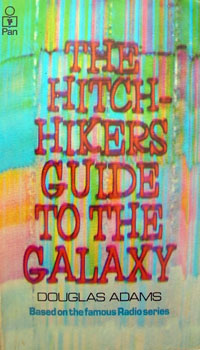
HitchHikers_DouglasAdamsI’ve read Hitch-hiker’s Guide To The Galaxy so often that now I only have to look at the page and the words flow from my memory. And every so often, I will binge re-read the Discworld books. I know what’s coming, but I still enjoy the storytelling and the humour. They make me smile, no matter how many times I read them.
We enjoy comfort, and that includes mental comfort. So re-reading a book we know we enjoy can be a settling experience, especially when other aspects of our lives might be going through changes. Familiar books are something steady we can cling to.

Sometimes, it is not so much the book but the memories connected with it. I’ll always associate Tolstoy’s War And Peace and Louis de Bernieres’ Birds Without Wings with caravan holidays, and Asimov’s original Foundation books remind me of my grandparents’ house. And Thomas Hardy, strangely, puts me in a summery mood, simply because I can recall reading some of his books on an old Sony Reader in our garden one summer, when it was warm enough to wear shorts.

Reading familiar books can be like listening to a favourite song or re-watching a favourite film. It’s a break from reality, but one that makes us feel relaxed and comfortable.

Re-assessing

Over time, everyone changes. We grow, we take on new ideas and we reject old ones. We see the world through different eyes, coloured by the experiences of our on-going lives.

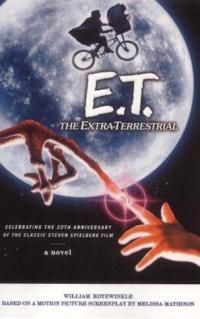
ET_WilliamKotzwinkleIt can be interesting revisiting books we enjoyed when we were growing up. Sometimes the books seem too childish, and we wonder if we were ever really taken in by them. Sometimes we are disappointed by the book (as I was when I re-read the original Star Wars novelisation a bit ago). And sometimes we see new things. When I revisited ET recently, there were things I was sure I’d missed before, simply because I’d been too young to understand what William Kotzwinkle was hinting at.
I read a great deal of horror as a teenager, and it’s been interesting re-reading some of my favourites from that time. Some stand up well, like The Shining‌—‌although obviously a story of a family cut off from the rest of the world is going to have a different impact on a father than it does on a teenager. Others were a disappointment, like James Herbert’s The Rats. I can see why I enjoyed this before, but for the adult me it was nothing special (apologies to any Herbert fans, although I did enjoy Ash when I read that a couple of years ago).

I don’t watch many films now, but in the past these have given me the nudge to re-read certain books, and the visuals have enabled me to see the words in a different light. One strong example of this is Fight Club, a rare phenomenon where both book and film are excellent. On re-reading, I could hear Ed Norton’s voice, and it made for a great reading experience.

So re-reading with fresh eyes can alter the perception of a book, for better or for worse.

Digging deeper

At first, this might appear to be the same as revisiting, but there are subtle differences. I’ll revisit a book when I’m not sure what I think of it, or when something triggers a fresh look. But certain books have depths that I know I have not yet mined, and I will re-read them because I want to uncover more of their secrets.

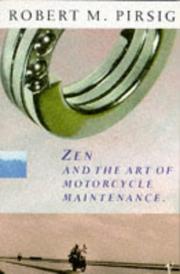
ZenMotorcycleMaintenance_RobertMPirsigZen And The Art Of Motorcycle Maintenance is the most obvious example. This book is a journey into ideas, set against a father-and-son motorcycle ride across America. At times the thoughts and questions it poses are almost too dense, and every time I read it I pick up on something new. Between my first and second readings, I spent a bit of time reading Plato, and this influenced how I understood Prisig’s inquiries into the meaning of quality. Later, the relationship between the father and the son had a greater impact on me, simply because I was able to relate to that situation. And having recently found out that Prisig’s son was murdered some years after the book came out, the next time I read it I am sure that will colour what I take from it.

Yet there are still things to uncover in the ideas in the book. It doesn’t lecture, but guides, and what I bring to the reading is as important as the words itself.

In contrast, I’ll re-read American Psycho because I want to understand how that book works on a technical level. I think it’s a classic. There are so many different ways of interpreting it (comment on consumerism? Study of sociopathy? Discussion on desires?). There’s no clear story, and at times it seems to drift along as random thoughts (two pages on the pros and cons of Huey Lewis and the News, anyone?). But it works, and it’s clear that Bret Easton Ellis knew exactly what he was doing. So I’ll re-read it, paying attention to how he uses words and phrases, and how he structures it.

I suppose this is more of an intellectual enjoyment than an emotional one, but I’m re-reading with the same purpose‌—‌to delve deeper into the book in order to discover more of its secrets.

* * *

So, three reasons why I will re-read a book. There are probably more (like re-reading a book simply because I’ve forgotten that I read it a few years ago), but these will do for the moment. I’m sure there are people who will argue that I am wasting my time‌—‌for all I get out of re-reading, wouldn’t that time be better spent reading one of the thousands of books I have yet to read? They might have a point, but I’m never going to read everything I want to anyway. And I don’t see reading as a tick-list activity. It’s about enjoyment and entertainment, and if I can get that from re-reading, there’s no reason to stop.

The Problem With Accents

I listened to a free audiobook of Dracula a while back. The narrators were all volunteers, and each took a separate chapter. Of course, the quality varied‌—‌some went for a drawn-out reading to heighten the dread, others went with a more conversational tone. There were some interesting mispronunciations, too, which might be down to a 19th century book by an English novelist being read by American narrators‌—‌language changes over time and place, after all.

Then there were the accents. Most of the narrators read in a single voice, but some used accents for occasional characters. This was most usually Van Helsing, and I believe his lines are written with a hint of his Eastern-European pronunciation.

The main characters in the book are ‘educated’, and all speak with proper diction (with the exception of Van Helsing), but they occasional encounter ‘locals’, who would naturally speak in dialect (mainly in the sections set around Whitby, so we’re talking Yorkshire accents here). For one of these, Stoker writes the dialogue as the character would speak.

nosferatu-1-615x349The narrator for this chapter did his best, and I don’t mean to mock him. I know I could do no better with, say, a Texas accent. I don’t even know if the narrator had ever heard a Yorkshire accent before attempting to read Stoker’s text. But the accent he narrated in didn’t work. You know Dick Van Dyke’s ‘cockney’ accent in Mary Poppins? Imagine that combined with the occasional Scottish twang, and you’ll have a rough idea what this Yorkshire character sounded like.
Again, I want to stress that this was a free audiobook, narrated by volunteers. They all did a far better job than I could do.

But it got me thinking about accents in books.

The standard advice for writing is to be careful with accents. If you have to ‘write accents’, don’t overdo it. The aim is to convey a flavour of the voice, but the text always has to be understandable. Add too much authenticity, and things go wrong.

This might sound counter-intuitive, but spoken and written language are two different things. Just listen to how people normally talk, and then imagine this written down. How many times do people ‘umm’ and ‘ahh’? How many sentences are left unfinished? How much is repeated? Even when people are telling a story of what happened to them, their words will not translate perfectly to text.

“So, like, I says to him, um, ‘you want this or not?’, right, and he’s all like ‘I don’t know’, and so, um, I say ‘but it’s your favourite’, and he’s still, like, unsure, um, so, like, I don’t know, is he winding me up or I don’t know, why doesn’t he want it, I don’t know.”

You get the idea.

So the advice with accents is to be sparing.

“Aye, they came up from the South, like they allus do.”
“You talkin’ to me, son?”

The odd word, the occasional missed letter. It helps give a flavour of the accent while still being readable.

Too much can be hard to read, and I think this is down to how we are taught to read, and the way our brain decodes the written word. Initially, we learn letters, and use these letters to make up words and parts of words. We learn that ‘ough’ is sounded ‘oooh’ in words like ‘through, and ‘ohh’ in words like ‘though’. Gradually, out brain starts to decipher these combinations automatically, and we no longer have to sound out individual letters and sort them into groups. Instead, we glance at a word and instantly understand it. This is when we really start reading.

But with words written in accent, we have to go back a step. The words look wrong, and our brains have to resort to mentally sounding a letter at a time. The odd dropped letter (walkin’, ‘ope), especially when signalled with an apostrophe, isn’t too bad. Bu’ a rendrin ah th’slurrd word a slip aht in t’heat o’normal torkin is allus a buggr t’unnerstan’. Even with apostrophes.

That’s why too much ‘accent’ in writing is a problem.

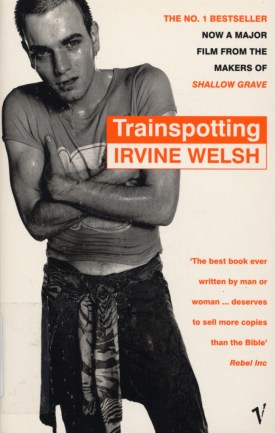
But there are authors who use this to great effect.Trainspotting_IrvineWelsh

One obvious example is Irvine Welsh, especially in Trainspotting. The story is set in Scotland, and is told through a series of incidents from different characters’ points of view. At first, it is hard to read. Welsh doesn’t only render the dialogue in accents, but also the prose. At first glance, a page can look like it is written in a different language entirely.

But with a little perseverance, it becomes easier to understand. And the language fits the story. We’re in the heads of these characters, and Welsh uses the accented language to see the world through their perspective. It makes the book far more immersive than it would have been if he’d ‘written properly.’

FeersumEndjinn_IainMBanksAnother book comes to mind here, and although it’s not written ‘in accent’, it is still relevant. That book is Iain M Banks’ Feersum Enjin. Take a little time over that title, and you’ll get an idea where I’m going with this.
(I haven’t read this book for a good few years, so apologies for being a little hazy here.)

The story is split between a number of viewpoint characters. One of these is written almost phonetically (and this is shown in the title‌—‌Fearsome Engine, while being ‘correct’, just doesn’t work as well.) Banks also uses ‘text-speak’, using numbers and symbols to replace letters (so ‘into’ becomes ‘in2’, and ‘at’ becomes ‘@’).

Here’s the first line from this character’s sections, to give you a taste of it:

Woak up. Got dresd. Had brekfast. Spoke wif Ergate thi ant who sed itz juss been wurk wurk wurk 4 u lately master Bascule, Y doant u 1/2 a holiday? & I agreed & that woz how we decided we otter go 2 c Mr Zoliparia in this I-ball ov thi gargoyle Rosbirth.

(Incidentally, that was a pain to copy out. I’m used to typing, so deliberately mis-spelling things slowly me down.)

Why does Banks use this style of writing? Again, it is down to character. This character is young, with a naive outlook on life. The language reflects this, unhindered by convention and free to view things in an intuitive and original manner. Language is used to provide insight into the character.

And, as with the Scottish dialogue Welsh uses, it does become easier to read as you go along.

There are those who say that all writing should be like this. Every so often there are rumblings about written language being too tied up with rules that, on the face of it, make no sense, and that words should be spelt out as they are sounded.

I’m not going to get into a major discussion on this, but I will point out one of the major problems with this approach to spelling, and it comes back to accents. A word like ‘out’ might be spelt ‘auwt’, or maybe ‘owt’. But ‘owt’, in some parts of the country, is a word that means ‘anything’ (as in ‘you doing owt today?’). So if we came across a word spelt ‘owt’, what is the meaning of it? We’d need to decipher the surrounding words, using context to gain meaning. But if we see the word ‘out’, we know what it is because we have been taught that this combination of letters reflects a certain concept.

And this is the problem with phonetic spelling. Spoken language varies from country to country and from region to region, even when the language is ostensibly the same. The English language is spoken in many flavours across the world. If written English reflected that, its universality would be greatly reduced.

This is the thing to remember with writing accents‌—‌we write to be understood. If the accent gives an insight into the character or the setting, or brings a scene to life, then it has its place, if used carefully, like a dash of seasoning. But overuse creates a barrier, like heavy seasoning can mask other flavours. And then, the reader is pulled out of the story, just as I was listening to that strange accent in Dracula.

AllusionistLogoNote: I listen to a lot of podcasts. One of them, The Allusionist, is all about words and language, and it just so happens that the latest episode is all about accents. You can give it a listen here.


Does Writing Spoil Reading?

knowledge-1052010_1280I had a good friend who studied English at A-level. I was a little envious of that, until he told me that it pretty much put him off reading for pleasure. Whenever he read, he’d start analysing the sentences, and searching the subtext. He’d find himself comparing that book to others. Reading became an exercise, one that he no longer wanted to do. He said it took him years before he could pick up a book and simply enjoy it.
Of course, there’s nothing wrong with analysing and studying literature. But reading, at least reading fiction, is primarily a leisure activity. It should be fun, even while being scary or confusing or thought-provoking. It should be a pleasurable experience. Reading fiction should not be a chore.

I understood what my friend meant, at least in theory. But now, I’m starting to appreciate what he meant on a different level.

I’ve been writing seriously for a while now, and I’m constantly working to improve my craft. Obviously, that involves lots of writing, but reading is important too. There are all the ‘how to’ books, but becoming a critical reader of fiction is also extremely helpful.

I don’t use ‘critical’ in a negative way here, although there are increasingly times when I spot ‘mistakes’ in books I read, and find myself thinking of ways to improve the writing. Learning from the ‘mistakes’ of others is always useful, but learning how to do things ‘right’ is equally important. I’ll read a passage, then re-read it in an attempt to figure out how the author was using language.

TomorrowGene_PlattTruantI’ll give you an example from something I’ve read recently‌‌—‌The Tomorrow Gene by Sean Platt and Johnny B Truant. It’s another of their ‘big idea speculative thriller’ books. They always push the envelope with their books, and it’s been interesting to watch their development as writers.

The main character in this book is called Ephraim. It’s not a name I’m familiar with, and I’d imagine there are many others who are unsure how to pronounce it. The authors must have been aware of this potential difficulty, and so they include these lines of dialogue in an early scene:

“How do you prefer to be addressed? As Mr. Todd? Or as‌…” She peeked again at the tablet. “Eff-ryum?”
“It’s pronounced EEE-frum.” Then, unnecessarily, “It’s biblical.”

I read that, and had to stop. It impressed me. It’s a great way of telling the reader how to pronounce the name. It’s providing information through dialogue, in a way that feel natural and unforced. Even the added ‘it’s biblical’ comment isn’t random‌‌‌—‌‌it tells us that Ephraim has been asked about his strange name so often that explaining it becomes automatic. We gain insight into the character while being told, subtly, how to pronounce a tricky word.

If I wasn’t interested in writing, I doubt I would have dwelt on this. I might have realised what was happening, but it would have been a passing moment. I doubt the lines would have impressed me in quite the same way, and I’m pretty sure they wouldn’t have pulled me out of the story.

Johnny and Sean intended their craft to be invisible, and for the reader to remain in the story, but I had totally the opposite reaction.

I was analysing rather than simply enjoying, and I now understood, on a different level, how my friend had problems simply enjoying reading.

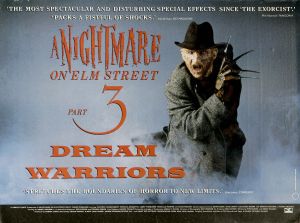
nightmare_on_elm_street_3_poster_02This isn’t the first time I’ve experienced something like this. I can recall, years ago, watching the third Nightmare On Elm Street film in a cinema. There is one scene where one character has tendons pulled from their hands and feet, turning them into a puppet. When this came on screen, there were definite sounds of discomfort around me, but I can clearly remember thinking ‘how did they do that and make it look so good?’

I used to watch a lot of DVDs (remember them?), and if I had the choice, I’d always go for the ‘special edition’ with all the behind-the-scenes footage and ‘making of’ features. I’d re-watch the film, maybe with the director’s commentary, and I’d find so many little things I hadn’t noticed first time round. Knowing how a particular sequence was created, and the camera tricks it used, added another layer to my enjoyment of the film.

Maybe there’s always been a part of me that is interested in what is happening behind the camera, or beneath the page. Maybe that’s why I found Stephen King’s Danse Macabre so interesting, and can still recall his explanation of how he slows the pace just before a scary moment in his books. And maybe that’s why being an avid reader has not been enough, and I have to write.

As I learn more about the craft of writing, I spot more and more examples (both good and bad) in books. In some ways, this means that I have lost a certain innocence in reading‌‌—‌I can’t experience the thrill of the story in quite the same way as someone who is able to read purely for pleasure. But it does not meant that reading is no longer enjoyable for me. I simply come to the story from a different angle, and see different things in the writing. Not better or worse, but simply different.

EdenExperiment_PlattTruantBut back to The Tomorrow Gene. The authors run an occasional podcast, called Backstory, where they go behind the writing of one of their books (and they refer to these are their ‘DVD extras’, so it’s no surprise that they interest me). They posted one recently that talked about the whole Tomorrow Gene trilogy, even though they’d only released the first book. I believe they did this by accident, because a few days later they’d taken this podcast down‌—‌but I’d already downloaded it, so I gave it a listen.

Maybe I shouldn’t have done so, because they discuss certain plot twists that occur in the second and third books. But I’ve listened to it now, and I can’t un-listen (although the books deal with mind and memory manipulation, so maybe one day…)

I’ve since read The Eden Project, the second book, and I found it better than the first. Yes, I felt like I knew more than I should have done, but it was still a great read, and I’m looking forward to the release of the third book. Knowing what’s coming hasn’t spoilt the books for me. If anything, I’m looking forward to finding out how the authors build up to, and then reveal, their big surprises.

So does writing spoil reading?

No. It adds another layer of understanding, and another angle of approach. It opens up more levels of appreciation.

As someone who is writing more and more, reading is now both a learning experience and a leisure activity. Depending on the book, I now have more scope for immersing myself in the writing.

And if reading is making me a better writer, then writing is also making me a better reader.

What do you read?

What do you read?

I’ve never been a fan of that question, and my standard response is to say ‘I read books.’ Yes, this answer is glib, and it’s also inaccurate, or at least incomplete. Ignoring the whole issue of what a book is (is it a physical thing, or are we ready to accept mobi and epub files as books?), I read other things. There are posts and articles online, and magazines. When I get a new CD I’ll read through the accompanying booklet. And I’m one of those strange people who actually reads instructions when they get something new.

But when people ask what you read, that isn’t what they want to hear. Usually, they mean to ask ‘what kind of fiction do you like to read?’

I find this really hard to answer.

Loads of books!

I could say I enjoy speculative fiction, but many are unfamiliar with that term. This means I have to explain that it is fiction that stretches the imagination, often in alternative settings. It encompasses fantasy and science fiction, as well as horror. But this includes a plethora of sub-genres, and there are many books in this wide-open field that I have not enjoyed. To be honest, some high fantasy bores me, and hard military sci-fi often veers towards a gung-ho attitude I struggle with. And while I am drawn towards darker fiction, I appreciate the occasional blast of humour, and a light-weight ‘fun’ read can be an excellent mental palate-cleanser.

But I enjoy other types of fiction too. I picked up one of Bernard Cornwell’s Sharpe books a few months ago, and greatly enjoyed it. James Clavell’s Shogun is another recent read that impressed me, especially in the way the romance is handled. Then there are all the fantastic classics. Wuthering Heights is a favourite, and I enjoy Thomas Hardy’s novels. And there are the ‘literary’ authors on my list of favourites; Iain Banks, Cormac McCarthy, Douglas Coupland, Chuck Palahniuk.

Then there are newer authors, ones I have come across because of the e-book revolution. Chris Ward, Barry Hutchinson, Sean Platt & Johnny B Truant, Mark Dawson, Rick Gualtieri. These are authors whose writing I enjoy, and who tell good stories. What particular flavour of story, what genre, isn’t important to me, because I trust them to entertain me. Maybe they’ll make me laugh, or maybe they’ll make me think. They might take me on an exhilarating thrill ride, or they might make me shiver with dread.

I think I’m drawn to characters more than plot, but I’ve read Colin Dexter’s Inspector Morse books a few times, and it is the mystery in each that draws me in. I might say story is important, but American Psycho is wonderful because of the way Bret Easton Ellis uses language, and the way he writes such a compelling but nasty character with only the barest of linear structures. The story is secondary (at best) to the character, and the ideas behind the writing are more important than the narrative drive.

I enjoyed Umberto Eco’s The Name Of The Rose, but I’m not sure if this was because of the mystery, or the amount of information it contained, or the challenge of reading something that made me think. Or maybe it was because the book is one of those ‘must read’ books, and I wanted to know what I thought of it.

So you see my problem with the question ‘what do you read’. I read different books for different things. I am drawn in by exciting stories just as much as well-crafted sentences or wonderfully-drawn characters. Sometimes I want a roller-coaster read, other times I want to drift into a new world. Sometimes I want to be challenged, other times I want popcorn. I can forgive clumsy prose if the story pulls me along, but I also appreciate artistic use of language.

Every book is unique. Every book that appeals to me does so for its own reason, and each book I read gives me something new.

So maybe saying ‘I read books’ isn’t such a flippant answer after all.

What I learned from reading ‘Tube Riders’

TubeRiders_series

I recently read the Tube Riders trilogy by Chris Ward, and I loved the books. It’s great when I come across an author who blows me away like this‌‌—‌it makes reading all those ‘so-so’ books (and worse) worth it all when you find a true gem.

I posted a short review on Goodreads (you can check it out here), but that looks at the trilogy from a reader’s perspective. However, while reading the books, there was so much I picked up on as a writer. As well as being enjoyable, entertaining reads, they were also instructive. Below are a few of the things that stood out.

Characters

I love the way the characters were written in these books. They are all three-dimensional, and they all change over time. When their is dialogue, they have distinctive voices. And they also all have their faults as well as their strengths.

An obvious example is the character of Stitch. He is one of the Tube Riders, which makes him one of the heroes, but he has a nasty side, and at times he comes across as very selfish. Or maybe he’s so used to having to look out for himself that others are secondary‌—‌after painting him as a slightly unsavoury character, we get a glimpse of the hardness of his life. It’s easy to understand why he’s wary of anyone new, and maybe we can understand why someone like Stitch would use violence to solve his problems.

Yet he is also loyal, and throughout the books you kind of know he will come through for the others in the end.

Then there are the baddies.

In the first book, one of the agents after the Tube Riders is Clayton. He wants to capture them, so he’s clearly a baddie. But he’s working for the government because he believes that is the right thing to do. And, as that first book progresses, he comes up against other government agents, and we see how not all ‘baddies’ are the same. Clayton is not mindlessly following orders‌—‌he genuinely wants to do what he believes to be right. And this brings him into conflict with other government agents, even though they are ‘on the same side’.

More interesting is the Governor. He’s the main villain of the trilogy, but the way he is written it is clear that he also believes in what he is doing. He is not afraid of making hard decisions, and is willing to make sacrifices (of others) for the greater good. And we get glimpses of his true motivations, which make us question our assumptions, at least for a while. Is he really evil, or just misguided? As the trilogy progresses, and he seems to become more unhinged, there was a part of me that wanted him to make the right decision, and to turn his back on his wrongdoing. Even up to the end, he has the potential for redemption.

I’m not going to say how he ends up‌—‌you’ll have to read the books to find out.

Nobody Is Safe

The protagonists in these books are young, but they are in a tough situation. Their world is nasty, and they take risks in part because of this. Death is in the air, even in their hobby of tube riding (jumping and ‘riding’ moving trains before leaping off to safety). In the first chapter, we hear of those who have died doing this.

But the heroes won’t die, right? They all need to survive to the end, don’t they?

In many books, that would be true. But Chris Ward does something near the start of Tube Riders that lets us know that nobody is safe.

I’m going to give a little of the story away, so if you want to read the books without spoilers, skip down to the next section. But this is something that happens near the start, so it’s not like I’m giving any of the main plot points away.

The Tube Riders have rivals, in the form of the Train Jumpers. Instead of leaping onto moving trains, they jump from platform to platform in front of trains, aiming to get as close as they can. The Train Jumpers hate the Tube Riders. And if that sound like petty, childish behaviour, remember that these characters are teens and young adults‌—‌acting childish is in their nature.

One of the Tube Riders feels dissatisfied with his gang, and he goes to the Train Jumpers, betraying his old gang. It’s a bit of a shock, so soon into the story. It makes us question the loyalty of all the Tube Riders‌—‌if one of them can defect, so could others.

Then something worse happens. The Jumpers seem to accept him, and as an initiation he has to join them in a jump. Yet this is a set-up. He is pushed as he is about to jump, and he falls under the train.

He’s only in the book for a few chapters, but he was one of the Tube Riders. He was one of the heroes. And now he’s dead. The stakes are raised for all the others‌—‌if one of the Tube Riders can die, none of them are safe.

This sets up more deaths as the books progress, and those deaths underline the overall uncertainty. It’s the same thing George RR Martin pulled in his Game Of Thrones books‌—‌kill off a main character, then nobody is safe.

The reader is no longer assured a happy ending.

A Trilogy Of Complete Stories

I was impressed with the structure of this trilogy. The story unfolds, with more and more intrigue and questions blossoming in the first book. Obviously, not all of these questions can be answered in a single book. You know, as a reader, that things will only be resolved at the end of the third book.

Yet there is no major cliffhanger between books. In each part of the trilogy, there is an arc, with its own satisfying conclusion.

This is so different to many other series I’ve read. Often, an ending seems in sight, but the author swerves at the very last moment, and leaves the main character in jeopardy. Sometimes, I’ll reach the end of a book, and it feels incomplete, like the author has simply chopped up a larger story.

This annoys me. Yes, leave questions unanswered. But I expect a book to end. I expect the author to craft a good story with a satisfying payoff at the end, even if I know there is more to come.

Chris Ward, as I have said above, manages to pull this off. If I read these books individually, over a year or so as they were released, I would not feel let down. I would close each one with a good feeling while still be anticipating the next one.

How does he manage this? By focusing on the main arc of that story. In the first book, the Tube Riders are trying to escape. Yes, we learn more about the Governor, and there are hints at what he is planning. There are characters who we just know have more of a part to play later on. But the escape is important, and when this arc is completed (spoiler alert‌—‌they escape), the book is finished.

As a trilogy, the conclusion works, although there is scope for more books (as you would expect with such an interesting world and a rich cast of characters). I understand that the author does not intend to write more sequels, but has not ruled out other stories set in the same world (in fact, there is a fourth book, filling in some of the time between the second and third in the trilogy. I’ll let you know what I think of this when I’ve read it).

The Writing Itself

I love the writing in these books.

We see events through different characters, and the prose in each character’s section has their voice, putting us in their heads wonderfully. As an example, when we are with Stitch, there is far more cursing in the descriptions, fitting his character. The Governor is colder, with less emotion in what he sees.

The dialogue feels so natural. I’ve already mentioned how characters have their own voices, but there was something else about the dialogue that impressed me. Often, rather than writing loads of history or backstory, authors will use dialogue to give the reader this information. However, this often feels unnatural and stilted. Not so in these books. The info-dumps are a natural part of the conversations, and we learn what the characters are learning.

There is a great deal of action in these books. This is promised from the very first scene, with the Tube Riders partaking of their potentially lethal hobby. Later there are chases, fights on the tops of moving trains,beatings, and loads of other exciting stuff.

I’ve read far too many books where the action reads like a description of a film‌—‌blow-by-blow fights, or sequences that simply have too much detail. And writing like that becomes tiresome very fast.

Chris Ward doesn’t fall into this trap. In every action scene, we stay with a main character, and experience it through their senses, filtered through their emotions. We might never see the bigger picture, but the chaos surrounding a scared individual fighting for their lives had far more impact, getting the adrenaline flowing and the heart pumping. And there is a reason for every action scene. We learn, through the fights, more about the characters, or about the world around them.

The action is not added simply to make the books more interesting. It is integral to the story, and the development of the characters.

TubeRiders_ChrisWardSo, there you have a few of the things I picked up on while reading the Tube Riders trilogy. As you can no doubt tell, I was impressed. I’m going to be following Chris Ward from now on, reading more of his books (and his newsletters — he asks some interesting questions). He’s my kind of author‌—‌exciting, entertaining, and instructive.

If this has piqued your interest, check out his books here. The first book in the Tube Riders trilogy is free, so you have no excuse!