I often find that dialogue can make or break a book. It might be snappy and sarcastic, or rich and evocative—and I’ll feel I’m in the scene with the characters. If the dialogue feels realistic, and drives the story on, I’m willing to forgive plot holes and clunky prose.
I also find long passages of prose rarely work (unless very well written). Even internal dialogue can help propel a scene forward.

But writing dialogue is hard. For starters, it needs to feel realistic, but it can’t be too realistic.
I recall an Kevin Smith interview, where someone commented on the natural way the characters in his films talked. He responded by saying that there was nothing natural about their dialogue. His characters go off onto rambling monologues while others listen—something that very rarely happens in real life. They’re not constantly being cut off, or using strings of filler words and sounds (‘um’, ‘er’, ‘like’ and so on), they don’t repeat themselves too often (‘So I said…and he says…then I say’). But his dialogue still feels natural, and that’s the important thing. He uses character-appropriate words and phrases to bring the spoken lines alive.
And this shows another aspect of good dialogue—it has to serve a purpose. In Smith’s case, much of the actual stories the characters tell one another seem only partially relevant to the story, but they reveal character, both in the words themselves and the way they are delivered. The same can be done in books—what a character says can reveal so much about who they are, in a far more natural way than simply being told.
For instance, a male character who peppers their conversation with words like ‘love’ and ‘dear’, especially when talking to younger women, comes across as condescending and sexist, even if the reader doesn’t consciously pick up on this. Likewise, a character who says ‘maybe’ and ‘I think’ a lot will often appear indecisive—so when they step up and make that all-important decision in a moment of crisis, we understand that they’re finally overcoming their inner demons.
Dialogue is also important for moving the story forward. Unfortunately, I’ve read far too many books where this is done poorly. Characters will say things like “Hey, you remember that time Bob broke into that old factory, and had to face all those vampires?” or “As you know, the master is due to return from his sojourn in the tropics any day now, but his mother still refuses to have the east wing redecorated, meaning she’s still in the suite next to his—and this is bound to cause a great deal of friction.”
Yes, these examples tell the reader possibly important information. But do they sound natural? Not at all. The characters are mentioning things other characters already know, merely to give us, the reader, information.
Another problem I’ve noticed with poorly written dialogue is the use of grammar.
Most people don’t talk with correct grammar. They use slang, and part-sentences. They’ll misuse words, or string words together in bizarre ways. It might be grammatically correct to say “We will leave as soon as we can,” but it sounds far more natural as “We’ll leave as soon as.”
Of course, some characters will speak ‘properly’—but even then, each character will have their own vocal idiosyncrasies. This is something I know I need to improve in my own writing. Some characters will speak in long, complicated sentences, others will use simpler constructions. Some will use dialect words, or enjoy showing off an extended vocabulary.
Dialogue can also indicate things about how each character experiences the world. One who focuses on visuals might say “I see”, whereas a character who’s more auditory might say “I hear you.”
With well-written dialogue, it should be clear who is talking from the spoken words themselves, and tags (“Bill said”, “Sheila asked”, and so on) are only needed as occasional reminders.
Writing dialogue that works well is hard—and it stands to reason that authors who can pull this off, who can use natural-sounding dialogue to develop characters and drive story, are also skilled at other areas of writing. After all, books are simply a means of telling stories. When we read a novel or a short story, we’re allowing the author to speak to us. Even when no characters in the story are talking, we’re still listening to the voice of the narrator.


 And, as with any bunch of co-workers forced together, there are tensions. Some of them get on well with others, but there’s a lot of animosity just beneath the surface. Just like any other work environment.
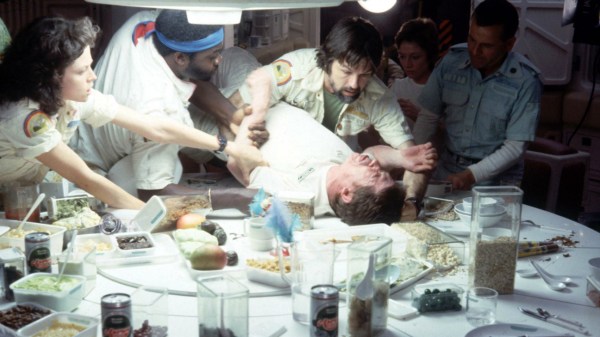 And this tells us that nowhere is safe. Even if characters are together, in brightly-lit familiar rooms, they’re still in danger. We don’t need to peer into the darkness looking for monsters, because they could leap out of anywhere, at any time.
 The rest of the crew are following his progress through the ducts. They have audio communication, but the only visual is on a map, with a marker to indicate his position. And then a second marker appears, indicating the alien’s position—and it’s closing in on Dallas. They yell for him to get out, but as the alien approaches there’s nothing they can do to prevent the inevitable.
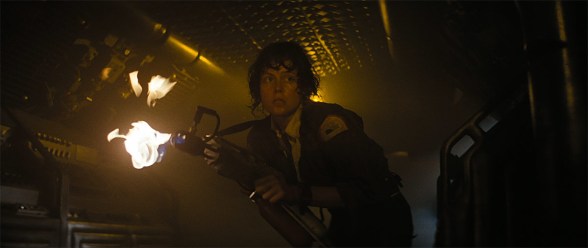 But she makes it. From the shuttle, she sees the Nostromo explode—and then realises she’s not alone on the shuttle. The alien is with her.


