If I Wanted Facts, I’d Read A Textbook

I recently bought a collection called Star Heroes: 9 Novels of Space Exploration, Aliens, and Adventure‌—‌9 novels for a ridiculously low price. As with anything that seems like too good a deal, I was initially dubious of the quality, but so far I have been pleasantly surprised.

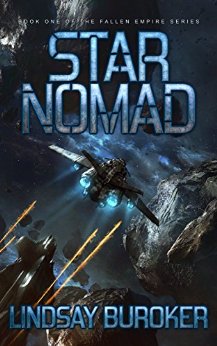
starnomad_lindsayburokerThe first novel in the collection is Star Nomad, a sci-fi adventure by Lindsay Buroker, and it is a very enjoyable read‌—‌lots of action, a fast-moving story, and an interesting cast of characters. I’ve already bought the next book in the series.

When I’d finished it, I popped onto Amazon and read some of the reviews. The vast majority were positive, but, as with any book, there were a few one-stars. Although I personally didn’t agree with these, one of the complaints against the book got me thinking. A couple of reviewers took Buroker to task over the weak science in the book, with one especially complaining about her apparent lack of understanding of how craft would move in space.

That comment made me think of another book I read recently, Neal Stephenson’s Seveneves‌—‌800 pages, with about half of them explaining the science behind what is happening. In this book, manoeuvring in space is a precise, drawn-out procedure that can take hours, days, or even longer. Everything moves at a slow pace, because that is more scientifically accurate.

I enjoyed that book, and it was clear that Stephenson had done a great deal of research. There is no way I can vouch for the technical details, but even if Stephenson invented parts of it, it reads like fact.

seveneves_nealstephensonBut it is a very different read to Buroker’s book. Where Stephenson starts with a premise (what would happen if the moon exploded?) and uses science to plot his story, Buroker is more interested in the action and adventure, and putting her characters in different situations to see how they cope. Where Seveneves is serious (most of the time), Star Nomad is escapism.
But I’m also reminded of Arthur C Clarke’s statement that ‘any sufficiently advanced technology is indistinguishable from magic’. Today, we can do things with technology that would astound someone from a century ago. We can hold an entire library on a small, hand-held device, or we can travel the globe in a matter of hours. We can control computers with our eyes, and cars can drive themselves. So, in books set in the far future, or in alternative universes or dimensions, who’s to say what can be done with science? Just because something is impossible today doesn’t mean it will always be so.

Both books are science-fiction, but there are two parts to that description. Stephenson is driven by the former, and Buroker is more concerned with the latter. Yet it should be remembered that these books are both fiction. They are invented stories, not factual accounts, and to fully appreciate them we have to buy into the implausibilities. Yes, the way Buroker’s heroine throws her craft around cannot be explained by science as we understand it, but so what? It’s a fun read. It’s entertainment. And it doesn’t pretend to be anything else.

When we read (or watch) fiction, we have to give ourselves that freedom to accept the ridiculous. It’s how we can enjoy James Bond films without concerning ourselves over the seemingly indestructible nature of Bond himself (how many lucky escapes can one man have?) It’s how cosy-mystery fans can ignore the implausibility of a Jessica Fletcher character who stumbles across, and solves, more murders over a series than many police officers would deal with in their whole careers. It’s how we can accept, for a couple of hours, that a hero can survive and win, despite being beaten so much that he should be in intensive care (see just about any action film for examples of this‌—‌most fights should be short and brutal, with both combatants soon out of breath or incapacitated from their injuries, not long drawn-out affairs with breaks for witty comments).

So were the negative reviews of Buroker’s book wrong? No. Reviews are personal opinions, not facts. And there is validity in the claim that her book is light on actual science. This clearly bothered some readers, and they would probably prefer something like Seveneves.

And that is fine. There are so, so many books out there. Even a specific genre like science-fiction contains a vast spectrum of books, including Stephenson’s hard sci-fi and Buroker’s sci-fi adventures. Not every book will appeal to every reader.

My opinion‌—‌and that is all it is‌—‌is that Star Nomad is a fun read, and gave me a few hours of solid entertainment. Which is exactly what I was looking for.

If I wanted to understand the science of space, I’d read a textbook.

Next short story – ‘Influential Friends’

Another short story for you‌—‌Influential Friends. You can read it here.

With these short stories, I’m exploring some of the characters that appear in the Dominions books. A Lesson In Death was about the main character, Rodin, and now it’s the turn of another characters, Genna.

She’s one of my favourite characters so far, even though she only plays a small part in the first book. She’s tough and smart, and she’s had to fight for everything she’s got. She’s the kind of person you’d definitely want on your side‌—‌you wouldn’t want to go up against her unless you had to.

From the first moment she appeared in Dark Glass, I knew there was far more to her, and as I work on Dominions IV, I’m delving into the vulnerabilities behind that rock-hard exterior. Her strengths, weaknesses, and her past are all being revealed, and it’s interesting watching her develop into one of the pivotal roles in the ongoing Dominions series.

But that book is not yet finished. For now, here’s a short story about one of my favourite characters. I hope you enjoy Influential Friends.

Dead Flesh (Dominions II) out now

Dead Flesh (Dominions II

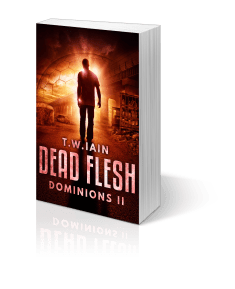
The second novel in the Dominions series, Dead Flesh, is now available from all major e-book stores.

I’m really pleased with the way this book turned out, although it started as something totally different. When I first planned what was then simply called ‘Dominions 2’, I wanted Rodin (the main character) to pull off a daring rescue, but I had to work out why a mercenary would care enough to do this without being paid. Before he could charge in and be a hero, I needed to explain how he came to question his purpose in life.

That book didn’t work out. I liked big parts of it, but there was simply too much story. I think the first draft came in at over 150,000 words, and I was aiming for 100,000. And at that, it still felt rushed. I needed to cut it back, but I also needed to expand it. There was the big rescue, and all the build-up to that. There was another whole section about the person who needed rescuing, and how they got caught. And then there was Rodin’s journey before this, the part that needed to be there for his actions to make any sense.

As I worked on this, I realised that the initial section, where Rodin had his crisis of conscience, was pretty strong on its own. I looked at this part in more detail, and it started to grow into its own thing. Soon, it was clear that Rodin’s journey alone would be the second Dominions novel. The rest of the story could wait for the next book (although that didn’t work out, either. Sometimes I don’t know why I bother trying to plan these stories!)

As I said before, I’m pleased with how this book turned out. It’s dark, but it also has heart. There’s lots of action, but there is also lots of introspection. It answers some of the questions posed in the first Dominions novel, but also opens more loops.

If that all sound intriguing, check it out – click here to find out where you can get Dead Flesh. And if you’re interested in the start of the Dominions series, check out Dark Glass.

And next month I’ll release the third novel, Deep Water.

If A Book Makes Me Feel Sick, I Know It’s Good Writing

When you think about it, reading fiction is a strange activity. It involves staring at symbols on a page or screen, ignoring all distractions, and yet it can take us to other worlds. We take this static information in through our eyes, and allow it to run through out minds, and yet it can open up whole realms of sensations. It involves nothing but words, but it can have such a deep effect on us. And sometimes that effect is physical.

I’ve heard it said that there are two genres that specifically go for this physical effect — horror and erotica (maybe that’s why James Herbert always managed to include a sex scene in his horror books). I can’t comment on the latter, but I have read quite a bit of horror, especially as a teenager. Stephen King, James Herbert, Peter Straub, Clive Barker — I’d get through loads of this stuff, and sometimes, when I put the book down, I wouldn’t want to walk around the house without the lights on. I’d get that tingle, that nagging ‘something’s waiting in the dark’ feeling.

So I got goose-bumps, and a shiver running down my spine. But
one book took me further. One book stands out — Iain Banks’ debut novel, The Wasp Factory.waspfactory_iainbanks

At the time it affected me so memorably, I was re-reading it. I’d enjoyed it first time round (strange how the word ‘enjoy’ can be used for something dark and disturbing), but couldn’t recall much of it. I was working shifts at the time, and needed something to keep me occupied on my breaks — and so, obviously, I took a book in to work, alongside my sandwiches.

So there I was, eating while I read another chapter, sitting on cheap plastic chairs in an empty factory canteen. And I reached a particular part of the book, where it describes the main character’s brother working in a hospital, looking after young children.

The scene (which I won’t even attempt to describe) was shocking, and as I read I felt my stomach churning. My cheeks puffed out with the sensation that I was about to vomit.

I had to stop reading for a while. I put the book down and let my stomach settle.

I wondered if there was something up with my sandwich, but it was fine. It wasn’t food that had made me feel nauseous, but words.

I returned to the book. I re-read that scene. It still made me feel uneasy.

Yet Banks didn’t describe any of the horrors I pictured in my head. There was a build-up, when the character realizes something is wrong. And then there is a jump, to a nurse entering the room and seeing the aftermath.

How could words make me feel ill, especially when so little had been described? How did Banks do it? He built up the scene, but he didn’t tell us exactly what was wrong. Only in the aftermath do we get a glimpse of it, and the whole thing is described in a few sentences (maybe even one — it’s a while since I’ve read it again).

Everything else is left to the imagination.

I believe that’s the key. If Banks had described the scene in detail, the words would have got in the way. I’m sure he would have written it well, but I doubt it would have had the same impact. Describing something is never as intimate as imagining it.

This idea works well in films. Compare the claustrophobic dread of Alien, where any dark spot in the shadows could be the creature, to the reduced impact in later films when the aliens are seen in their entirety. Think of the way the shark in Jaws is never seen for the first hour of the film, yet we know this unseen terror is there, waiting for its moment to strike. Think of the ending of Seven, where we never see what is in the box (despite what some people still believe), but our imagination fills in the blanks.

It’s arguably far harder to do in books, but writers like Iain Banks shows that is is possible. By describing around a scene, our imaginations are let loose, and the horrors we can summon up are far more personal. By choosing just the right words, an author like Banks can guide our thoughts to darker places. By using suggestion and hints, a great author can give a scene such startling realism that we become physically part of the world they have created.

factory-387868_640Sitting in that factory canteen in the middle of the night, I realized for the first time how words could trigger not only our minds but also our bodies.

And that book still impresses me. It has to. Other books have made me question things, or set my pulse racing. Other books have scared the hell out of me, or made me feel good about myself. But no other book has brought me so close to throwing up.

I should write a review for it, and limit myself to a couple of sentences. ‘This book almost made me lose my lunch. Five stars.’

Writing A Book – It’s More Than Just Writing

I’ve finally managed it! I’ve got a book out. I can go to Amazon (or Kobo, or a few other places) and see it, and it feels fantastic!

It’s taken over a year and a half, and it’s been a lot more work than I initially thought.

home-office-336378_1280

Back in January 2015, when I decided to get serious about writing, I didn’t think I was being naive. I knew I couldn’t type out a first draft and expect it to be good enough to publish. I knew there would be rewrites and edits.

But there was so much more. I learnt about it gradually, and started to see just how much was involved in creating a book.

The first draft of this novel (Dark Glass) came pretty quickly. I’d had the ideas fermenting in my mind for some time, so the story itself wasn’t a problem, and I was working on it enthusiastically. Things were progressing well, and I thought I’d get the first draft finished in a month, take another couple of months to polish it up, and have it for sale by early spring.

Yeah, right!


I started editing. There were big chunks that needed changing, and the edits were more in-depth than I initially thought. I started reading more and more books on the craft of writing, and spotted more areas where I could improve my story. By the summer, I still wasn’t happy with it.

I also learnt about the business side of publishing. I wanted to go the self-published route rather than looking for an agent and a traditional deal. I knew it would be hard, and I started to listen to various podcasts and read books and blog posts about self-publishing. They talked about external editors, and covers, and all kinds of stuff I hadn’t even considered (like funnels, lists and CTAs).

I found an editor and nervously sent off my manuscript (by this time it was as good as I felt I could get it). I wondered how it would come back, almost dreading the amount of errors that were sure to be uncovered. It felt like being at school, waiting for the paper to be returned with streams of red ink.

There was not as much as I feared, though. There were mistakes — some I hadn’t even considered, and others that I was mentally kicking myself for not spotting. And I learnt through this. I found I enjoyed the process, and I felt my writing improve with what I learnt. Maybe it was my attitude, or maybe I simply lucked out and found a good editor to work with.

But good text does not make a good book. If there was one clear thing from all I was learning about marketing, it was the importance of a good cover. You know that stuff about never judging a book by its cover? Turns out this is exactly what everyone does. If I wanted this book to be good, I needed a well-designed cover.

This was something I knew I couldn’t do myself. I did some research on-line, and came to understand that a cover was not about the story itself, but acted as an advert for the book. I found a design company, told them what I wanted, and they gave me some professional-looking covers — exactly what I was wanting.

I got more than one cover, though. I’d already started working on other books, all part of the same series, and I knew that the covers needed to work together, branding the series. It made sense to get all the covers done at the same time.

See, I was already starting to think beyond writing. I was already treating this as a business.


So, where was I now? I had the text of the book ready, I had a cover. Now for the e-book.

I’ve read a lot of e-books, and I know what I like to see in them. I like chapter headings to stand out. I like justified text, like I see in physical books. I like an e-book to look like some care and attention has gone into its creation.

I knew there were people out there who could format the book for me, but I started reading up on the whole area and realised I might be able to do this myself. E-books can be formatted using HTML, and I’ve got some prior experience of this (one of the ‘useless’ parts of my degree course that has come in handy a few times since).

So I learnt. And I managed to format the book myself. I created an epub and a mobi, and both looked fine.


man-114437_1280But there was still more to do.

I needed to write a product description, something that would entice potential readers.

No problem, I thought. Just say what the book’s about, maybe hint at a few of the interesting bits, and that’s it. Half an hour, an hour tops.

There are people who get paid for writing things like product descriptions, and I soon understood why. In many ways, it’s harder writing a few short paragraphs of product description than writing the novel itself. Every word has to count. It has to be trimmed back to the bare minimum. It needs to excite and interest a reader, telling them what to expect without giving everything away.

I went over my product description I don’t know how many times. It’s still not great, but it’s the best I can do. I’m proud in a kind of ‘it’s the first time I’ve tried this, and I think it stands up with loads of others out there’ way.


internet-1028794_1280The book’s formatted. Now all I had to do was put it out there.

Only I still wasn’t ready. I needed to let people know about it. I needed to get my name out there — or at least the name I’d chosen, TW Iain. I knew this would be hard. I’m not good at talking to people. Put me in a group of even a few, and I’ll slide into the background, listening but rarely making a noise. I’m happier on my own. So telling others about this book would be outside my comfort zone.

Even worse, I’d need to convince people to buy it. I’m fairly introverted, and I’m British (so I have the whole ‘ keeping quiet and not blowing my own trumpet’ thing). I can always spot flaws in what I’m doing, and see where others are better than me.

It’s something I’m still struggling with, but I realised I needed to do something. I needed a space where I could be myself, but where people who might like my books and my writing (and me?) could come.

I sorted out a website. I know it’s not great, but it’s fine for the moment (see what I mean about not blowing my own trumpet?). I’m blogging, and also putting up short stories. The stories are fun — not only are they something I can offer visitors to the site, but by limiting myself to 1000 words I’m also forcing myself to concentrate on my writing.

There is so much more I need to do here, though. I’m not great on social media. I’ll get into this, but not yet. I can’t do everything at once. There will be time later.


So, I’m ready to publish.

I already have an Amazon account, but I don’t want to limit myself. I’ve read all the Kindle Select pros and cons, and I’ve gone back and forth in my mind. But I’m looking long-term. I don’t want to be tied to one vendor. I want as many people to have the chance to discover this book as possible. So I need to go wide.

I sign up with Kobo and Draft2Digital (I’m in the UK, so using an aggregator like D2D is the only way to get into Barnes & Noble, and I don’t have a Mac so I can’t go direct with iBooks). And, over a couple of evenings, I get this book out into the world. Kobo’s a breeze (it almost feels too easy), D2D’s pretty simple, and Amazon’s more involved, but I get it done.

Then I wait for the e-mails telling me the book’s live. I click on the links.

There it is — my book, for sale in the biggest bookstores in the world. I’ve done it.

I started writing this book in January 2015 and now, at the start of September 2016, it’s a real thing.

And it feels great.

Of course, I’m not going to get complacent. I know this is only the beginning. Now the real work starts. Now I have to market and promote, and all those other scary words that make me realise this is a business, and I’m not even good at talking to people, so how the hell can I do this?

I know how I can do it. I can do it the same way I got the book out there — by learning from others, and by working at it. I’ll make mistakes, but that’s part of learning. I’ll only fail if I give up.

And I don’t want to do give up, because I’ve had so much fun bringing this book from idea to finished product. I want to keep on doing this.

When I think of that, I feel like a writer.

Dark Glass (Dominions I)

And now for a shameless plug: click here for more information on Dark Glass (Dominions I)