There are so many good books out there. I’m reading more now than I ever was, and my to-be-read pile keeps on growing. Loads of these books are by new authors, too—people who are publishing independently, without the backing of big-name publishers, and many of them deserve far more recognition. Every time I finish a great book, I tell myself I should review it. It’s a way of spreading the word, and of doing what I can to help these fantastic authors.
Problem is, by that time I’m already onto the next book. And when I turn on my computer, I’m distracted (if that’s the right word) by stories I’m working on, or finding things to write about on this site. Somehow, I never get around to these reviews.
But I intend to. And, as a start, I’m going to let you know about books that have impressed me. Every couple of months, I’ll pick a few great reads and write about them.
So here goes.
 Space Team (Barry J Hutchinson)
Comedy books are hard to pull off. It’s tempting to simply run from one joke to the next, leaving the plot to fend for itself. Yes, Douglas Adams got away with this in his earlier stuff, but his writing could carry it. Other authors who use comedy, like Terry Pratchett, work just as hard (harder?) on the things that make a story great—plot and characters. The comedy comes out of the situations and how the characters react.
Barry J Hutchinson does this with Space Team. It tells the story of Cal, a wise-cracking petty criminal who is imprisoned in a cell with a cannibal. And things get worse when he’s abducted by aliens and forced to join a gang of reprobates on a mission to save the galaxy. And, of course, things don’t run smoothly.
It could have been a mediocre story, but there are enough turns to keep things interesting, as well as a feeling that things are not quite what they seem. The start promises intrigue, and it is clear that there is more to this simple mission than meets the eye. See, Hutchinson has a plot that could work for a serious book. The humour just adds an extra layer.
The fact that he has a main character who reverts to insults and comedy as a defence mechanism helps. So too does the way Hutchinson doesn’t over-explain things. Just like Pratchett, much of the comedy lies in what isn’t on the page. He also uses running gags, but again, by putting them in the mouth of a character who is trying to wind others up, they don’t become annoying.
I really enjoyed this book, and bought the next two in the series as soon as I’d finished it. I hope they carry on the same high standards.
Mr Ruins (Michael John Grist)
I’ll start by saying that this book isn’t for everyone. Looking at reviews on Amazon, a couple mention that it is confusing, and I can see this. From the very first page, we’re thrust into an incredibly strange world, where the main character goes diving in the minds of others, and little is explained outright (in fact, much is left unexplained throughout the book). The main character (Ritry Goligh) is being chased, or something, but then there is a secondary story, with a group of marines (possibly) battling across this world that feels like something out of Lewis Carroll, only with deadlier intentions. Who these marines actually are, and how they connect to Ritry’s story, is left hanging for much of the book.
But there are hints, and I think I picked up on these fairly quickly. And the strange terms that are thrown in with no explanation, such as ‘lag’—it is possible to understand them in context. Besides, I’d far rather read a book like this than one that slows down with paragraphs of exposition every few pages. The fact that there is no explanation shows how confident Grist is in his writing, and because of this, as a reader I trust him. I might not quite get what’s happening, but I’ll follow, because I trust he’ll deliver in the end.
Another facet of this book that many will find off-putting is the tense—it’s written in first person present (so we have things like ‘I walk into the room’ rather than ‘I walked into the room’). That did jar with me initially, but I soon grew accustomed to it, and I can see how it works in the book’s favour. It makes things seem both more intimate and more distant (and I’ve no idea how Michael John Grist pulls this off), which suits the character perfectly. Add the lack of explanations, and it does feel like you’re in Ritry’s head (or maybe someone else’s).
Mr Ruins himself is a shadowy character, and at the end I was a little disappointed—I felt he wasn’t developed as well as he could have been. And I’m still not sure I totally understand what happened to him (even after reading the second book—hopefully the final part of the trilogy will help me there). But that’s only a small negative. With this book I enjoyed the ride (even if, like a decent roller coaster, it sometimes felt like I couldn’t follow what was happening), and as with Space Team, I bought the rest of the trilogy immediately I’d finished it.
So, not for everyone, but if you’re looking for a mind-bender, and are prepared to try something difference, check it out.
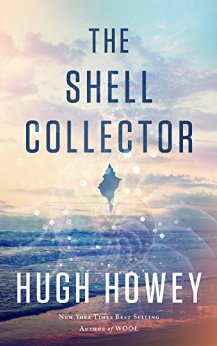 The Shell Collector (Hugh Howey)
I’ve come to Hugh Howey a bit late. I read Beacon 23 last year, but I still haven’t got round to reading Wool. I really should, though.
Judging from reviews, this book is different to the rest of Howey’s work. That’s mainly down to it being a romance. And before you switch off, let me say that this isn’t a genre I’m familiar with, or one that particularly appeals. I’ve read a few, and I’ve been unimpressed.
But The Shell Collector is different.
To start with, the prologue is one of the best pieces of writing I have read in a long time. It would stand up as a short story on its own, and I was almost tempted to stop when I reached the end, as I couldn’t imagine how Howey could top it. There is so much emotion and back-story conveyed in a short time, and it’s a fine indication of how good a writer he is.
But I carried on, and the book became intriguing. I didn’t know I was reading a romance, because the build-up to the relationship is slow, and evolves around a mystery, as journalist Maya Walsh gets an invitation to interview Ness Wilde, one of those responsible for the destruction of the oceans (at least, as she sees it). The story’s set in the near future, and shows the effects of environmental change without resorting to ‘end of the world’ catastrophes, and without beating us over the head with ‘look after the planet’ stuff. Instead, the world is what it is, and Maya (and the other characters) just have to cope with it. It’s like a real-world dystopia, if that makes sense.
The characters are very believable, as are their interactions. And the mystery element really keeps things moving, as Maya finds out more about the real Ness Wilde (and his grandfather). I don’t know if I totally like either character, but they are interesting and real enough that I wanted to find out more, especially about Ness’ secret.
And this was one let-down in the book. When this secret is finally revealed at the end, it felt rushed. Maybe Howey thought that giving it more time would have impacted on the romance, or maybe it was never supposed to be the driving force of the book. I don’t know. But I would have preferred a little more meat to the mystery side of the story.
But it’s still a very good book, written by someone who definitely deserves the success he’s enjoyed since Wool got so much interest. Where Beacon 23 hides its seriousness behind a playful exterior, The Shell Collector is earnest throughout. It shows how Howey can change his writing to suit the story he’s telling. It’s a fine example of character-driven story. I’ll definitely be reading more of his books.
So, three books that have impressed me over the last month or so. I know they won’t appeal to everyone (a comedy, a book that seems to purposely make reading difficult, and a romance), but the writing itself is great in all of them, and I’d recommend all three.
And now I’ve got more books to read. Some promise to be cracking stories, others are things I’m not sure about but I’ll give them a go anyway. Some will leave me unimpressed. But others will blow me away.
I’ll let you know which ones do that for me in a couple of months.
 Write To Market. This book details how he wrote his Void Wraith trilogy with the aim of hitting as many popular space opera tropes as he could, writing a book that would appeal to as many fans of that particular genre as possible. He initially wanted a powerful female lead, but his research indicated that most successful space opera books had a jaded, slightly older male as the main character. So he altered his character to conform to the popular trope.
 There are many who argue that there is a link between violence in the arts and violence in real life. There are those who argue that what you see leads you to think and act in a certain way. There are those who feel that erotica and pornography (and yes, I do realise there is a distinction between these two) are unhealthy because of how they change the viewer/reader’s viewpoint and attitudes.
 So are tropes bad? Should writers avoid them?
 These three books are connected by the fact that they all deal with topics that could be considered religious conspiracy theories. They all use biblical passages and other quotes to back up some fairly far-out ideas.
 Of course, once you realise this, it’s easy to question everyone—especially those who talk or write well. So maybe that poorly written book with the wild theories is closer to the truth, and Umberto Eco is simply having a clever laugh at the gullible masses. Maybe we should trust those who come across as less skilled or less intelligent, because they can’t lie as subtly or be as creative with their words.
 My Aims For 2017
 A few decades ago, when dinosaurs roamed the plain, there were places known as bookstores, where these strange physical objects called ‘books’ could be bought. Often, these bookstores stocked nothing but books, and many didn’t even sell coffee. If you wanted to read, you’d enter one of these establishments, browse the shelves, select what you wanted, then pay at the till, handing over these strange notes and scraps of metal that were called ‘money.’
 I’m one of those strange people who would rather read than watch TV. I do enjoy the occasional film, but I’d still prefer to relax with a book at the end of the day. And a novella is the perfect length for an evening of escapism. 25000 words, or just over 100 pages, normally takes a couple of hours to read, the same time as the average film. It’s a great length of time for an escape, and when I put the book down (okay, turn off the e-reader), I feel satisfied—I’ve had a complete story. I feel like I’ve been watching a film in my head, and now I’m emerging into daylight, my eyes adjusting after the dark of the cinema, sad to have to return to reality, but happy for the couple of hours I’ve been entranced by the story.
