Riled Dogs (Dominions IV) now available to pre-order

The next story in the Dominions series, Riled Dogs, is now available to pre-order for only 99p/99c.

Riled Dogs (Dominions IV)The only certainty in life is death.

Genna can’t let her guard down, even for a moment. Running a district is hard work, and there are always those determined to undermine her. And now she has a fugitive from the Dome to protect, someone who is still seen as a threat to be neutralised.

Then there is her old enemy to the east, an enemy who appears to have new, worryingly powerful weapons. Already, the dog is snapping at her heels. Genna knows that is it only a matter of time before he attacks.

And if he wins, she could lose everything.

Click here to pre-order now‌—‌the price will rise a few days after the book is released on 27th March.

Is reading fiction useful?

A couple of weeks ago, I looked at the use of story in relating real-world events, and how this engages us on an emotional level (and you can read that post here). But what about fiction?

Fiction obviously uses story to engage us, but using imagined events. We might become wrapped up in the plight of the protagonist, but we know it’s all make-believe. It’s entertainment, with an emotional pull to keep us reading/listening.

But there’s more to it that that.

Think, for a moment, what children do when they play. They make up worlds and characters, and seem to exist in a make-believe world. But this play is important, because it enables the child to learn. Through pretending to be an intrepid explorer, or a doctor, or a teacher, the child is learning how they might cope indifferent situations. They are developing an understanding of the way the world works.

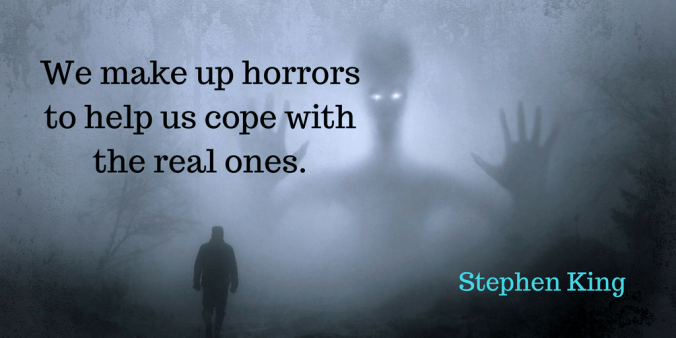
Fiction works in a similar way, by allowing us to explore settings and situations that are unfamiliar to us. And there’s a quote from Stephen King that encapsulates this‌—‌’We make up horrors to help us cope with the real ones.’

Cope with Horrors

Obviously, that doesn’t mean we read a book like Salem’s Lot to learn how to deal with a town overrun by vampires, and The Shining isn’t a manual on how to cope with a deranged writer when cut off in a creepy old hotel. But these books do deal with characters facing situations that they never even considered could happen. They deal with characters who have to make difficult decisions, often requiring them to go against what they would normally do. In The Shining, Jack’s wife doesn’t want to leave him, but she had to think the well-being of both herself and her son. In Salem’s Lot, as more members of the town become vampires, characters are forced to confront their own feelings towards friends who are now turning on them.

But the characters don’t always make the best decisions. King says the horrors help us cope‌—‌they don’t simply give us a list of actions to follow. The best stories don’t tell us what to think, even though they might nudge us in a certain direction. Sometimes, the lesson in the book (the ‘coping strategy’) is not obvious. Of course it isn’t. Nobody likes being told what to do, and if our fiction did just that, how many of us would continue reading?

Sometimes (most of the time?) what we learn from a work of fiction will depend on us at that particular time. The same work can have different meanings, all equally valid, for different people. Take Lord Of The Rings‌—‌is this a simple tale of good overcoming evil, or is there more to it? Frodo cannot let go of the ring at the end, so what does that tell you about either the power behind the ring or Frodo’s character? Maybe Sam is the real hero‌—‌the one with no real power, who doesn’t want to be there except that he is loyal to his friend, but who ends up carrying Frodo for so much of the story‌—‌and the lesson here is that we can look past our own fears and limitations. And what of Golum‌—‌is he villain or victim, and what does his plight tell us about ourselves? There is clearly a warning about greed, but is there also a fatalistic lesson in how our desires can control us no matter how hard we try to fight? And what does the way we view him tell us about ourselves, and how we see others who are ‘evil’? Does our attitude to Golum change as we realise how he has been manipulated?

It’s a vast book, and there’s clearly more that can be drawn out‌—‌but only when we start to question. We put ourselves in the characters’ positions, and ask what we might do (or what we’d like to imagine we’d do, if we didn’t freeze with fear the moment an orc appeared).

Purpose of Storytellers

Brandon Sanderson put it this way‌—‌’The purpose of a storyteller is not to tell you how to think, but to give you questions to think upon.’ And a good storyteller will often leave the answers open. A well-crafted story will force questions into our minds, where they will ruminate for days. Think of the character of Hannibal in Thomas Harris’ books (such as The Silence Of The Lambs), and ask why we are drawn to an unrepentant cannibal?

America Psycho is another book that provokes questions. On the face of it, the book is a nasty tale of a sociopathic killer. But it’s also about money and wealth. It’s about power, and the lack of it. Why is Patrick Batemen such a despicable creature? Is he simply evil, or has something pushed him to this point? Is he, like Golum, corrupted by a power that he never saw coming? And what of the revelation (spoiler alert) that the killings are all in his head? Does this make him less of a monster, or does the way his mind convinces him that he has killed make him more evil?

Are there definite answers to these questions? I’d say no. Bret Easton Ellis is well-known for not explaining his book, and that is good. The reader needs to pull whatever they can from his stories. And that means one person’s answers will be different to another’s. Because we are all different. We all have different questions, and seek different answers.
But surely this is all academic. We’re discussing fiction, and characters who don’t exist in real life. What difference can this make to our day-to-day lives? So what if we analyse‌—‌it’s all make-believe.

Hopefully you’re ahead of me here.

We think, and we question. The answers we arrive at affect the way we think, and that alters the way we see the world. And, when so many books are, at their heart, about humanity, and about the way people respond to others, this alters the way we see those around us. It alters our whole world-view.

We could make these changes through other means‌—‌philosophical discussion, or ‘education’ (whatever that means). If we want people to think a certain way, we could simply tell them. We could come up with a set of rules, or instructions. But stories speak to us in a way facts and data cannot. Stories reach deep inside and force us to step outside ourselves. Stories show us a world far wider than anything we can imagine.

And that is why, throughout history, fictional stories have been used for the advancement of mankind. From camp-fire tales, to religious parables, to morality tales, stories have always been at the forefront of guiding us in our journey through life.

Yes, fiction can change us. Think of the anti-war sentiment in Erich Maria Remarque’s All Quiet On The Western Front, or the challenge to prejudiced ideas in Harper Lee’s To Kill A Mockingbird. Think of the chilling vision of the future in George Orwell’s 1984. And then think of the books you’ve read, the books that have stayed with you. Maybe the ones you re-read, the ones that are still opening up their secrets. The stories that are still making you think.

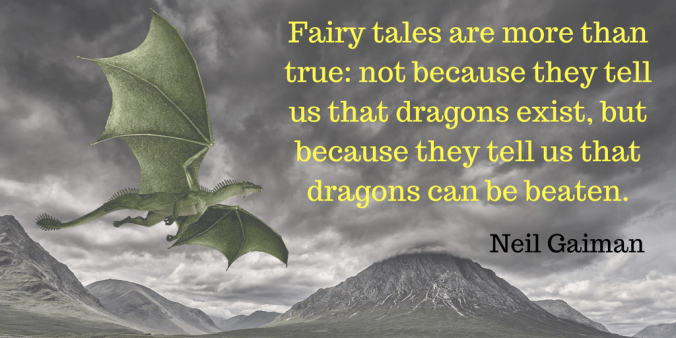
I’ll finish with another quote, this time form Neil Gaiman. His stories are larger-than-life, with fantastical elements, and I don’t think it is any surprise that he writes for both adults and children. He understands how those age-old primal stories can be a force for good, and he knows that we should never lose that child inside, the one that play-acts as a way of solving difficult problems before they even appear. He understands the power in stories. And that is why he said, ‘Fairy tales are more than true: not because they tell us that dragons exist, but because they tell us that dragons can be beaten.’

Dragons Can Be Beaten

New short story ‘…if you only walk long enough’

Bit of an odd short for you this time. Not sure where the idea came from (although the quote from another book hidden in this story might be part of it), and the title was slow in coming (and is another quote from a different book), but I’m pleased with how it turned out.

It’s called ‘…if you only walk long enough‘, and you can read it here. As usual, I’d love to hear any thoughts on it (I’m interested to see how many people spot where the quotes come from — the one used in the story itself is becoming something of a classic now).

If you want more short fiction, don’t forget the other forty-two stories on this site. You can read them here (and if we’re playing about with quotes, the number forty-two could count as another).

The World is Built on Stories

We have told stories probably since we first developed language. Maybe language came about because we wanted to tell stories. There’s something in-built about the need to relate events that have happened, to us or to others. There is a need for companionship, and for camaraderie, and stories are instrumental in initiating and strengthening bonds with others.

Of course, good stories entertain. They might make us laugh, or make us cry. They might scare us, or take us on a wonderful journey. But they are often fun. We don’t have to be forced to endure stories‌—‌we choose to listen, or watch them played out, or read them.

But stories do more than entertain. They instruct. It is easy to imagine our ancestors after a day’s hunt, relaxing around a fire and swapping tales of their day’s adventures. They told stories of what worked, and what didn’t. And through these stories, they learnt.

people-2557508_640The same thing happens today. Parents tell stories to their children as ways of explaining the world, and as guide to behaviour‌—‌Santa, the tooth fairy, all the lessons of good and evil in bedtime-stories. Religions use stories, too‌—‌tale of miracles, morality stories, parables and so on. And even science uses stories. Evolution is explained as a ‘survival of the fittest’ tale, where those who are better suited are the ones who live on. The water cycle is presented as a journey.

That doesn’t mean these stories are fabrications, just that they are ways of explaining concepts.

Over time, these stories change. Once, the sun rose because some god-like being willed it so, or because some larger-than-life being dragged the sun across the sky. Then we discovered more about the universe, and our place in it. And now, we know that our fairly small planet spins around a star. We know about the orbits of the other planets, and we know about other universes. We have gone back in time to discover how (probably) things came into being. And we have searched forward, seeking an answer to what will one day happen.

Yet this is still a story. The journey of the universe, from big bang to whatever happens at the end (heat death?) A journey is always a story, and we can learn from any journey.

But stories do more than entertain and inform. I would argue that stories are one of the major things that separates us from other creatures. Stories make us human.

The word story comes to us from the Latin historia, and was originally used to describe a narrative of an important event. It wasn’t until the fifteenth century that it came to mean a fictional tale, but we still use the word in that original meaning. We are presented with stories every time we read or watch or listen to the news. Think about the number of times news-readers say ‘‌…‌and more on that story later’.

news-1074604_1280Maybe some people still refer to news ‘reports’, but there is a world of difference between a report and a story. A report sets out to give the facts and figures, whereas a story strives to explain what happened. A report lays an event before us like an autopsy, whereas a story takes us on a journey through the event. A report engages our intellect, but a story engages our emotions too.

It’s worth repeating that‌—‌a story engages our emotions.

Those who create news stories know this. That is why they look for the human angle. That is why, rather than simply showing collapsed buildings after an earthquake, they linger on devastated faces and frantic searches for survivors. That is why, after a tragic death, we see (and hear from) those left behind, those who are struggling to understand how their worlds have been turned upside-down.

This could be seen as cynical‌—‌using misery to evoke a reaction. But I like to think this drive to display pain serves another purpose.

Most of us will not encounter the kind of tragedy we see on the news. In the UK, hardly any of us will have a friend shot dead. The majority of us won’t be caught up in humanitarian or natural disasters. And so, it is hard for us to understand, on an emotional level, what is happening to those who are involved. It is easier to shut ourselves off, even though we know this is cold, even though we know that we should feel something.

Reports state the facts. Stories engage us on an emotional level.

For a story to ‘work’, we need to empathise with the characters. We need to be able to put ourselves in their shoes and in some small way feel what they are feeling. Facts and figures (a report) of a shooting can leave us cold, because it’s names and dates, nothing more. But a story strives to put us there, with those caught up in the horror. It forces us to join with the victims in their suffering, or (and) feel the elation when the antagonist is brought to justice. If it is a natural disaster like an earthquake, details of the magnitude and the epicentre are numbers, the amount of damage a stream of figures. But the stories of those caught up in it‌—‌those who have lost loved ones, those who have been rescued, those who have put aside their own safety to help their neighbours‌—‌these are the things that make it real. These stories are what make us care.

And when we care, we are more likely to act. When we not only see people suffering, but also sense their pain, we are driven to help.

Then there are those stories where something negative is given a positive spin. There are stories of people defying disease and recovering, but there are also stories of those who succumb, but in a manner that humbles us. There are those who know they don’t have long left, but who strive to make every day count.

A news report could give details of the disease, or how fast the cancer spread. It could give facts and figures about white blood cells. Or the story could tell us of the person themselves, showing us their determination to life the remainder of their life to the full. It could focus on the way they are trying to help others with similar conditions.

Stories are powerful. They put meaning behind the data. They turn facts into action. They might enable us to live vicariously through others, but they also enable us to empathise with people we have never met, from different cultures in far-off places. They spur us on to do more, or to face barriers within ourselves. They enable us to see those around us not as mere human beings, but as people. They turn existence into life.

Without stories, we are nothing.

New short story

This latest short has a thriller/espionage flavour, influenced by recently reading Mark Dawson’s Isabella Rose books. It’s about a simple operation, a meeting in a cafe — what could possibly go wrong?

It’s called The Rendezvous, and you can read it here.

I have more short stories, all under a thousand words long — you can read them all here. For those of you who prefer e-books to web pages, I have a couple of free anthologies available (Millenary and Millenary 2). And as always, I’d love to know what you think of them.

Reading Fast and Slow

Some books, I shoot through. Others seem to last ages. And it’s not simply because I’m not interested in reading them. It feels like the length of the book is not the only factor in how fast it takes me to read it.
Time_Angel

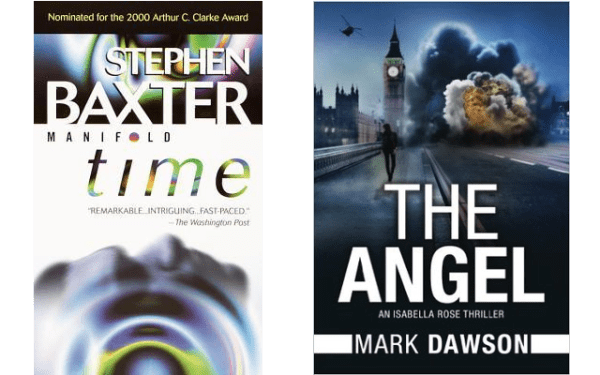
A couple of books highlighted this to me recently. I read Mark Dawson’s first Isabella Rose thriller, The Angel over a couple of days (which is about what time I’d expect to take for one of his books), but before that I read Stephen Baxter’s Time, and this took ten days.

Time clocks in at about 550 pages, and The Angel at 350, so I’d expect to read the latter quicker. But the maths doesn’t add up‌—‌350 pages in two days works out at 175 pages a day, so Time should have only taken about four days. Not over twice that time. And there was no difference in the amount of reading time I had available for each book, either.

But The Angel flew by, and Time took its time.

Why? Why do some books take ages while others feel like they’re over almost as soon as I’ve started?

Length of chapter/paragraph/sentence

It’s common writing advice that short, sharp sentences make for a fast pace. This works really well in thrillers. The ones with punchy sentences. A couple of words. It keeps the tension high. It keeps you reading.

Single-sentence paragraphs work well, too.

Then there’s the opposite‌—‌the languid, drawn out prose that linger on the scenery, like a slow-panning camera, allowing you to savour the setting. Then there are the sentences that dive deep into a character’s thoughts, often leaping about from idea to idea (because that is how thoughts work), so by the end of the sentence you can hardly recall the beginning, and you feel like you have been on a journey between those full stops, and you need a moment to recover before you drift into the next sentence. These sentences are written to draw the reader in, or to offer the reader the opportunity to dwell on the poetry of the language.

It doesn’t always work that way, but generally something written with a short, snappy style tends to flow faster.

It also results in more white space on the page, and this is another factor in reading speed, for a couple of reasons. First, a page of solid text can appear daunting, and we almost need to build up the will to start attacking it, whereas a page with lots of white space is more appealing and we dive straight in. And secondly, it is easier for readers to lose their place in dense passages, so they proceed with more care, taking more time to ensure they don’t miss out lines.

With the books I mentioned above, The Angel has lots of short sentences and paragraphs, with loads of white space on the page. Time has its short, sharp moments, but overall the sentences are longer, and there are long passages with a couple of paragraphs taking up single pages.

Information

Stories are there to provide entertainment, but in many stories there is a need to impart some information as well. Baxter’s Time has a strong hard sci-fi element, with lengthy scenes where the characters discuss in-depth science. At times it veers close to becoming a lecture, and it requires effort for someone unacquainted with that type of science (like myself) to follow the arguments. This concentration naturally slows down the reading speed. As much as I enjoyed these passages in Time, they took longer to get through than more action-based scenes.

Compare that to Dawson’s book. Yes, there is technical information in this book‌—‌such as details of weapons and other pieces of kit. It’s what you would expect in this type of well-researched thriller, and it makes the book more believable, more grounded in reality. But Dawson keeps these passages short, a paragraph or two at the most, often only a brief sentence. He doesn’t allow the information to detract from the story.

And this highlights a difference between the books. In Time, Baxter is exploring scientific possibilities, and so the information is an integral part of the story itself. Hi work is as much about the ideas as it is about the story. But in The Angel, the story is the most important aspect, and technical information is there as colour.

Description

This is similar to information, but is also connected with giving the reader different depths to each image. There are some wonderful passages in Time where the characters are watching space, and naturally Baxter uses many words to do this in order to give us the huge scope of what they are seeing (and feeling). He builds up a dense picture for us, taking his time (and many words) to get things just right.

universe-2742113_640

But this doesn’t work for a fast-paced action sequence (of which there are many in The Angel). Here, we want action, not description. A car might be red, or a particular make, but we don’t need to know about the rust on the wheel-arches, or the dent in the rear. Likewise, when a thug attacks the hero, we’re not interested in his shirt, or exactly how tall he is, or if he’s shaved that morning. We want to know what he’s going to do, and how the hero’s going to respond.

Obviously, some colour is good. A fight scene that is nothing more than a blow-by-blow account of the action gets boring. We need some emotion, and we need some details so that we can ground the fight in reality. But we don’t need too much that is overly descriptive. We don’t want to slow down for unnecessary detail.

So a terse style, more suited to thrillers like those written by Dawson, pulls us through the book, increasing the speed at which we read.

Language

Most people, even if they know a great many words, use a limited vocabulary in their day-to-day lives. Maybe this is down to the need (or desire) to be readily understood‌—‌using possibly obscure words will make others pause, and could lead to misunderstandings. And this is as true with text as it is with the spoken word.

Some books (or passages within books) benefit from using a wider vocabulary, but they are usually more literary works, where the particular choice and usage of words are a main part of the pleasure of the book. These are books that are designed to be savoured, designed to be devoured slowly. They are books where we are invited to acknowledge the poetic and aesthetic word-crafting of the author.

But stories are different. Stories need to be told using language that doesn’t get in the way. We want to know what happens next, and we don’t want to be distracted by flowery prose. Maybe a sharp one-liner or two in dialogue, and possibly the odd enriching description, but for the most part we are interested in the story. We want to know how the characters are going to get out of a particular situation.

Thinking of those two books I read, The Angel is definitely plot-driven. Although Dawson does use a wider vocabulary than other authors in his genre (and that is one of the things I like about his writing), he doesn’t let it get in the way of the story. Baxter is different‌—‌there are times when he wants us to take our time, to savour the images he is presenting, and so a more expansive vocabulary is required.

Story Time and Jump Cuts

The scope of Time is large. There are passages that describe short periods of time, but the story takes place over years. Months can pass in a couple of paragraphs. In contrast, the events in The Angel take place over very short time periods, and an action sequence of only a minute or so might take two or more pages to describe.

At first, it might appear that this would make Time read quicker than The Angel‌—‌slowing down to describe in detail what is happening, for instance, in a fight scene should make those intense few minutes last far longer, right? And maybe, sometimes, it does work this way. But I think the reverse can happen, too. If we know that things are moving fast in the story, we naturally read faster. Similarly, if events in the story are unfolding over many weeks or months, we feel that we can take our time.

It depends on how that passage of time is described.
man-2797590_640

One technique Dawson uses to keep the tension high and to keep us reading is that of cutting between points of view. We might start off a sequence with one character, but then (usually at the moment when they are in greatest danger), we cut to another character, and learn what they have been doing. We chop and change quickly, which is like the fast cutting of a movie action sequence. It keeps us wanting to return to each character, eager to find out what happens to them.

In Time, although there are a number of point-of-view characters, we are generally with each one for more pages, and for more time. This is like the kind of movie shots that follow the character or action with one camera, giving us a long, unbroken sequence that allows us to dive deep into the scene. There is no urge to rush, so we read at a more leisurely pace.


Of course, there are many more things that can affect reading speed. There are all those external factors, like interruptions (a sudden storm hammering rain against the window, the kids playing, noises on the street outside) and our current state of mind (feeling tired, having other things on our minds). Sometimes we have our own time constraints (something else to do, a new book we want to read), and we naturally speed up, maybe skim-reading some passages. A thick book might feel daunting, so we start with more trepidation. Or maybe we don’t want a thin book to finish, and we actively slow down (which is something that happened to me when I first read Douglas Adams’ Hitch-Hiker’s Guide To The Galaxy).

But that is one of the pleasures of books. Unlike films and TV programmes, or music, books are not constrained by time. We can fly through a hundred pages, or we can linger over a single sentence. We can enjoy a thrilling roller-coaster ride of a story, or we can savour the richness of the language. We can set aside an evening for the adrenaline rush of racing through a whole book, or we can read a little each night, drawing out the immersive pleasure of the book.

But however we do it, reading is always time well spent.


New short story – ‘Pushing The Limits’

Pushing The Limits is based on one of the characters from the Shadows series (but this story doesn’t rely on knowing what happens in those books). It’s a bit of light sci-fi action (a change from my normal darker tales). You can read it here.

I’d love to know what people think of this, and any of my other stories (the full list can be found here). And later this month I’ll be bringing out the second e-book collection, for those of you (like me) who aren’t too keen on reading fiction on web-pages.

If I don’t like a book that others love, am I wrong?

bad-review-2813741_640This happens quite often: I start reading a book, and within a few pages I find myself thrown out of the story. Maybe there are too many grammatical errors, or the story doesn’t make sense, or possibly the writing is bland and uninspiring. I’ve read too many books in need of an edit, and sympathise with those who moan at the amateur nature of independently-published books.

But I don’t like to give up on books, so I plough through to the end, inwardly moaning about the hours of my time I’m wasting.

feedback-2800867_640Then I’ll pop on to Amazon or Goodreads, interested to read what others thought of the book. And I’ll be confronted with pages of five-star reviews. They’ll praise the exciting story (that I considered tedious and predictable), or the wonderful characters (that I found to be cardboard cut-out cliches). These reviews talk of the enjoyment they got from the story, and how much they’re looking forward to that author’s next book.
This happens often enough that I wonder if I missed something, or if my judgement on books is awry.

But it isn’t. What I think of a particular book is what I think of it. It’s my personal opinion.

There is no right or wrong here. Everyone is different. What I look for in a good book will not necessarily correspond with others’ idea of an enjoyable read.

Other people will have different opinions.

Some readers can’t get past more than a handful of grammar issues, but others don’t even notice the mistakes. Some readers are turned off by bland descriptions, while others are enraptured with the dialogue in the very same book. Some people enjoy the richness of the language, while to others the words are nothing more than a way of getting the story across.

Everyone is different, in both their preferences and what they expect from a book. An author like Dan Brown is often frowned upon by those who prefer more intellectual books (whatever they are), but he has far more readers than any of the year’s Booker nominees. James Joyce’s works are considered classics by some, and undreadable nonsense by others. Some people relate to Twilight‘s Bella, and others find her a nonentity.

This doesn’t only happen in books, of course. A new art-house film might receive outstanding reviews from film critics, but it will never come close to making as much money as the latest big-budget effects-driven spectacular. The latest pop music sensation will easily outsell a band that is pushing the boundaries of music. Sometimes, a musician might straddle both ‘popular’ and ‘experimental’ music, but they are rare indeed. Bjork continues to produce challenging music, but she is no longer the ‘popular’ artist she was when she had hits with tracks such as ‘It’s Oh So Quiet’ or ‘Human Behaviour’.

So if her older music was more popular, is it better than her latest stuff?

That’s not a sensible question. It’s different. Each album is what it is. Just as each book by each author is what it is. As every author is individual, so is every reader. Every reader is seeking something different from a book.

pair-707505_640So no, I’m not in the wrong if I don’t enjoy a book that others view as a classic. I might not have the same opinion as the majority of others, but that doesn’t mean I’m wrong. Just different.

And that is why reviews can only ever be guidelines. For all the importance placed on them, especially in the independent-publishing field, they are not fact. A load of good reviews might mean that the book is popular, but they are still only the opinions of individuals.

Of course, reviews have their uses. If a review favourably compares a book to one of your favourites, of it that reviewer has given positive reviews to other books you like, then you might want to check the book out. If the reviews talk about plot twists, or evocative language, or snappy, sarcastic dialogue, and you enjoy these things, then it’s more likely that you will agree with their opinion of the book.

Negative reviews can be ‘positive’ in guiding a reader to a book too. If you enjoy violence and lots of swearing in your books, and a negative review decries the coarse language and gore-filled descriptions, this might be the book for you. If the reviewer moans that the sappy relationship gets in the way of the mystery, but you like romance stories, that could be a good sign.

So is there a lesson in this? If there is, it is probably to take reviews with a pinch of salt. Read them, yes. Take note of the thoughts of others. But don’t take their word as anything other than their personal opinions. Understand that when you read the book, you are doing so for yourself, not for them. Remember that you can think for yourself, and you can reach your own conclusions.

If you disagree with a review, it’s not a case of right and wrong, just a difference of opinion.

‘Unspoken’ – new short story

I read Ray Bradbury’s Fahrenheit 451 recently (can’t believe I’ve only just got round to reading this book), and it got me thinking‌—‌how would book-burning work today, when so many books are digital? That knocked around in my head for a while, and this short story, Unspoken, was the result. You can read the story here.

This is the fortieth short story I’ve posted (you can reach all the others by clicking here). The first twenty are available in a free e-book download, Millenary (click here), and with Unspoken now out there, the next anthology (imaginatively titled Millenary 2) will be out in a few weeks‌—‌again, totally free.