Story lessons from The Rise Of Skywalker

The art of telling stories is complex, and there is always more to learn. As I read books or watch films, I’m always on the lookout for tips and ideas, seeking to learn how good stories work and why other stories leave me unimpressed.

star-wars-the-rise-of-skywalker-logo

I went to see the latest Star Wars film recently, and while it was enjoyable enough as an escape for a couple of hours, the overall story didn’t excite me too much. I also didn’t feel it totally succeeded in closing the whole Star Wars nine-film epic story in a satisfying way.

When I analysed why this might be, I came up with a number of lessons for my own writing.

Lesson One: Actions should have consequences

There was one moment in The Rise Of Skywalker where I was genuinely excited for the direction the story was taking. Rey attempts to rescue a friend, but while using the Force she ends up destroying the craft she believes him to be on.

Kylo Ren has been trying to get Rey to join the dark side, and so far she’s resisted. But with a moment when her own mastery of the Force comes into question, and when ‘good’ use of the Force has such a negative outcome, surely Rey will start to doubt. This, I felt, was going to be the start of her descent toward possibly turning to the dark side.

But this wasn’t to be. In the very next scene, we (and Rey) learn that her friend was on a different craft. Her failure to use the Force ‘correctly’ has no consequence (at least, for her), and she carries on as if nothing has happened.

The problem goes deeper, though. If the choices a character makes has no bearing on their success or failure, then they’re just along for the ride. And if nothing they do really matters, why should I care about them?

Second lesson: Story events must come from somewhere

There’s a well-known saying‌—‌plot twists should be surprising yet inevitable. They should shock us in the moment, but in hindsight it should be clear that this was the only way events could be played out. Think of the reveal in The Sixth Sense, and how it seems obvious on second viewing.

The Rise Of Skywalker fails in this right from the start, by suddenly mentioning that Palantine is not only alive and well, but also behind everything that happened over the two previous films. This reveal hasn’t been foreshadowed in these films, and his death seemed pretty definitive at the end of Return Of The Jedi.

It feels like a cheap move, or an attempt to pander to fans by bringing back an old character. Through the lens of story, it doesn’t work.

Just as actions must have consequences, events too must have origins. Otherwise, the story becomes nothing more than a bunch of stuff that happens.

Third lesson: The ending of a story is for tying everything together, not for introducing new characters and ideas.

There are some interesting ideas in The Rise Of Skywalker. We get insights into Poe’s back-story, and are introduced to a new (to us) character from his past. Also, we learn that Finn is not the only stormtrooper to have defected.

But this is the final chapter in a longer story. There isn’t the time orspace to develop these ideas, and ultimately they mean nothing. They feel tacked-on.

Maybe they serves some minor plot-point, or were an easy way to move the story on‌—‌but a well-told story would have found some other way of doing this. The ending should build on what has come before, not introduce new ideas and characters in order to work.

Lesson Four (the big one!): Have a vision for the whole story

The original Star Wars trilogy had a clear over-riding story (and I’ve written about this before, in this post), as did the prequel trilogy. But these latest three films, the sequel trilogy?

As one story, they’re a mess‌—‌and the reason for this seems to come down to a lack of clear direction. When JJ Abrams made The Force Awakens, it seems like he had some idea of where things were going, introducing plenty of open loops. But in The Last Jedi, Rian Johnson took things in his own direction (and, by all accounts, actively reversed many events set up in the previous film.) So in The Rise Of Skywalker, Abrams had to weave together a whole array of disparate plots.

Whatever he did, he was always going to disappoint people‌—‌fans of Johnson’s direction would accuse him of trying to undo, rewrite or ignore the previous film, while fans of his first film of the trilogy would moan about how Johnson derailed the whole thing, forcing Abrams’ hand too much.

A story should build. Yes, it will probably go through twists and turns‌—‌but eventually, these will be resolved in a way that (in hindsight at least) makes sense. Again, a story is not just a bunch of stuff that happens, but a coherent whole.

This is true of individual stories (books, films etc), but also true of a series. The seeds of the eventual ending should be sown early on, and the final chapter (episode) should build on everything that has come before.


So, four reasons why The Rise Of Skywalker left me underwhelmed, as both its own story and the final chapter in a series. And (more importantly) four lessons that I can take into my own writing.

New short story – ‘Where Does The Time Go?’

Another short story this week. I had the idea for this one ages ago, but only got round to actually writing the thing a couple of weeks ago. It came out pretty well as a first draft, but I’ve made a few changes and tightened things up a bit.

After going for a positive story last time (with Sentinels), this one is definitely darker (just to warn you). It’s called Where Does The Time Go, and you can read it here.

My aims for 2020

After looking back over 2019 (in this post), it’s now time to look ahead, and lay out what I hope to achieve over the next twelve months.

These aren’t resolutions, though. There’s too much pressure in that word, and it’s too easy to call myself a failure if I don’t keep to a specific resolution. Rather, these are aims. Some are specific, but others are more ambiguous. They’re realistic, though. And if I don’t achieve everything, then that simply means my aim was slightly off.


Writing

My first priority is to complete the sixth Dominions novel. I’m currently in the first round of edits, and things seem to be going well, so I’m aiming for an April release.

And then, I need a break from Dominions. I’ve already been throwing a few ideas around for a new series, and I’m going to aim to have a couple of books finished by the end of the year.

I’m continuing to write short stories, and 2020 should see the hundredth of these, along with the fifth Millenary anthology. In my mind, I always saw this as a good time to stop, but I don’t want to stop writing short fiction. It’s great fun, and also an excellent way of pushing my writing. So, once I have all hundred shorts out, I’ll change things up a bit. I might scrap my thousand-word limit, and possibly aim for one story a month rather than one every two weeks. I’m not sure yet.


Marketing

This is something I struggle with, but my mindset on marketing has been shifting over 2019. Rather than seeing it as an attempt to get punters to part with their money, I now see it as a quest to put my books in front of readers who are likely to enjoy them. Selling my books should be mutually beneficial‌—‌I receive some financial recompense for my time, effort and money in producing the books, and readers receive a few hours of entertainment.

Over 2020, I’ll make a concerted effort to improve in this whole area. I’ve recently started Mark Dawson’s Ads For Authors course, and will be attending the Self-Publishing Formula conference in London in March. And I’ll continue to read books, listen to podcasts and watch webinars to keep on learning.

But learning is useless without implementation, so I’m going to put time aside each week specifically for marketing activities. This could be setting up and analysing ads, or seeking promotional opportunities, or contacting other writers, or any of the other ways I could help my books reach potential readers.


So, a quick summary. Over 2020, I will:

  • complete and publish the sixth Dominions novel
  • start a new series, and have at least a couple of books ready by the end of the year
  • become far more focused on marketing, setting aside time each week to work on helping my books reach readers who will enjoy them

2019 round-up

With the end of the year approaching, its time to take stock of 2019. Looking back, I had six goals for this year

  • To release the new edition of Dark Glass and seriously market the Dominions series
  • To release two more Dominions novels
  • To go wide with the Shadows series
  • To release paperback books
  • To dive into dictation
  • To start a new project

So, how have I done?

Dom1CoverSmallDark Glass

The new edition went live back in February, and judging from feedback the re-write definitely resulted in a better book. I also released a box-set of the first three novels a couple of months after this.

I did some marketing on the series, and had some success‌—‌but marketing is still something I need to work on.

Dom5_small(Hi_res)More Dominions books

This didn’t go well.

Rogue Wolf (Dominions V) was the hardest book for me to write so far. I’m used to books changing as I edit them, but with this one the process involved at least three total re-writes, just to get the story working. Even though I started planning it back in 2018, I only managed to release the finished version at the start of November.

I did manage to publish another Dominions novella, Errant, but the sixth novel has yet to appear. I’m working on it at the moment, though, and I don’t think I’m going to take as long over this one (at least, I hope not).

Go wide with Shadows and release paperback books

From September onward, I got new covers for all three novels (and the novella) in the Shadows series. I’d started pulling the novels from Kindle Unlimited, and these books are now available through Kobo, Barnes & Noble, Apple Books, Tolino, and as many other vendors as I could get them into (as well as Amazon).

Shadows series - paperbacks

I think the new covers look great‌—‌very eye-catching, and they give a far better idea of what to expect from the books than the old covers did. I also got paperback covers, and these books are now available in physical form.

I’ve yet to release any of the Dominions series as paperbacks, though. I’ve formatted the internal files, but I’m still considering how to get covers done.

Dictation

I’ve tried, but this hasn’t gone well. I’m not naturally talkative, so maybe it’s not too surprising that I find it easier to ‘write’ through my fingers than through my mouth.

I’ve tried dictating directly into my laptop, and editing mistakes as I go slows me down. I’ve also tried recording and transcribing, but at the moment this process (including time taken correcting the transcription) isn’t any faster than typing. The only advantage has been the ability to ‘write’ while doing other things.

But I’m persevering. I got a great tip from a recent Creative Penn podcast, where Kevin Anderson talked about using dictation in his planning, simply talking through ideas as they came to him. I’ve been giving this a go for a week or so, and it seems to be working. Talking while thinking is slowly getting easier, and I’ve now got loads of ideas down for a new project (more on that in a moment).

I’m going to continue with this strategy for a while. Then I might try dictating some of my blog posts (because a lot of them are me working through ideas anyway), and hopefully I’ll end up feeling more comfortable dictating fiction.

A new project

Due to the time spent on Rogue Wolf, I haven’t made any major headway on this. But I have ideas.

Okay‌—‌I always have ideas. In the spring I wrote the first draft of a novel that was an attempt at continuing the Shadows series, but it didn’t work too well (didn’t have the same horror feel, being more action/adventure), so I’ve shelved that for the moment. I’ve also thought about writing a series following on from Ghost Stream, the novella I had included in The Power Of Words anthology, and while I have a few ideas I haven’t developed any of them yet.

But I also have a brand new idea for a series, and that’s what I’m working on in my dictation practice. The more I think about it, the more excited I get‌—‌and that has to be a good sign.


So, some successes and some disappointments, and lots of lessons learnt. I need to work smarter when writing, and I still need to improve in finding potential readers (which is what marketing really boils down to). As far as sales go, 2019 was an improvement on 2018, but not where I want to be.

But I’m moving forward. And in a couple of weeks, I’ll lay out what I aim to achieve over 2020.

Why writing isn’t the whole story

Over November, as my NaNoWriMo project (more details in this post), I wrote the first draft of the next Dominions novel. I was confident I could manage the usual NaNo target of 50,000 words, but I wanted to get the whole thing written. I pushed myself hard, and gave dictation another try for some of it.

I finished, a few days before the end of the month. 125,000 words.

It’s too long. And it’s a mess.

The sections I dictated are extremely stilted, because I still find that words flow better through my fingers than through my mouth. But there are problems with other parts, too. In some sections, I realised my planning wasn’t working, so I had to change things. There are plot holes, and redundant character point-of-view scenes. I’m not convinced by some of the character arcs or motivations. And there’s a lot of repetition and poor writing.

Does this concern me? No. I know that the first draft is not the finished book. It’s a way of getting words on the page. It allows the story to be discovered, and for characters to grow. It’s an opportunity to understand more about themes and ideas that underpin story events and motivations.

The first draft is similar to the artist’s initial sketches, or the musician’s rough demo recording. Reaching ‘The End’ for the first time is really only the beginning.

Now comes the hard work‌—‌editing.

editing-1756958_640I used to see this as a chore. I used to believe that editing involved correcting mistakes, and that I should have foreseen many of these. I used to view writing as the fun, creative part of the process and editing as a mundane slog.
My view’s changed a great deal on this. As I’ve learnt more about the craft of writing and storytelling, I’m starting to understand just how many working parts go into creating a written work, and how it’s impossible to nail even a fraction of these on the first attempt.

There’s the ebb and flow of the story, and the various tent-pole moments that need to meet reader expectations while also being different or surprising in some way. There are the subtleties of character arcs, and the interplay between characters and their settings.

And then there’s the writing itself‌—‌not simply grammar and spelling, but the choice of words. There are things to avoid‌—‌info dumps, repetition, superfluous description. There’s tone and characterisation. There are times to become more poetic, and times to use more straightforward language. And so much more.

Editing isn’t a matter of correcting mistakes. Editing takes the raw material of the first draft then manipulates and moulds it. Editing turns those rough, messy words into something that will pull readers in, giving them the entertainment and excitement they seek.

Far from being mundane, editing is incredibly creative. A great deal of it is about problem solving, on many different levels. There’s the macro, whole-story work, where scenes are positioned just right, where the feel of the book as a whole is considered, where pacing plays such a vital role. And then there’s the micro, sentence-level work, dealing with minutiae of language. There are levels in-between‌—‌structuring each scene or chapter to have its own flow, re-writing paragraphs to ensure the important details are in the right place.

And all these changes have to work together. A sequence of brilliantly-structures scenes doesn’t necessarily tell a great story. Perfect sentences are meaningless if the reader has lost interest in the characters. An exciting story can fail if told in a bland way.

Editing, far more than writing, is what creates good stories. It’s a challenge, and it’s time-consuming‌—‌and it’s one of my favourite parts of the whole writing process.

The first draft is just the start. And now, I’m excited to begin the important work of turning those 125,000 words into something I can be proud to release.

No new story this week, but a free copy of one of my Dominions shorts

I’ve kept to my schedule of a new short story every couple of weeks for a long while now, and it’s frustrating that I’m going to have to break the habit this week. With work on a new book, and various other things, I simply haven’t got a new short ready yet. I’ve got a few things almost there, but that’s not good enough. You deserve better.

But I don’t want to leave you with nothing. So, in lieu of a new short, I’d like to offer you a download link to one of my Dominions shorts.

Animus (A Dominions Story)In a violent wold, can the meek survive?

Ostar knows he’s nothing special. But he’s useful to the crew‌—‌not with the violence, but as a look-out. He’s never hurt anyone in his life. He simply wants to keep his head down and live without conflict.
But the crew are dying. Someone is killing them, one by one. And it is only a matter of time before they come for Ostar.

You could buy Animus on all the usual sites, but click here to download a free copy (this link will only be live for about six days). And I’ll be back with a new short story in a couple of weeks.

Can’t stand cliffhangers, but love open loops

Cliffhangers annoy me. When I read a book, I expect a full story. If I reach the end, and it stops with the hero in mortal danger, I feel cheated. I feel that either the writer hasn’t figured out the ending yet, or they’re using a very cynical marketing ploy to encourage me to buy more books.

This makes me less likely to continue. Unless the story really grabbed me, I won’t get any more in the series.

But open loops are different. If I reach the end of a complete story, but there’s an odd niggling question that hasn’t been answered, I’m intrigued. I’m satisfied that the story is finished, but I still want to know more. And with books like this, I’m far more likely to continue with the rest of the series.

Star Wars did this. The Death Star was destroyed, but Darth Vader still lived‌—‌the villain had been defeated, but not vanquished. The Empire Strikes Back had a more sombre ending, with more loops left open, but (apart from Han Solo, encased in carbonite), the characters all survived, ready for the next part of their fight against the Empire.

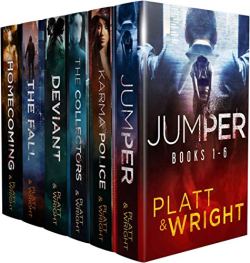
JumperSeries_SeanPlattDavidWrightSean Platt and David Wright’s Jumper series (at least, over the first few books) is another great example of open loops to drive a series. It begins with Jumper, the story of someone who wakes up each day in someone else’s body. They do what they can to minimise harming the people whose bodies they inhabit. But these hosts are all connected, and the main character is forced to make difficult choices to protect his hosts.

It’s an intriguing premise, reminiscent of Quantum Leap without feeling derivative. The book’s an enjoyable read, and tells a complete story‌—‌and then, we get the epilogue.

It feels like it’s going to tie up a few loose ends. But instead, the writers drop their bombshell. [Spoiler alert] There is more than one jumper.

This great little twist immediately builds interest in the second book, Karma Police.

The second book follows a similar pattern‌—‌the main character waking in different host bodies, being forced to solve a particular problem. But again, the writers open another loop. The main character talks to another jumper, and learns things that give rise to more questions than they answer.

It’s only once we’re through the first half of the series that the pattern breaks, and the final three books are more of a continuation of the same story rather than individual stories with hints of a larger overall arc. But by this time, the reader is hooked (at least, I was), invested enough in the overarching story that the individual tales don’t matter as much.

This is a hard trick to pull off, and I’m not convinced that Platt and Wright fully succeed‌—‌the last book felt too rushed, and I would’ve liked them to explore some of the ideas a little more. It was still good, but didn’t quite live up to the promise of earlier books. But, in the authors’ defence, they do push themselves with their writing, and even if the story isn’t totally successful there’s still a great deal to be enjoyed in these books.

And at least this series feels like it was planned out fully, something that unfortunately can’t be said all series.

I used to love watching The X-Files. The stand-alone monster-of-the-week episodes were fun, but the development of the larger story (the ‘mythology’) was what kept me watching‌—‌at least, over the first few series. But by about series four, this larger story became more ridiculous. Rules that had been set up in earlier episodes were ignored, and it felt like the story was being changed as it went along. No, it was worse than that‌—‌it felt like the larger story hadn’t been thought through properly. It felt as if the writers were making it up as they went along.

You might argue that this is what writers do anyway. Fiction is make-believe, so all stories are made up. There are many popular authors, including Stephen King, who start writing with only a vague idea where the story will end up, discovering the details as they write.

But however a story is first written, it is always edited. Things are changed so that the story has a more satisfying arc.

And this is where I feel some series, such as The X-Files, fall down.

Planning a story take time and effort, a good story even more so. To develop a satisfying series, each book has to be planned, but so too does the overall story.

Of course, most series aren’t written in one go (although it is becoming more common, in independent publishing, to hold off releasing books until at least the first three in a series are completed). George RR Martin’s Song Of Ice And Fire is still unfinished, and Robert Jordan’s The Wheel Of Time, initially only conceived as a six-book series, eventually stretched to fourteen, with the final few being written by Brandon Sanderson after Jordan’s death. It’s hard to see how these series could have been planned out in their entirety in any detail.

This can make writing later books in a series harder‌—‌all those open loops have to be closed, and done so in a way that feels natural. Also, stuff in later books shouldn’t contradict what happened earlier. Yes, it is possible to change earlier books and produce new editions (which Tolkien did with The Hobbit, once he understood how it complemented the larger story of The Lord Of The Rings), but this is time-consuming, and disappoints readers of the original versions.

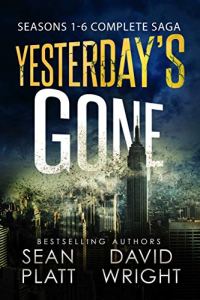
YesterdaysGone_SeanPlattDavidWrightWriting a series is hard‌—‌which makes ones that work even more impressive. So maybe I should be a bit more forgiving about cliff-hangers. After all, I enjoyed Platt & Wright’s first foray into fiction, the serialised Tomorrow’s Gone, where every ‘episode’ ended on a cliffhanger.

But Tomorrow’s Gone was structurally based on old TV shows, with episodes that formed seasons, and the complete story told over six seasons. They started with a very ‘throw everything out there’ idea, trusting themselves to bring the story together later. But (I believe) the final three seasons were planned in advance, so even though each episode ended on a cliffhanger, the writers knew exactly where the story was going.

I didn’t read Tomorrow’s Gone until it was finished, until I could devour the whole thing. I think reading it episode by episode, having to wait to find out what happened next, would’ve frustrated me. And maybe that’s why binge-watching is becoming so popular, and why some people hold off watching a series until at least a couple of seasons are available.

Cliffhangers can work, but the resolution can’t be held off too long. The excitement wears thin, and then we forget what happened, and instead remain with the dissatisfaction of having an unfinished story. I’m wary of reading a first book in any series now, and I’ll often check reviews to discover if it’s a complete story.

So don’t give me cliffhangers. Give me a story that keeps me reading. Show me that you can tell a satisfying tale. But sprinkle in a few open loops. Make me question some of the stuff happening just off the page. That way, you’ll keep me reading and buying more books.

Rogue Wolf out now

It’s been far too long in coming, but, finally, Rogue Wolf (Dominions V) is out, and it’s only 99p/99c for a few days.

Dom5_small(Hi_res)He does what needs to be done. He’s cheated death a hundred times, and he has the scars to prove it.
But Rodin’s put all that behind him. He’s no longer an assassin for hire, or a pawn in the fight against Authority.
At least, that’s what he tells himself. But when a favour brings him close to the infamous Factory‌—‌a prison in all but name‌—‌and a chance encounter forces him to rethink, can he still do what needs to be done?
Facing death is one thing, but can Rodin face a life of imprisonment in the Factory?

Rogue Wolf continues the dark Dystopian Dominions series, as Authority’s hold over the Dome and the districts grows ever-stronger.

Get Rogue Wolf now, from all the usual ebook stores.