I read China Mieville’s The City And The City recently (I’m slowly chipping away at my ‘to-read’ list). I enjoy his writing style, and I think his world-building is fantastic (in many meanings of that word). But something strange happened as I read the book.
It’s written in first person, and I automatically pictured the narrator as female. I’ve no idea why, but even when it became clear that the character was male, I still saw him as female. I don’t think there was anything specific Mieville wrote that would make me picture his protagonist as anything but male, so I can only think this is down to how I approached the book.
And this got me thinking. When I read, I picture things in a certain way, but this isn’t necessarily how others picture the book, or even how the writer saw the story in his or her own head. Every reader is different, and we each bring our own unique perspectives to anything we read.
 Stories (in books) pass from writers to readers through the medium of words, but there is always going to be interpretation involved in this. Writers aim to give as much action/emotion/description in as few words as possible. If everything was described in enough detail to convey every single aspect of the story, the action would move at a glacial pace, and all sense of forward momentum would be lost. Stories that describe too much are (for most readers) tiring to read—hence the search for conciseness. Gustave Flaubert talked about finding ‘le mot juste’, the right word.
But even that causes problems. Words mean different things to different people. I’ve heard the word ‘solid’ used to mean both good (as in ‘rock-solid’, firm and unmoving—a solid fellow) and difficult (as in ‘hard’—“that game’s well solid!”).
Think of that classic story opening; ‘It was a dark and stormy night.’ That might conjure up thoughts of uncertainty, maybe even fear. But to some, storms can be exciting. Or maybe darkness helps others escape from their day-to-day troubles, and the addition of poor weather brings up thoughts of being beside a fire, enclosed in the safety and warmth of their very own home.
There is no perfect word. There is no ideal way to describe something.
Is this a problem? Not necessarily. One often-repeated piece of writing advice is to picture your ideal reader, and write to them. I believe Stephen King’s ‘ideal reader’ is his wife, and others might use real people too, but many create their own ideal reader (maybe a female forty-something divorced librarian living in Pittsburg, or a heavy metal fan working an office job but dreaming of becoming a professional musician). This might seem strange, but it is impossible to write a book that pleases everyone, and trying to make a story too universal usually means creating something bland, something that many find ‘okay’ but that nobody gets excited about. Anything designed to appeal to a wide range of people will fell watered-down.
Attitudes to books will naturally differ. Even if two readers enjoy the same book, it could well be for different reasons—some King fans might get a kick from the build-up of tension, and others might love the way he pulls them into the minds of his characters. Some people read Iain Banks’ sci-fi books for the vast ideas, others enjoy his way of telling a story.
There’s no right or wrong here. Every book is written by an individual (or a few individual in the case of co-written works), and the words are formed through the filter of their own lives. These books then get consumed by individual readers, who digest these words through the filter of their own experiences and ideas.
And this means that books are never static.
There’s this idea that, when something is created, it’s completed. In some ways, this is true—when a writer puts a book out, it stays the same unless they bring out a revised version. It’s the same with any art form—music, paintings, sculpture, films. But this ‘completed’ work can be digested by different people at different times. It can bring forth different emotions or lead to different thoughts. Every person who reads a book experiences something unique. And even re-reading a book can be a new experience.

As we grow, we develop, learning and understanding more, and our appreciation for things changes. The books we read ten, fifteen, thirty years ago might contain the same words in the same order that they did when we first picked them up, but if we re-read these words today we experience something totally different. Our interpretation is not only tinged with nostalgia, but also with our different perspective on life, our different personality. It’s part of the reason why books we loved as children can sometimes seem flat when we read them as adults, and why books we struggled to get into a few years ago can later become favourite reads full of meaning and excitement.
We never simply read words. We absorb them, run them through our experiences, our own unique thoughts. We take those marks on page or screen, and we breathe life into them.
The writer takes a story, moulds it, and lays its foundations on the page. But the reader brings it to life.
 The narrator for this chapter did his best, and I don’t mean to mock him. I know I could do no better with, say, a Texas accent. I don’t even know if the narrator had ever heard a Yorkshire accent before attempting to read Stoker’s text. But the accent he narrated in didn’t work. You know Dick Van Dyke’s ‘cockney’ accent in Mary Poppins? Imagine that combined with the occasional Scottish twang, and you’ll have a rough idea what this Yorkshire character sounded like.
 Another book comes to mind here, and although it’s not written ‘in accent’, it is still relevant. That book is Iain M Banks’ Feersum Enjin. Take a little time over that title, and you’ll get an idea where I’m going with this.
 But recently I came across something on Twitter that threw some light on this. It showed me that the ‘error’ I’m seeing is not an error to everyone. I only see it as a problem because of my background.
 I’ve got a few things that will always pull me out of a story. One of these, in both books and TV/films, is the phrase ‘over and out’. It’s pretty much always used by characters who are professional, using a radio as part of their job, and yet they continually get this wrong. ‘Over and out’ is either a contradiction, or it’s an insult.
 There are other words and phrases that I find annoying, but one of these I have had to reassess. See, language changes, and it looks like I haven’t kept up with this particular word.
 I’ll explain. In UK schools, there are official lesson observations, carried out a few times a year on every teacher. When these observations started up, the teacher was given an overall rating from a choice of four; requires improvement, satisfactory, good, or excellent. As long as you did not ‘require improvement’ you were doing okay. ‘Satisfactory’ meant that you knew what you were doing, and that the kids were learning. There was room for improvement, of course, but you weren’t letting anyone down. You were doing okay. Just as the word ‘satisfactory’ implies.
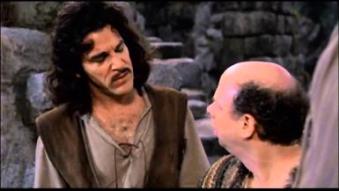 Maybe if it’s me, I can blame my education. I’m sure my teachers were satisfactory, so they were clearly getting things wrong somewhere. I can’t expect words to remain static. To bring this back to the title of this post (for anyone who’s a fan of The Princess Bride), such a notion would be inconceivable.
 TW Iain