I read genre books. Yes, I read literary fiction too (whatever that actually means), but because I enjoy science fiction, fantasy, horror, the occasional thriller and so on, I’m predominantly a genre reader.
As I both read and write more, I’m becoming increasingly conscious of tropes in different genres. These are those scenes or events that are expected, those parts of the story that almost define it as a certain genre. Thrillers have the ‘hero at the mercy of the villain’ scene, the ‘speech in praise of the villain’. There’s often a false ending, too—and this crops up in horror as well. In romance there’s the first kiss, the misunderstanding that appears to ruin everything, but there’s always a happily-ever-after (miss this and endure the wrath of countless romance fans). Then there are all the internal genres, those that follow a characters development (either positive or negative)—the moment when they have to make a choice from which there is no going back. In a maturation story, there is that moment when it becomes clear to the main character that the world they believed to be true is based on a lie of some kind.
So different genres have different tropes. But what about science-fiction stories? What defines a sci-fi story?

It has to be set in the future—unless it’s set in the past (like Star Wars), or an alternative present.
There has to be some kind of cool technology—unless there isn’t (think Planet Of The Apes.) And the technology doesn’t have to play a major role in the story either—it can be simply setting.
What about action? Well, there’s action in a lot of sci-fi—but not all. There might be battles in space, or there might be duelling in dialogue between two characters. Some sci-fi is fast-paced, but other stories in this area are slower and more reflective.
And are there any set scenes in sci-fi? Erm…no.
The more I think about this, the more I realise that science fiction is not a genre, at least in the same way that horror or thriller or crime or romance are genres. Science fiction refers more to the setting than the type of story being told.
Maybe a few examples will help:
 The Martian is definitely sci-fi, but it is also a survival story; one man against the elements. It’s just like Robinson Crusoe, or any other survival story. It just happens to be set on Mars.
 BladeRunner (Do Androids Dream Of Electric Sheep) is a philosophical detective story, with musings on what it means to be human, and also has many noir tropes—downtrodden detective, questions over who are in fact the good guys. Oh, and there’s a love story underneath all this. But it has replicants, and it’s set on an Earth that many people have abandoned to travel to the stars.
 Ender’s Game is almost a sports story, with Ender starting off in the little leagues and working his way up to the big time. Ender takes his team and uses their weaknesses as strengths, overcoming all the obstacles in his path. It could almost be viewed as a coming-of-age story, too. The fact that the games involve space battles is secondary.
 Hitch-Hiker’s Guide To The Galaxy is comedy, full of bizarre happenings and loads of satire. The plot is secondary to the humour, and the science fiction setting simply gives Adams more scope for letting his ideas run riot, and allows him to satirise many things in our current world/time.
 Asimov’s Foundation books (at least in the original trilogy) tell the story of a civilization over time, with much of the action involving political shenanigans and business dealings. The technology is used in trade, rather than in space battles, and the most important science is social science. And then, in the third book, there is the Mule, the lone individual who throws a spanner in the works, and proves that even the greatest minds are not infallible. Science-fiction is simply the setting in which Asimov tells his generation-spanning saga.
 Dune is another saga, with all the political and familial intrigue of a historical novel. Like the best sagas, it draws the reader into a rich world populated by diverse characters, each with their own motives and desires. It just happens to be set on a desert planet.
Six science-fiction books, and all so different. Many sci-fi readers will enjoy them all, but there will be those who love getting embedded in the world of Dune but can’t stand the apparent frivolity of Hitch-Hikers. Those who become engrossed in Watney’s constant struggles in The Martian might be turned off by the socio-political dialogue in the Foundation books. These books area all undoubtedly science fiction, but they are very different story-types.
Have a look at the science-fiction sub-genres on Amazon—alternative history, first contact, metaphysical & visionary, military, time travel, space exploration to name a few. There is a science-fiction subgenre in romance, another in action & adventure. There’s science-fiction erotica, and there are technothrillers (where science-fiction and thriller meet). And that’s just the official categories. The film Alien uses the sci-fi setting to tell a classic horror story. Another film, Gattaca, is basically a society story (different classes of citizens and so on), but told in a future world.
I think this is a great strength of science-fiction, and it is something that sci-fi writers have utilised for years. In the late 1930s, L Ron Hubbard, already a successful writer of adventure stories, was approached by Astounding Science Fiction magazine to write for them. He was initially reluctant, saying that he didn’t write about ‘machines and machinery’, but about people. The publishers of the magazine told him that this was precisely what they wanted. His first story for the magazine was a success, and led to more and more people-based sci-fi stories, by writers such as Isaac Asimov.
There are some sci-fi stories that are primarily concerned with the science aspects (hard sci-fi, such as Neal Stephenson’s Seveneves or Arthur C Clarke’s Rendezvous With Rama), but the majority use the setting to tell other stories, and may use this further to reflect on our present-day world. Science-fiction gives a writer great scope for asking ‘what if…?’ and then crafting a suitable story around wherever that question takes them. Or it gives them a vast canvas on which to tell a myriad of stories, drawing on whatever influences and preferences they have.
And this is one of the reasons I love reading science-fiction—the whole ‘genre’ gives me such a huge array of different stories. When I read sci-fi, I can explore types of stories I wouldn’t normally consider, but without stepping too far out of my comfort zone. I can escape to new worlds while still, for example, being presented with an intricate puzzle in the form of a crime/detective story. I can be entertained while being challenged, made both fearful and hopeful.
Much of this relates to fantasy, too—unsurprising, as the two ‘genres’ share many similarities. There are fantasy action stories, fantasy romances, fantasy thrillers, fantasy sagas—the list goes on.
Of course, in the end, the setting is only secondary to the story. A cool world is fun to visit, but without interesting characters being thrust into intriguing situations there’s little to hold us beyond a brief visit.
This is why, as a writer, it’s important that I understand tropes, and that I understand different kinds of stories. My own stuff fits in science-fiction, but to make the stories work, I first need to know what kinds of stories I’m telling.
 The Shadows series used to be exclusive to Amazon, but not any more. The first book in the series, Shadowfall, is now available wide, with a brand new cover. The next two books in the trilogy will release across different sites over the next couple of weeks, with paperbacks to follow.
 It’s natural to compare that first draft to great books we’ve read, but it’ll always fall short. We need to remember that all those wonderful books started off as messy first drafts, and sometimes the writer struggled for years to craft their story. Often, these great books were written by people with years of experience under their belt, too, with plenty of abandoned projects sitting in desk drawers or on hard drives.
 You could argue that each technology serves a distinct role in science fiction, whereas magic can be used as a ‘get out of jail free’ card—but in my experience, some of the best fantasy books treat magic in a very similar way to science. Brandon Sanderson is a great exponent of using magical systems, where there are rules over what it can and can’t do. For instance, the magic in his Mistborn series is based around metals, and each type of metal gives different abilities. Then there is the training and study that must go into using these magics—just as characters in science-fiction often need to train in the use of technologies. So Luke trains to use the Force, and Harry Potter studies at Hogwarts so that he can use more magic. Neither technology or magic can be freely used by the uninitiated.
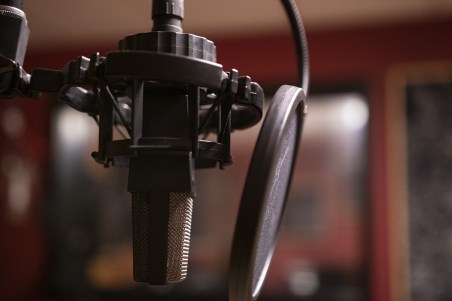 It’s often said that a good writer has a distinctive voice, but so do narrators. With audiobooks, a poor narrator can kill a story, and a great narrator can make a good book even better. Sometimes, the success of a book is due, in part, to the success of the narrator, such as The Martian. It gained a following as Andy Weir shared it over his website, and sold well when he first published it, but it’s popularity really soared with the narration by R C Bray, leading to more sales of the book, and then a film deal (which is a whole other way of telling a story).
 Maybe audiobooks should develop into their own form of storytelling. Maybe writers should produce two version of their stories, one for reading from the page, and another for narration. But writing and narration are different skills, just as producing a stage play and a film are very different processes, so maybe audiobooks will become close collaborations between writer and narrator, either stripping down the original text or working up from a ‘bare bones’ version of the story. Then, the audiobook will become not a repetition of the text, but a complement to it, a way of telling the story the writer created but utilised to capitalise on the audio environment. If a narrator can impart meaning through their performance that would take a couple of sentences of text to impart, then the audiobook can become leaner and more focused, allowing the story to take advantages of all the medium can offer.
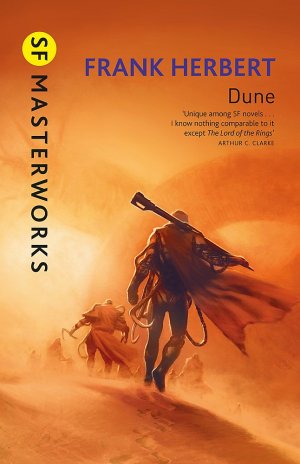 Before I dive in, there’s a couple of things to bear in mind here. Dune was published over ten years after Frank Herbert’s first novel came out, and he’d had years of publishing short stories in magazines before that, so this is a book by an experienced writer. I’m still near the start of my writing life, so I’m in no way holding myself up to be ‘better’ than Herbert (or the numerous editors who would have been involved in the book’s journey).
 Stories (in books) pass from writers to readers through the medium of words, but there is always going to be interpretation involved in this. Writers aim to give as much action/emotion/description in as few words as possible. If everything was described in enough detail to convey every single aspect of the story, the action would move at a glacial pace, and all sense of forward momentum would be lost. Stories that describe too much are (for most readers) tiring to read—hence the search for conciseness. Gustave Flaubert talked about finding ‘le mot juste’, the right word.
 TW Iain