Special offer on Dead Flesh (Dominions II)

DeadFlesh_smallIn light of the upcoming release of Rebel Rout (Dominions VI), I’ve knocked the price of the second book in the Dominions series, Dead Flesh, down to 99p/99c (or your local equivalent‌—‌basically the lowest price Amazon will allow me to enter).

With Dark Glass (Dominions I) free everywhere, this makes it even easier to get immersed in this dark Dystopian thriller series‌—‌perfect if you’ve got a bit more time on your hands at the moment.

Dead Flesh will only stay at this price for about a week, but I might have another offer for you in early April.

Dark Glass (Dominions I)‌—‌free

Dead Flesh (Dominions II)‌—‌99c/99p

Rebel Rout (Dominions VI)‌—‌pre-order only 99c/99p

Final part of ‘What Goes Around’ now available to read for free

The fourth and final part of the short-story sequence What Goes Around is now out.

It’s called It Takes A Steady Hand, and probably works best if you’ve read the previous three parts (Get The Right OneAlways A Silver Lining, and No Return). It also features the first appearance of a character who has been mentioned a great deal in the Dominions novels and stories (including the first of these short stories, The Job.)

It almost feels like I’ve had a plan for Dominions right from the start!

Anyway, you can read It Takes A Steady Hand here (and the previous parts of What Goes Around by clicking on the titles above). As always, I’d love to hear your thoughts on it.

Rebel Rout (Dominions VI) now available for pre-order

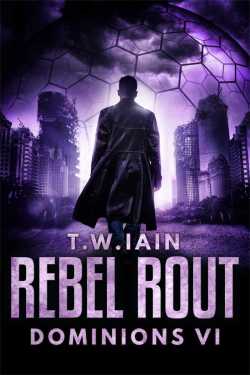
The next Dominions novel, Rebel Rout, will be released on 6th April, but is now up for pre-order at the bargain price of 99c/99p (or your local equivalent).

Dom6_small

Rodin might have liberated the Factory, but it’s still a prison to him. So an order from Authority is the excuse he’s been seeking, an opportunity to escape the meetings and the drudgery, a chance to get outside once more.

But he’s heading into a war zone, on a mission of deception. Those he travels with might be friends at the moment, but Rodin knows how easily allegiances can change.

That’s a problem Genna must face, too. Forced underground, her district in the hands of another, she’s determined to fight back. But Garrick’s always one step ahead, and that can only mean one thing‌—‌she’s being betrayed by someone close, someone she needs to trust.

And behind everything lies the invisible, powerful Authority, working toward their own ends, playing enemies and allies off each other. How can Rodin and Genna possibly win against Authority?

In the sixth book of the Dominions series, loyalties are tested, hope is pushed to breaking point, and nothing can be the same again.

Click here to pre-order Rebel Rout (Dominions VI)

Why readers are so important (5-star review for Shadowfall)

Writing is something that, for me, has grown from an activity I’d do a couple of evenings a week to something that happens every day. I’m working harder and harder at all aspects of the process‌—‌planning stories, writing first drafts, and running through different rounds of edits‌—‌as well as spending more time on marketing and other ‘business’ activities.

So why is writing important to me? There’s no single reason. A large part of it is pure enjoyment, from the excitement of developing a cool story idea through the fun of writing itself and onto the rewarding work in moulding those initial words into something I can feel proud of. Then there’s the possibility of earning money from these stories‌—‌we all need money to live, and there’s nothing wrong in seeking some kind of financial recompense for all the time, effort and money I’ve put into producing these books.

Then there’s the opportunity to entertain, to take readers on a journey, to help them escape from their daily lives for a few hours. This is more nebulous than the other reasons, but is no less important. Maybe it’s the most important reason for writing. After all, story-telling is communication, and each story only truly comes to life when it reaches across to another person.

It’s harder to quantify this reason, though. I can judge my own enjoyment in the process, and I can look at my bank balance to judge the financial rewards (or otherwise). But the effect my stories have on others‌—‌how do I judge that?

This comes down to communication. I’ve received a few e-mails and comments from readers, as well as a few reviews. I received one review for Shadowfall recently that I thought I’d share here.

Wow. That is all I can say about this book. It kept me on my toes waiting to find out what came next. I was left wanting more and I am very eager to read anything written by this writer. This book had everything I like in the fantasy genre. It was well-written with a lot of character and world building. I would definitely recommend this book.

Every time I read that review, I feel warm inside. It’s so positive, and it tells me that (for this reader, at least) I succeeded in many things I set out to achieve in Shadowfall. This review tells me it’s a page-turner, and that my work in creating a believable world, populated by relatable characters, succeeded.

Yes, the review came through BookSprout (a service that aims to match readers with books in order to provide reviews), but there was no pressure on the reader to leave a positive review. As I’ve said many times before, I’d far rather receive an honest critical review than an insincerely positive one.

2019-1719 TW Iain b01 animationShadowfall‘s slowly getting more reviews and ratings, and many of them are positive. I know the book isn’t for everyone, so I’ll receive negative comments at some point. And that’s fine‌—‌I know there will always be areas of development in my writing and story-telling. I know, too, that every reader is different, and one reader’s drudgery is another’s page-turner.

But I hope I never stop feeling so good when I receive a review like the one above. I never want to become complacent. I want to always remember that the stories I write are not only for myself (and hopefully for my bank balance). I need to remember that stories are never complete until they are consumed by a reader. Only then can they truly live.

I feel honoured and grateful that what I create can give others enjoyment. And I thank any reader who takes the time and effort to leave a review. Without readers, there is no need for writers. Without readers, stories never emerge from the depths.

Without readers, there are no books.

[As a quick post-script, what do you think of the animated cover above? Many thanks to Deranged Doctor Designs for this‌—‌one of the best cover design companies around.]

Dialogue is more than talking

I often find that dialogue can make or break a book. It might be snappy and sarcastic, or rich and evocative‌—‌and I’ll feel I’m in the scene with the characters. If the dialogue feels realistic, and drives the story on, I’m willing to forgive plot holes and clunky prose.

I also find long passages of prose rarely work (unless very well written). Even internal dialogue can help propel a scene forward.

black-and-white-2591246_640

But writing dialogue is hard. For starters, it needs to feel realistic, but it can’t be too realistic.

I recall an Kevin Smith interview, where someone commented on the natural way the characters in his films talked. He responded by saying that there was nothing natural about their dialogue. His characters go off onto rambling monologues while others listen‌—‌something that very rarely happens in real life. They’re not constantly being cut off, or using strings of filler words and sounds (‘um’, ‘er’, ‘like’ and so on), they don’t repeat themselves too often (‘So I said…‌and he says…‌then I say’). But his dialogue still feels natural, and that’s the important thing. He uses character-appropriate words and phrases to bring the spoken lines alive.

And this shows another aspect of good dialogue‌—‌it has to serve a purpose. In Smith’s case, much of the actual stories the characters tell one another seem only partially relevant to the story, but they reveal character, both in the words themselves and the way they are delivered. The same can be done in books‌—‌what a character says can reveal so much about who they are, in a far more natural way than simply being told.

For instance, a male character who peppers their conversation with words like ‘love’ and ‘dear’, especially when talking to younger women, comes across as condescending and sexist, even if the reader doesn’t consciously pick up on this. Likewise, a character who says ‘maybe’ and ‘I think’ a lot will often appear indecisive‌—‌so when they step up and make that all-important decision in a moment of crisis, we understand that they’re finally overcoming their inner demons.

Dialogue is also important for moving the story forward. Unfortunately, I’ve read far too many books where this is done poorly. Characters will say things like “Hey, you remember that time Bob broke into that old factory, and had to face all those vampires?” or “As you know, the master is due to return from his sojourn in the tropics any day now, but his mother still refuses to have the east wing redecorated, meaning she’s still in the suite next to his‌—‌and this is bound to cause a great deal of friction.”

Yes, these examples tell the reader possibly important information. But do they sound natural? Not at all. The characters are mentioning things other characters already know, merely to give us, the reader, information.

Another problem I’ve noticed with poorly written dialogue is the use of grammar.

Most people don’t talk with correct grammar. They use slang, and part-sentences. They’ll misuse words, or string words together in bizarre ways. It might be grammatically correct to say “We will leave as soon as we can,” but it sounds far more natural as “We’ll leave as soon as.”

Of course, some characters will speak ‘properly’‌—‌but even then, each character will have their own vocal idiosyncrasies. This is something I know I need to improve in my own writing. Some characters will speak in long, complicated sentences, others will use simpler constructions. Some will use dialect words, or enjoy showing off an extended vocabulary.

Dialogue can also indicate things about how each character experiences the world. One who focuses on visuals might say “I see”, whereas a character who’s more auditory might say “I hear you.”

With well-written dialogue, it should be clear who is talking from the spoken words themselves, and tags (“Bill said”, “Sheila asked”, and so on) are only needed as occasional reminders.

Writing dialogue that works well is hard‌—‌and it stands to reason that authors who can pull this off, who can use natural-sounding dialogue to develop characters and drive story, are also skilled at other areas of writing. After all, books are simply a means of telling stories. When we read a novel or a short story, we’re allowing the author to speak to us. Even when no characters in the story are talking, we’re still listening to the voice of the narrator.

Second part of the short-story sequence ‘What Goes Around’

(If you haven’t read Part 1, Get The Right One, you can read it here).

The second part of What Goes Around is Always A Silver Lining. It’s a bit more light-hearted than a lot of my stories (if a story about a dead body can ever be light-hearted), a little moment of release between the other darker, more serious parts.

You can read Always A Silver Lining here. And, as always, I’d love to hear your thoughts on it.

An offer for Kobo readers

I’ve got a lot of time for Kobo‌—‌not only are they a serious competitor to Amazon/Kindle in many places, but they are also incredibly focused on books and writers. They run a great deal of promotions, and their latest gives readers 40% off certain books.

I’m mentioning this because they’ve accepted two of my books for inclusion in this offer, Shadowfall and the Dominions Box Set. The offer runs until the 24th February, and to get the 40% discount simply use the promo code FEBSALE at checkout.

Shad1_lowShadowfall (Shadows Book One)

The company enhanced Brice. They promised him action and adventure. But he’s stuck on a malfunctioning craft, with a crew who treat him like a child. He’s miles from home, in the worst storm of the season, and night is falling.
And in the shadows the creatures wait, their hunger growing.
The company prepared Brice for many things, but nothing can prepare him for what he must face when the shadows fall.

2017-1326 TW Iain 3D Box Set on white on transparentDominions Box Set

When Rodin, professional assassin, is forced to take a contract in the perfect society of the Dome, he expects enemies. But he doesn’t expect to start questioning his own motivations, or the deadly threats from a past he no longer remembers.
Dive into the dark Dystopian world of Dominions with this collection of three novels and one novella, and begin to uncover the secrets buried beneath the glass.

Don’t forget, use the promo code FEBSALE on Kobo to get 40% off‌—‌that’s almost half price.

And to check out more books in the sale, click on the following links for specific Kobo stores: UK, US, Canada, Australia, Ireland, Germany

Why ‘Alien’ works

One of my favourite films is Alien, but only now do I appreciate how well constructed the story is. When I started working on my sci-fi/horror series Shadows, Alien was a major influence, and I’ve learnt a great deal from considering just why the story of Alien works so well.

Alien_poster

It’s easy to relate to the setting and characters

Yes, the film’s set on a spacecraft, but the setting is also surprisingly mundane‌—‌it’s a working vessel, populated by a crew who are simply doing their job. For some of them, the job’s clearly important (the captain, Dallas, takes his role seriously). But others, like Parker and Brett, are the kind of workers who turn up because they have to. It’s easy to imagine these two sloping off somewhere for a sneaky break when nobody’s watching.

Alien_2And, as with any bunch of co-workers forced together, there are tensions. Some of them get on well with others, but there’s a lot of animosity just beneath the surface. Just like any other work environment.

It’s also worth noting that the Nostromo isn’t some sleek, high-tech craft like the Enterprise, or a fast fighting vessel like the Millennium Falcon. It’s scruffy, dirty and in need of repair. It’s a floating factory‌—‌and once again, this is the kind of environment that many can relate to.

Nobody is safe

Most stories focus on a hero, and in films this role is normally played by a big-name actor. We can usually be pretty secure in guessing that this character will survive, with the lesser characters (played by actors we don’t recognise) becoming fodder for the monster.

But Alien turns this on its head. John Hurt was one of the bigger names attached to the film, and he’s the first to die. With him gone, maybe we assume Dallas will survive. After all, the film starts with him alone on the Nostromo, before the rest of the crew wake. He’s the captain, and Tom Skerritt was another fairly well-known actor at the time.

When Dallas dies, it’s a shock, and it leaves things wide-open for who will eventually survive (although as the crew dwindle further, Ripley does step up to be the hero). With with lack of certainty, tension increases.

Horror can come at any time

The alien bursting from Kane’s stomach is probably Alien’s most memorable scene, but it’s worth noting the setting. This moment of gut-wrenching (sorry!) horror comes not in a dark corner of the craft, or on an alien planet. No, it occurs while the crew share a meal. They’re eating and joking. It’s a bonding moment, something we’re all familiar with‌—‌right up to the moment Kane’s stomach starts to bulge.
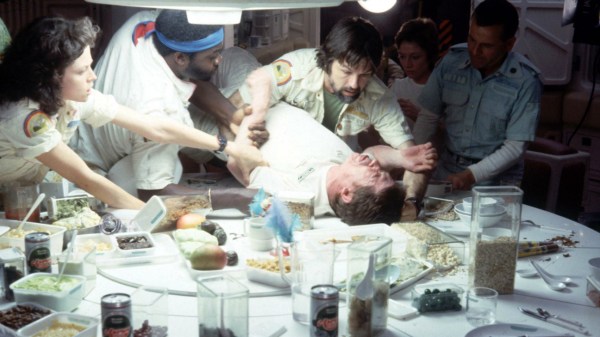
Alien_1And this tells us that nowhere is safe. Even if characters are together, in brightly-lit familiar rooms, they’re still in danger. We don’t need to peer into the darkness looking for monsters, because they could leap out of anywhere, at any time.

We’re in the dark with the crew

We never get to see the alien in its entirety until the very end of the film. In part this was down to film-making restraints at the time, but it makes the film so much more effective‌—‌we never quite know what’s after the crew.

Jaws pulled off a similar trick, in refusing to show the shark until the second half of the film. We see the victim through the shark’s eyes, and we see the effects of the attacks (the swimmer being dragged under, the blood soaking the water). But we don’t see the shark itself.

What we can’t see is far more scary than what’s in front of our eyes. Our imagination fills in the blanks with our own worst nightmares.

There are things we have no control over

Its worth taking a closer look at Dallas’ death.

Alien_4The rest of the crew are following his progress through the ducts. They have audio communication, but the only visual is on a map, with a marker to indicate his position. And then a second marker appears, indicating the alien’s position‌—‌and it’s closing in on Dallas. They yell for him to get out, but as the alien approaches there’s nothing they can do to prevent the inevitable.

In that moment, the crew are helpless witnesses, with no control over the outcome. Just like us, watching events unfold on a screen, unable to alter events.

We’re helpless, just like the crew.

Time is running out / the false ending

As the alien takes out the crew one by one, Ripley sees only one way to destroy the creature‌—‌self-destruct the Nostromo while it’s still aboard.

This give a tense race against the clock. As alarms blare and Mother counts down to self-destruct, Ripley rushes to the shuttle while trying to save Jones the cat and avoid the alien.
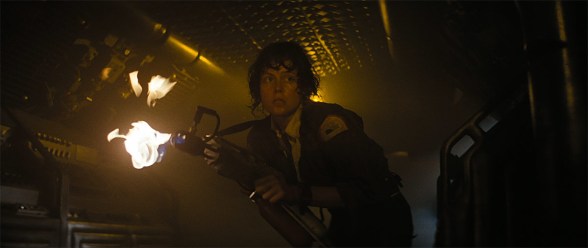
Alien_3But she makes it. From the shuttle, she sees the Nostromo explode‌—‌and then realises she’s not alone on the shuttle. The alien is with her.

The tension and fear jump up a notch now. There’s nowhere for Ripley to run.

It’s a wonderful ending to a beautifully constructed story.


This list isn’t exclusive, and I know there are many great moments and ideas I’ve left out. But even this limited look at Alien shows why the story is so effective at pulling us in and keeping us engaged right to the end.

None of these things are original, of course. But the creative minds behind Alien used them to great effect, giving us a film that still works, over forty years after it hit the screens.
New short story – ‘Get The Right One’

This story’s part of something I’ve wanted to try for a while now.

I enjoy reading books in a series, but cliffhangers between books frustrate me. In my own series, I’ve always aimed for each book to tell its own story, while also being part of a larger story, told over the whole series.

And I wondered if I could write a series of short stories in the same way‌—‌each one its own thing, but all connected.

I’ve done something similar before, with For Blood (I) and For Blood (II), but that was one event viewed from two different sides. But now, I have a series of four stories, under the title What Goes Around. They’re set in the world of Dominions, and this first story, Get The Right One, is another tale of Rodin. He prides himself on always fulfilling a contract, and he’ll pay close attention to the wording, too. Even if that means he has to look past the obvious.

You can read Get The Right One (What Goes Around, part 1) here.