Join the Dark Sci-Fi Book Giveaway Now

They’re not for everyone, but some of us enjoy the darker side of sci-fi. The future might be some kind of utopia, but there are so many great stories where the future isn’t a happy place.

If you enjoy books that explore darkness in sci-fi, then check out the Dark Sci-Fi promotion for free books. Click here to find out more.

This promotion ends at the end of the month, so don’t hang around.

The Uncovered Consequences Of Technology

Revisiting my previous books leads to a range of emotions. There’s pride (’this is something I created!’). There are moments of surprise (’I’d forgotten how well that twist works!’) But there’s also a vague sense of disappointment.

Yes, I may uncover mistakes (proofreading errors always slip through), but that isn’t what I’m getting at here. As I continue to write, my writing and story-telling improves. And there are moments in those older books that now feel clunky. There are passages (some long, some short) that I would now tighten. There is a great deal of room for improvement.

In retrospect, I didn’t use technology to its full in my Shadows and ShadowTech books.

In both series most characters have a lattice. This is a tech layer that sits beneath the skin and interacts with the body and mind. It can speed up healing. It can increase the efficiency of the body. It enables people to interact with different systems without physical connections, too. Pilots fly their craft by the power of thought. Hackers don’t need to rely on keyboards or other interfaces, only their lattices. People can operate machinery without needing to press any buttons.

The lattice also enables a kind of tech-based telepathy. People can ‘talk’ through their lattices, either in tight or wide conversations, without uttering a sound or moving their lips. With the aid of boosters, this communication can happen over vast distances.

Almost everyone has a lattice‌—‌but not everyone. A central character in these books has to cope with being seen as ‘inferior’ because of her lack of functioning lattice. Another character’s lattice starts playing up, leading to various complications.

So, what’s the problem?

Let’s take a step back. Think of mobile phones, and how different things were prior to their existence. Travelling to somewhere new meant using paper maps to plan a route, with no sat-nav to guide every single turn. End up in difficulties in the middle of nowhere, and you’d better hope someone came along, because there was no way to (easily) call for help. And if you came across something amazing you’d be telling people about it later, trying to convince them you didn’t make it up‌—‌no magical device you could pull out to record and transmit images and videos across the world in real-time. Need to know something? You’d have to visit a library instead of doing a quick internet search. Need to sort out your finances? Better make time for a trip to the bank, then wait five working days for any changes to take effect.

And I haven’t even touched on social media. Or QR codes. Or having a complete library of books, music and films on hand wherever we are, all the time.

Having these devices on hand at all times has changed so much of our daily lives that pre-mobile times are like another world.

Technology has consequences. Technology can change societies, in ways that can’t always be predicted. Technology can be invented for one purpose, but people will use it for all kinds of other purposes.

The same should be true in fiction. A powerful technology should have a major impact on day-to-day life.
I came across a great example of this a while ago. I think it was in Peter F Hamilton’s Salvation series (although I could be wrong).

Many sci-fi stories circumvent the impossibility of faster-than-light travel through portals or wormholes. Sometimes they are in set places (think Stargate), but in the Salvation books portals can be any size, and are extremely portable. Characters have collapsible portals they can carry around with them.

But throughout the books Hamilton explores how these portals could be used in so many different ways.

How do you change a desert into fertile farming land? You need water. How do you get water to the desert? You can pipe it in, after first laying the pipes. Or, with these portals, you can literally drop water onto the desert‌—‌a portal in the air above the arid landscape, a corresponding portal being fed water, and instant rain!

Cities would change, too. When workers can use portals to commute, there’s no need for mass transit infrastructure, so those unused wide roads become green spaces, turning the cities into more pleasant environments. With travel times so drastically reduced, there is also less need for hotels, less need for dense urban residential areas. Why live close to work when, with portals, anywhere is close to work?

That might be fine for the hoi polloi, but what about the wealthy? There’s no need for holiday homes when each room of a ‘house’ can exist in a separate geographical location, connected by portal doors. Eat in a dining room looking out over a vast Savannah, then relax in a lounge on a tropical beach. When that gets too warm, retire to the bedroom and watch the snow-covered mountains from the balcony.

And what about those exploratory craft travelling through space (because portals only connect to other portals‌—‌you can’t skip to somewhere totally new)? Hitting debris in space could be catastrophic. Place a portal at the front of the craft, another at the rear, and the problem is solved.

See what I mean? A technology that serves an important purpose in the story (allowing characters to travel vast distances without the time of that travel slowing the story), but one that has story-world implications. Even if the technology itself is ‘impossible’, the consideration of the wider impact makes it feel ‘real’.

So this is my challenge (one of the many) as I work on this new series. For every piece of technology I introduce, I need to consider the implications. How would it impact daily life? How would it be used for work and for entertainment? How would people twist the technology to their own purposes?

How can I make the fictional technology in my books feel as real as a mobile phone?

It’s definitely a challenge. And a daunting one. But this kind of world-building is all part of the fun of writing science fiction.


This post originally appeared as a part of my Substack on writing a new series. If you want to have these posts delivered to your in-box when they’re released, please consider subscribing for free to my Substack by clicking here.

Kobo Plus: Your Gateway to Free Sci-Fi Books

If you read on Kobo, you might know about Kobo Plus. It’s their subscription service‌—‌pay a monthly fee, and you can read as many books as you want. And there are loads of books in Kobo Plus, including science fiction.

You want some examples? Check out the titles in this promotion‌—‌all free on Kobo Plus. And if you read on other platforms, you can find these books at other retailers too. So take a look, click on the covers that look interesting, and find a great new read for the start of the year.

When characters go off-script, and why working doesn’t only mean ‘doing stuff’.

You might’ve heard writers say things like ‘my characters keep on doing things I don’t want them to’, or ‘my characters are always surprising me’. For a long time I thought this was nonsense‌—‌if you’re writing the story, surely you’re in control. Those characters are your inventions. They do what you want them to.

But this happens to me. I’ll be writing, and because of my planning I’ll have a solid idea of where the scene’s going. Then I’ll have a line of dialogue come to me, and before I’m aware of it the words are out of my mind and onto the screen. I’ll read it back and realise this one line could throw the whole story off-script.

Maybe I should illustrate this with a couple of examples.


The main character in the story I’m currently working on (a story adjacent to the main series, because I needed a break‌—‌read my previous post for more information) is called Kane. He’s a loner. He’s been through a lot, done things he’s not proud of, and he’s learnt from his mistakes. Older and wiser (he hopes), he prefers to solve problems without resorting to violence, but if things get physical he can usually take care of himself.

As the story progresses he finds himself on a courier vessel, a part of a team hired for a particular job. But Kane manages to enter the crew’s area, where he strikes up something like a friendship with the vessel’s captain (once she’s overcome her wariness of him).
But as I wrote scenes where they talked I became aware that some of their dialogue and behaviours, bordered on flirting. This came from both the captain and Kane.

This wasn’t something I’d planned on. Kane generally doesn’t like people‌—‌he’ll work with them, and he can be sociable when it’s required, but he’s content on his own. H isn’t looking for any kind of relationship, even a short-term one.

At least, I didn’t think he was. But maybe there’s a side to Kane I wasn’t aware of.

But I didn’t plan for anything like this. It’s going to force me to reassess the rest of the story‌—‌if I introduce a bit of flirtation, that sets up an expectation. If I then ignore this flirting I’m not honouring an implicit promise‌—‌that this flirting will be relevant or important in some way.


Let’s look at another example. Kane comes into contact with another member of the crew (who I haven’t yet named). This crew-member is antagonistic towards Kane, and I initially thought this was because Kane shouldn’t have been in the crew area. But in a later conversation with the captain she said that this crew-member has been struggling for a while now.

The vessel, by this stage of the story, is docked at what I’m calling an orbital‌—‌a satellite the size of a large town. There are tensions on the orbital, with different factions vying for power‌—‌a situation that will, over the course of the story, push Kane to ‘save the day’.

But as Kane and the captain talk, she mentions that this crew-member has worked on the orbital before, and that this is a big part of his problems.

I have no idea where that came from. But as I thought about it, I saw possibilities. I saw how a troubled past could interact with the current situation. I saw how it could enhance the whole book.

But, as with the flirting, it’s going to mess with my planning.

So I have two options. Either I go with it, or I rewrite these scenes to edit out these ‘surprises’.

I’m reticent to throw these surprises out, though. Because there’s something important going on here.

I’ll try to explain.


We’ve been conditioned to think of work as ‘doing things’. If we’re being paid, we’re expected to be physically doing things for the time we spend at work. If there’s nothing productive to do, we find things to make us look busy‌—‌because not doing anything isn’t working.

It’s the same with writing. If words aren’t going down‌—‌whether in drafting, planning or editing‌—‌then it feels as if we’re not really writing. There’s a certain amount of pressure to produce a certain number of words each day. When we’re not physically writing (or typing) there’s a nagging guilt, and we tell ourselves we’re being lazy.

But writing, as with any creative activity, is far more than simply ‘doing the physical activity’. So much of writing involves thinking. We need to think about our stories and our characters. We need to explore different possibilities. In science-fiction we need to imagine exciting and interesting technologies, wild new worlds, craft that can travel across the vastness of space.

Some of that thinking is ‘active’. It happens when we’re sitting at our (metaphorical) desks. This is the kind of thinking we do at the laptop, typing up our ideas as they occur, or scribbling into a notepad. This is the thinking we do between lines, when we look up from the laptop and stare into space for a while, mentally running through possibilities for the next paragraph.

But thinking goes far deeper. When working on a story (or a whole series) we have countless ideas in our minds. We need to write them down to keep track of them, but those ideas are still buzzing around when we’re not typing or writing. We have a problem in the story, and that problem sits in our mind. We ruminate on it. It’s easy to become distracted while doing something else because we’re trying to find a solution.

And, far too often, that solution seems to come out of the blue, and at some random time. In the shower, or while exercising, or as we’re dropping off to sleep.

Because these problems sink into our subconsciousness. And our subconscious minds are churning away all the time. We’re ‘thinking’ even when we’re not thinking.

So when ideas seem to appear out of the blue‌—‌when characters do things I hadn’t planned or say things which go way off-script‌—‌I have to take notice. Chances are, these surprises come from my subconscious mind, and are solutions to problems I’m not yet fully conscious of in the story.

So Kane and the captain’s flirtation tells me I probably need to open Kane up to the possibility of not being so much of a loner. Or maybe it’s telling me that there’s another part of the captain’s character I haven’t fully understood yet, a part that is going to influence Kane’s decisions later in the story. And the crew-member’s history with the orbital tells me I need to make the story deeper to make it richer. It’s forcing me to reconsider Kane’s motivations for various things I ‘want’ him to do.

Does this mean more work? Definitely. I need to pause (maybe not for too long) and adjust my planning. When it comes to editing I’ll need to make sure these surprises don’t feel too random, that they’re foreshadowed as much as they need to be. And maybe this will lead to more ‘problems’ later on, with more things needing to be worked out when it comes to the edit.

But the extra work is worth it if it makes the story better.


This post originally appeared on my Substack, as a part of my attempt to document my work on a new series. If you’d like to read these posts as they are published, delivered to your in-box, then sign up to my Substack for free by clicking here.

Start the new year in a new world with these free books

How does a free book sound? What about a couple? Or five? More?

This promotion has almost a hundred books, all free. The range across science fiction and fantasy. You can find short stories, novellas, novels, and even collections. There’s something for everyone here.

But don’t cogitate for too long, because this offer disappears at the end of January. So click here to snap up some free fantasy and science fiction, and start your new year exploring new worlds.

Banner for the 'free fantasy & sci-fi ebooks' promotion

Escape Holiday Stress with Free Fantasy and Sci-Fi Reads

If you’re in need of a break from holiday festivities, books are perfect. Escape into a new world, experience exciting adventures, all from the comfort of your sofa. Or bed. Or wherever else you read (the bath?).

This promotion brings together over 80 free science fiction and fantasy books, all centered around friendship. Some are uplifting‌—‌found family, or friends helping one another to get through tough situations. Others could be darker, involving betrayals and ‘friends’ who are anything but.

There’s something for everyone. So click here and escape into a free book today.

Taking a break doesn’t mean stopping

I’ve done it! After what feels like far too long, I now have a finished first draft.

It feels good to reach this point but this is only the start. Editing is vital to writing, and this draft needs a great deal of editing. This book and series are more ambitious than anything I’ve previously written, with multiple points of view spread over multiple story arcs that all need to weave together seamlessly for the series to work.

I’ve been reticent about sharing too many details about the story itself (because so much can change), but I’ll give you a brief overview of the story strands in this first book. One involves a generation ship, a craft the size of a city travelling between the stars and seeding new colonies. On this ship is a kind-of detective who starts investigating what seems to be a straightforward case, but it soon develops into something that threatens the whole ship, and might involve strange signals the ship is picking up.

Another strand follows a rag-tag crew of a courier, running less-than-legal jobs across the various star systems. Their current job throws them into tensions in a particular system, where they’re forced to choose sides if they’re to remain at liberty.

The final strand involves a new member of Unity (a sort of galactic government), someone with lots of promise but who’s still naive about the way things work. She’s fighting for recognition against the backdrop of potentially alien signals emerging across the galaxy.

These strands will interact as the series progresses (and more strands will be added), but for the first book to work there has to be some kind of cohesion between them. But at the moment they feel too much like separate stories.

There’s also the matter of this first draft’s length. I normally aim for my novels to be no more than 100,000 words, with first drafts normally clocking in at around 125,000 (I tend to waffle as I find my way into the story). But this draft is a ridiculous 230,000. Each strand could easily be a book on its own.
This is something I considered — and then rejected. I doubt I could pull that off. The overall story would feel far too fragmented.

So I have a great deal of work ahead in wrangling this draft into something that resembles a coherent book (and that’s before I deal with the words themselves). It’s a huge task. And it’s not one I feel up to at the moment.

I won’t dwell on possible reasons for this (tired, busy day job, holiday season approaching?). Instead, I need to come up with a solution.

And I think I’ve found one.

Back when I wrote my first series, Dominions, I’d have multiple stories on the go at the same time. I’d finish a first draft of one novel, then jump to editing a previously drafted novel. Then I might plan and draft a short story or novella. And when I reached the mid-point of the series I took a short break in order to plan and write what became the first book in my Shadows trilogy.

And I felt very productive. If one particular project (novel, short story or whatever) was becoming too much I could jump to something else. I’d get energised by working on something different, and the problems in the original project would be churning around in my subconscious, running through all kinds of potential solutions.

This stopped when I reached the end of both Shadows and Dominions. I wrote my next series, ShadowTech, one book after the other, with very little in the way of ‘filler’ projects (a few short stories but not much else). And now, since the summer, I’ve been immersed in this new space-opera series.

So I need to have a secondary project. I need to have something else I can work on when the primary project starts dragging.

And I have just the thing.

I believe I mentioned in a previous post that, as I’ve been planning this series, I’ve had all kinds of adjacent ideas. Things have cropped up that fit in with the story-world (story-galaxy?) but won’t work directly in the main story arc. And I’ve had thoughts of different side-stories, even whole side-series.

So I’m going to work on one of them for a bit. I’m taking the captain of the courier ship, Kane, and exploring his back-story. In the main series he has a strong connection to his ship, Seraph. But how did he come to be Seraph’s captain? And how did he pull together his crew of misfits?

This will be a far more linear tale. In writing Kane’s back-story I’m following one character, one strand. The story itself won’t be galaxy-spanning (although there’s plenty of scope for travel to other worlds and other stars). Rather than being a complex story told over a complete series and following multiple point-of-view characters, Kane’s tale will be primarily a series of individual adventures.

I’ve started work on this, and I’m enjoying it. I have a rough outline, but I’m letting the story develop a lot as I go. I’m having fun exploring Kane’s character, and that means I understand him more. When I return to editing that original novel I’ll have a far better grasp on his character, which will enable me to ensure he’s acting as he should and not doing things that are wildly out of character. Also, as I explore the galaxy through Kane’s adventures, I’m developing my understanding of the setting and the technology, as well as how the people in this galaxy function.

Just as this side-story (and others that I’m sure I’ll write in the future) provide more information on the story-world for those who want it, they also help me create a more lived-in and realistic story-world.

So I’m not really taking a break. This is research. This is development.

It’s all part of that spiral of writing, circling around and around but always building. Is it easy? No. But nobody ever said writing a decent book, let alone a decent series, was easy.

If it was easy, there’d be no fun in it. If writing was simple, there would be no challenge.


This post first appeared on my Substack. If you’d like to receive these ongoing updates on my new series as they’re posted, please consider subscribing to my Substack for free by clicking here.

I have box-sets for sale on Kobo

Looking for an escape over the holiday season? Want to dive into a sci-fi box-set? I have a few in sales on Kobo at the moment.

Get Shadows: The Complete Trilogy, a sci-fi shot through with a dark vein of horror, for 30% off.

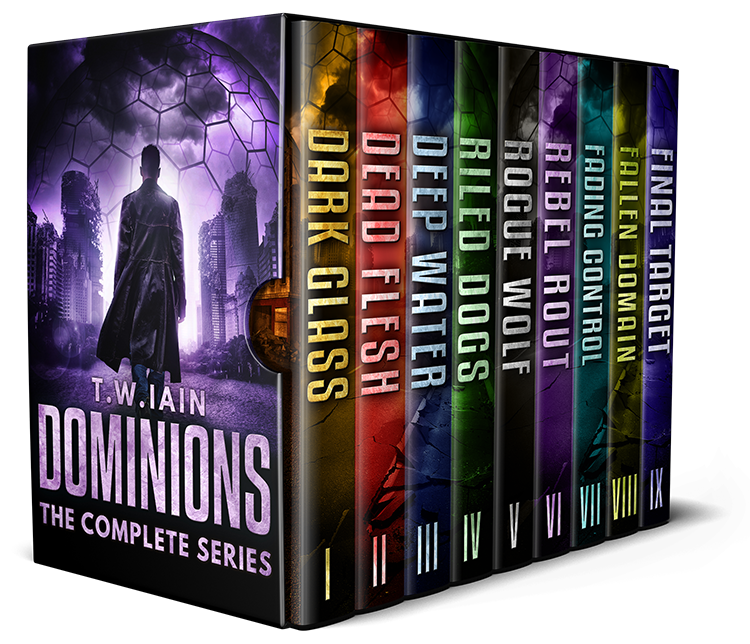
Get Dominions: The Complete Series for 30% off too‌—‌nine novels (and a few novellas and short stories) of Dystopian thrillers.

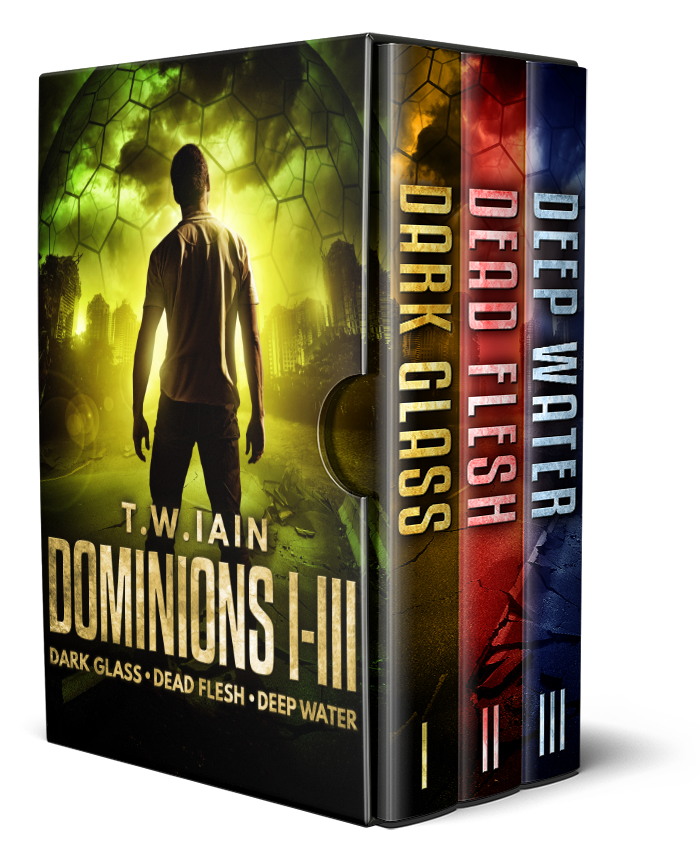
And if you’re a Kobo VIP reader, you can get my Dominions Box-Set (the first three novels in the series, along with the prologue short story, for 40% off.

Massive Discounts on Ebooks: Smashwords End-Of-Year Sale 2024

Smashwords is running a massive End Of Year sale, with books anywhere from 25% off to totally free. There are hundreds of titles to browse, across every genre you can imagine. And if you want any of my books, they’re all 75% off (which means the novellas and shorts are effectively free). Check them out here.

The sale runs until 1st Jan.

Why consider getting books from Smashwords? Apart from sales like this, Smashwords aren’t connected to any particular ebook ecosystem. Download the books you buy (or get free), and read them on whatever device you prefer.

Click here to start browsing the complete list of bargain books, or click here for my books.