If you enjoy science fiction or fantasy, and you’re looking for a new series to sink into, then check out this promotion—around 150 books, each one the start of a series. But hurry—this promotion finishes on 16th June.
If you enjoy science fiction or fantasy, and you’re looking for a new series to sink into, then check out this promotion—around 150 books, each one the start of a series. But hurry—this promotion finishes on 16th June.
As I gear up for the Tales of Dominions Kickstarter, I now have proof copies of the special edition paperback and hardcover.
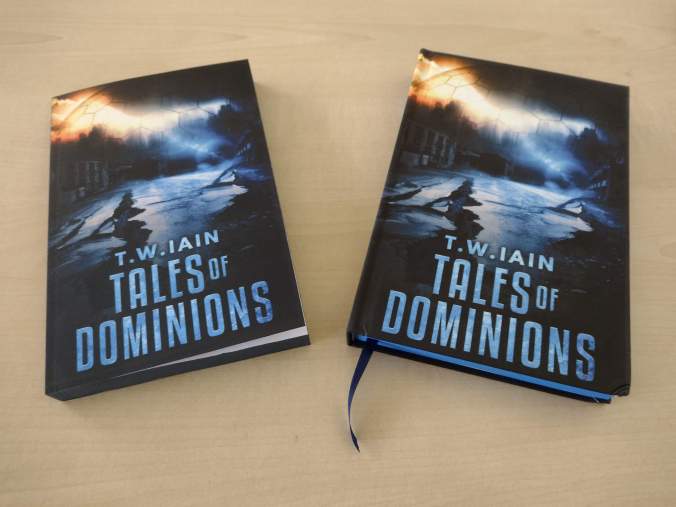
I’m already looking forward to ordering copies for others—but that’ll only happen after the Kickstarter campaign. It all starts on 9th June. To ensure you don’t miss out, click here and have Kickstarter notify you when the campaign launches.
And please share this with anyone who might enjoy a collection of dark Dystopian novellas and short stories.
Over the next few posts I’m going to be diving into lessons I’ve learnt from climbing, and how they relate to writing. I’ve enjoyed climbing for a long time (roughly as long as I’ve enjoyed writing), but it’s only recently that I’ve become more serious (or maybe the word should be ‘intentional’) about both endeavours. Along the way I’ve noticed connections between the two activities. Lessons I’ve learnt at the climbing wall correlate to lessons I’ve learnt typing away on my laptop. And on reflection, these lessons could be seen as ‘life lessons’.
But let’s back up. I need to tell you a little about my climbing.
I’ve never been keen on sports. Never got into football. Didn’t play on any teams. I swam with the local swimming club, but I never pushed myself particularly hard. I think I was content simply ploughing up and down. Oh, and I did enjoy cross-country running at school. I wasn’t the fastest, but I could keep going. I’d settle into my own rhythm and enjoy a bit of alone-time.
Definitely introverted tendencies coming out here.
Then, in my twenties, I wound up working in an outdoor activity centre in North Wales. This introduced me to all kinds of new activities—canoeing, archery, hill-walking. And climbing.
And I enjoyed them.
In retrospect, I can understand why. These activities aren’t sports so much as physical pastimes. The aim isn’t to ‘win’, but to enjoy the activity itself. They had their social elements, but these weren’t too overt—going climbing with someone isn’t the same as going to a pub in a group. And, in all these activities, there’s a certain amount of time spent alone. In climbing, even when with others, there’s usually only one person actually climbing at any one time, the other belaying (’holding the rope’).
A quick note on the word ‘climbing’. It covers a wide range of activities, from mountaineering to bouldering. I started with multi-pitch rock climbing—using ropes and all kinds of metal-work, learning how to securely attach myself and others to the rock, often spending a whole day on a single route (usually with fairly long walks to and from the rock-face). Later I got into bouldering—climbing shorter routes that don’t require ropes. I now climb at an indoor bouldering wall—twelve feet high, lots of mats, short but tricky problems to solve.
Back to my climbing story. I enjoyed the activity, but I never particularly pushed myself. I was content on easier routes, enjoying the experience and the views. I never tried harder routes. I wasn’t interested in working on my technique.
Eventually I stopped working at outdoor centres, and life took various turns (as it does). I still had all my gear (ropes and so on) but didn’t go climbing.
Until, about a decade ago, I chanced upon an indoor bouldering wall close to where I was then working. And when a change of jobs made it convenient, I started going regularly. But I didn’t particularly try hard (I’m detecting a pattern here!) I was happy simply climbing. I might give a problem a couple of goes, but if I couldn’t manage it I’d move on to something else.
But, slowly, that attitude changed. I started watching others, and talking with them. I started picking up on different techniques.
And, over the last couple of years, I’ve been pushing. I now usually go twice a week. Rather than give up after a couple of goes on a route, I’ll ‘project’ it—trying different techniques and approaches, climbing different sections then trying to put it all together, and coming back to it over a few weeks.
I’m improving. I wouldn’t say I’m a good climber (I’m probably on the low end of average). And at my age I can’t expect fast improvements. I’m not as flexible as I used to be. If I injure myself it takes longer to recover. My day-job (lots of heavy lifting) helps keep me in shape, but I’m not in my twenties any more. I know I’ll reach a point where physical limitations mean I can’t push onto harder routes. At some point remaining at the same grade will be success. But until I reach that point, I want to keep improving. A few weeks ago I managed to get up a route graded v7 (I usually just about manage a few v6 climbs), and while I’m sure it was soft for the grade, this has spurred me on to try more climbs at this level. And to have any chance at completing them, I know I need to improve my technique as well as my ‘mental game’.
So that’s where I am with climbing. And there are clear parallels with my writing development.
I’ve always enjoyed reading, and loved writing stories at school. This was pushed out by guitar playing for a while, but one winter, around working shifts at a local flour mill, I wrote a draft of my very first novel. I wrote it in pencil, in exercise books.
And it was terrible. I’ve since typed it into a computer, and I still have the file somewhere, and that’s where it’s going to stay. An achievement to have finished a story of novel length, yes, but it’s not something I’d want to inflict on readers.
Fast-forward to about ten years ago, and work wasn’t going well. I think I turned to writing as an escape (and I may expand on this later). In 2015 I made the conscious decision to ‘get serious with writing’. I wrote (or edited) every day. I planned a series. In 2016 I released the first three books in that series.
As of last year, and I had around twenty titles out. I was coming to the end of my third series, and was planning a new project. That project is the subject of this collection of posts—my space-opera series and spin-off series.
And, as I’ve previously mentioned in these posts, I felt this was a gear-change. To pull this series off I needed to focus. I need (and want) to vastly improve my writing.
So, I’m currently striving to improve in both climbing and writing. And, as I mentioned earlier, I’m seeing more and more parallels between the two. Lessons I learn at the wall relate to writing, and vice versa.
One of these lessons is that it is hard to improve in supposedly solitary activities without other people.
The kind of climbing I now do, bouldering, requires no ropes. I don’t need a partner to tackle a route. Once I’m at the wall I choose a problem and climb.
And I can make progress on my own. But it’s slow. I don’t know what I don’t know, so when I’m stuck I can’t always see a way forward.
Climbing with others helps me overcome this.
There’s a wonderful camaraderie amongst climbers. The atmosphere in climbing walls is always friendly. There is always someone around who’ll offer advice or suggest a different approach to a particular climb. As I rest between climbs I can watch and talk to others, picking up new ideas and techniques.
This help doesn’t have to come from ‘better’ climbers either. There’s one particular climber I often see at the wall who doesn’t manage the higher grades I climb, but when he’s on the wall he moves with incredible control. Watching him reminds me that I need to focus on my technique rather than throwing myself at holds. And because he relies on technique rather than strength he’ll approach problems from different angles, showing me more efficient ways to climb.
The encouragement from others is important too. So is the opportunity to rest and talk—when climbing on my own there’s too much temptation to keep going rather than allowing my body the rest it needs between attempts.
And, even for an introvert like me, there is a certain pleasure in being around others who share common interests.
Other people are important in writing, too.
Yes, a large part of the appeal of writing is the solitary nature of it—shutting myself off from everything and diving into imaginary worlds. But if I want to improve, I need to learn from others. This can be at a remove—reading books or listening to podcasts. It can be more direct—taking courses or attending conferences. And it can be even more personal.
I’ll admit I struggle with this. I’m as introverted online as I am in real life. Interacting with others, even on social media, is something I find hard. But I’m realising more and more that I need the support of other writers. If I’m part of a group of writers I have others to bounce ideas off, others to ask for advice. Being in a community of writers would provide encouragement along with practical support. Also, in the same way that watching others climb and reflecting on what I see can improve my climbing, seeing how other writers do things (be that craft-related or in marketing and advertising) can offer me fresh perspectives and new ideas.
So, my first lesson—community is important. Even if it means pushing beyond my comfort zone, I need to reach out to others if I’m serious about improving.
Next time I’ll examine what climbing has taught me about the nature of progress, and how that relates to my writing.
This post is the latest in a series I’m running on Substack, chronicling my work on this new project. If you’d like to read these posts as they appear, please consider subscribing for free.
As I work on a new series I’m also tying up loose ends on previous series. One of these involves the various Dominions stories I’ve published—those novellas and shorts that work as side-stories to the main nine-novel series. I’ve wanted to bundle them up in a single volume for a while, and I’ve finally got around to it.
Tales of Dominions will include all the published stories—Gatekeeper, Expedient, Errant, Animus and Impact—along with behind-the-scenes notes. It will also include Control, a novella previously only available through my newsletter.
Tales of Dominions will be available in ebook, paperback and hard-cover—but I’m not releasing it in the usual stores. Initially, Tales of Dominions will only be available through Kickstarter. And this will also include special exclusive print versions.

This Kickstarter campaign starts in the middle of next month, running for about three weeks. But if it sounds interesting, you can visit the pre-launch page. Click on the ‘notify me on launch’ button, and Kickstarter will email you when the campaign goes live.
Last week I read The Book Of Elsewhere, the collaboration between China Mieville and Keanu Reeves. I knew nothing about this book when I got it. I’ve read a couple of Mieville’s books, and I’ve enjoyed them, but apart from that, I came into The Book Of Elsewhere with no preconceptions.
I’m still not sure what I think of the ending, but I was definitely engrossed in the story after the first hundred pages.
Those first hundred pages, though, were tough. I wasn’t sure what was happening. Maybe this was intentional, or perhaps I simply wasn’t reading with enough focus, but I was confused. I had to read slowly. After browsing reviews, it looks like quite a few reviewers had similar reactions and didn’t finish the book.
I persevered, in part because I don’t like giving up on any book, but also because I trusted Mieville. The previous books of his I’ve read were strange, and the writing leaned towards a literary style. He’s not easy-reading. But he’s good. He knows what he’s doing. I chose to believe that he’d pull the story together, that all this struggle would pay off. And that trust was paid off.
This got me thinking. With any book, the reader has to trust that the writer knows what they’re doing—that those fragments at the start will come together at the end, that the seemingly random references will be important as the story develops. But there’s also trust in the other direction. A writer has to trust the reader.
A comment I received on my earlier books was that I explained too much (that was the gist of the comment, at least). And it’s a valid complaint. I wanted readers to experience the story through the characters, so I naturally wanted readers to know how the characters were reacting emotionally. I felt I needed to let the reader into the characters’ inner monologues.
But I was over-explaining. A lot of the time, even when I showed the character’s reaction, I’d also tell the reader how they felt.
Telling, not showing. I was breaking that fundamental ‘rule’. Yes, there are times when it’s more efficient to tell the reader what’s happening, but usually (and especially in important scenes) it’s better to show. It’s better to let the reader experience the scene through the actions and words of the characters.
It’s the difference between telling the reader that a character is angry and showing that character becoming withdrawn, or having them snap back when asked a question. It comes back to Chekov’s advice—‘Don’t tell me the moon is shining; show me the glint of light on broken glass’.
I can understand why I over-explained, and why I told the reader so much. It was down to trust. For one thing, I didn’t have enough experience to trust myself. But also, in not wanting the reader to miss anything, I didn’t trust them to pick up on subtle clues—like a character growing uncharacteristically quiet, or seeing light glinting on broken glass.
Readers are smart. Readers—and I’m talking about habitual readers here, those who always have a book on the go—have experience of story. They’ve devoured hundreds and thousands of character portrayals, scenes of emotional dialogue, well-crafted descriptions and so on. Reading is active (more active than watching visual media), so readers engage more of their intellect when reading.
And nobody likes to be beaten over the head. Nobody likes to be treated like an idiot. Dumb things down too much, and readers turn away.
But what if I’m too subtle? What if I don’t give the reader enough?
It’s a balancing act, and there are no perfect solutions. A big reason for this is that every reader is different. Some will pick up on those small clues, see them as obvious. Others will miss them entirely. But even readers who miss the clues consciously can pick up on them subconsciously.
I’m sure this has happened to you—you’re reading a book, and it should be good. It has everything you normally enjoy in a decent story, but something’s missing. It’s leaving you cold. You can’t quite put your finger on what’s wrong.
But your subconscious knows. It’s picked up on something, maybe in the writing, maybe in the story, possibly in the characters. It’s used all that experience, all those other books you’ve read, and it’s detected a problem in this one.
Then there are those ‘surprising but inevitable’ moments. A character does something unexpected, yet it feels right. Better than that—it’s good. Or the story develops in a way you could never have imagined, and even though you want to dismiss it as ridiculous, something about it makes total sense.
This is where those subtle clues come in. The writer has sprinkled them earlier in the story, passing moments that the reader hasn’t consciously noticed—but the subconscious has. And, when the twist comes, the reader can take a moment to reflect, and those clues become clearer.
A classic example of this is The Sixth Sense. Yes, some people saw the end coming, but for many the final revelation was a shock—but one that made sense when considering all those earlier scenes—the anniversary dinner where his wife doesn’t seem to register him being there, the scene where he’s sitting silently with someone else, no words spoken, no eye contact made.
If those clues had been too blatant, the shock of the revelation wouldn’t have been so effective.
So, in writing these new books, I need to be subtle. I need to trust the reader to pick up on those little character moments, those phrases dropped into the text, those references that on the surface appear to be nothing but world-building.
And getting this right won’t be easy. I won’t be able to succeed for every reader (because every reader is different). But I can try. Not in first-drafting, but in editing. Being aware of the issue is half the battle. Once I have the story working I will go back through it all, looking for places I’ve told too much, seeking moments I can drop those subtle hints.
Readers are smart. As a writer, it’s important that I remember this and trust them.
This post is the latest in a series I’m running on Substack, chronicling my work on this new project. If you’d like to read these posts as they appear, please consider subscribing for free.
It’s time to take stock. I’ve been working on this new project for a while. Before continuing it feels right to take a moment and see how things stand.
First, this is taking far longer than I anticipated. I started writing seriously back in 2015, and since then I’ve published nineteen novels and various shorts and novellas. That equates to roughly two novels a year—not fast by some standards, but not too shoddy. But the last book I released was the final ShadowTech novel, back in June last year. This will mean over a year with no new book released. It might even be longer until the first book in my Unity series appears.
There are reasons for this. It’s long. At the moment it stands at over 200,000 words, twice as long as anything else I’ve written. It’s also the most complicated story I’ve worked on. The first book has three separate arcs, in effect three short novels. These arcs have some connections, but won’t intertwine fully until later in the series—yet I’ve got to write them in such a way that they don’t feel separate.
I’m not making things easy for myself.
And the first draft was a mess.
I’ve been editing. I’ve worked on two of those story-arcs so far, wrangling them both into stories that work. I’ve strengthened connections between them. I’ve deepened character development. I’m pleased with them now.
Although they still need work. And the third story-arc pretty much needs a complete re-write to connect it properly with the other two, as well as to set up the rest of the series.
Problems, problems.
But this is why I started that side-story, right? The side-story that is the start of another series (Chronicles Of Seraph). Because why write a single series when I can work on two at the same time?
Yes, I’m an idiot.
But there’s method in the madness. The Chronicles Of Seraph books are going to be far more straightforward, containing only a single narrative. They’re going to be my palate-cleansers, stories I can work on when I need a decent break from Unity.
I have a first draft of the first Chronicles Of Seraph book completed. No title yet, but I’m thinking of it as Kane’s Tale (because it focuses on a character called Kane, in case you’re reading this before the coffee kicks in). I’m currently diving into the first major edit of this story. I already know some sections need tightening, even cutting. There’s at least one superfluous character who will be delegated to the Trash folder in the Scrivener file (and I’ve only just realised I could rename this—‘recycle folder’, or ‘scraps’ maybe). There’s another character that needs to be more prominent in the first half of the book. And I’m sure there are many other issues with the first draft.
But working on this edit feels fun. The book isn’t as serious (I don’t mean it’s a comedy, just that it isn’t as intensive as the Unity book), so the work feels lighter. And I anticipate finishing this edit fairly fast. Then, I’ll deal with the last story-arc in Unity. And that’s the one that needs a total re-write.
And all this makes me think I should alter my release schedule expectations.
Originally, I’d planned on releasing Unity Book 1 and Kane’s Tale at roughly the same time, then repeating this with the second book in each series. But the two series are different beasts. Chronicles Of Seraph will very much be individual stories. Yes, each book will build on the previous (I’ll be introducing the eventual crew of Seraph one character at a time, so they each get a book to show their stuff), but each one will be a complete story. It won’t be vital that they’re read in order.
But Unity will effectively be a single story (combined of different story-arcs slowly being twisted together) over multiple books. I have plans, tentatively for either nine or twelve, but I’m dividing this into sub-stories. The first will probably be a trilogy. While each story-arc in each book will come to some kind of conclusion (hopefully satisfying), the overall story (or sub-story) will run over that trilogy.
I don’t want to leave readers waiting too long between each Unity book. Ideally, I want to release the first group of Unity books (the first sub-story, that potential trilogy) over a relatively tight time-frame. This will not only make it easier for readers to keep track of the story, but will also make it easier for me to ensure consistency across the books. I’ll be able to easier spot story arcs heading in the wrong direction. When I have plot twists in later books, I’ll be able to make sure everything’s seeded properly in earlier books.
In short, I’ll be working on the first block of Unity books pretty much at the same time.
And, if the coffee’s kicked in now, you can see where this is going.
A new release plan. I won’t bring out any of the Unity books until I have the full sub-story (the first three or so books) written and edited to a stage where I’m happy with the story (where I only have ‘cosmetic’ editing to go). I can’t see that happening until next year at least.
But I still want to put something out into the world. I don’t want to leave people hanging too long. This is where Chronicles Of Seraph comes in. I’ll release the first book when it’s ready (which should be before the end of the year—I already have my cover designer booked). Then I’ll work on the second book, which is going to be Reba’s Tale (working title, and no prizes for guessing which character this one’s going to focus on). And so on. While carefully moulding those first few Unity books. I imagine I’ll have three or four Seraph books out before I release Unity.
tl:dr version: Current project’s taking longer than I anticipated. Expect a Chronicles Of Seraph book out before the end of the year, probably a couple of others in that series. Unity series won’t come out until next year at the earliest, but I’ll publish the first few books close together.
Does that make sense? I hope it’s not too confusing.
Oh, and to add to my work-load, as I work on Unity and Chronicles Of Seraph, I’m also tying up a few loose ends with older projects. I recently published ShadowTech: The Complete Series (all seven novels in one ebook). And I’m also going to be running a Kickstarter campaign in June for a collection of the short stories and novellas in my Dominions series. This’ll be called Tales Of Dominions, and will be the first time these stories have been available in paperback. I’m also doing a special edition hard-cover.
If that sounds interesting, I have a pre-launch page set up, where you can click to be notified when the campaign goes live. The pre-launch page can be found at kickstarter.com/projects/twiain/tales-of-dominions. I’ll also send out a link to a page explaining what Kickstarter is and how it works, for anyone unfamiliar with it.
And now, I have editing to do. Until next time…
This post is the latest in a series I’m running on Substack, chronicling my work on this new project. If you’d like to read these posts as they appear, please consider subscribing for free.
I recently read Neal Asher’s World Walkers. I’ve read a few of Asher’s books before, and remember enjoying them, but World Walkers left me cold.
I’m not saying it’s a bad book. It simply wasn’t for me.
As I often do after finishing a book, I took a look at reviews, and it’s received quite a mix of opinions. It seems I’m not alone in being disappointed by World Walkers.
But, as a writer, I can still learn from this book. So I started analysing why it didn’t gel with me.
The first major problem was that I didn’t particularly care about any of the characters. One reason for this could’ve been the number of characters introduced in the early chapters, with each one following their own story arc, with only vague links to others. I trusted that these different threads would weave together as the book progressed, but it still felt disjointed. I didn’t have enough time with each character to get to know them.
This is relevant to the writing of my Unity series, as I’m juggling separate story-arcs that will only pull together in sequels. So I have to figure out how I can help readers care about my characters.
I tend to write fairly short chapters, usually between one and two thousand words (roughly five to ten pages). Initially, I thought it would make sense to rotate story arcs—have one chapter from arc A, the next from arc B, the one after from arc C, and so on. But that’s too much jumping about. I don’t see it working.
But I’ve come up with a different structure. I intend to bunch story-arc chapters together, so we’ll spend longer with each point-of-view character before moving to the next. In effect, these groups-of-chapters will work as semi-self-contained short stories (although the endings will be very open—not necessarily cliff-hangers, but if I close any loops I’ll be sure to open others in preparation for that character’s next group of chapters). It looks like these sections will be between 12,000 and 20,000 words—technically novelette length.
Hopefully, this will help readers engage with the characters without feeling thrown about.
The next problem I had with World Walkers was an aspect of the writing.
The main recurring character in the early chapters is referred to as the Fenris. This Fenris needs to solve all kinds of problems, and these are explained in some detail.
Problems are vital to most stories. Literary fiction might be able to survive without a character having any difficulties, but in the vast majority of stories we need characters to face challenges. We want our characters to struggle with problems both internal and external.
And these problems have to have stakes. Failing to overcome a problem should leave the character in a bad place. We want the hero to win because failure would hurt.
In World Walkers, this wasn’t the case. At least, not initially. Towards the end the stakes increased for the Fenris, but at the start the problems seemed impersonal. Reading the Fenris solving these problems felt like watching someone solve mathematical equations or brain-teasing puzzles—interesting to a degree, but not particularly engaging. It felt like extended world-building rather than a story.
Which some readers love. I’ll re-emphasise that these are problems I had with the book, and to others, such as hard sci-fi fans, the world-building problem-solving might be what they read for.
And these readers aren’t who I’m writing for. I want my characters to be engaging in a more personal way, so their challenges have to be more emotional than intellectual or physical. In fact, I’ve used character arcs (the growth or otherwise of characters) as the basis for my planning. While the overarching story concerns alien signals, I’m focusing how way this affects my characters, and telling the larger story through their struggles.
This isn’t the case with World Walkers. Like a lot of great sci-fi, it’s a book with big ideas. But it feels like, for Asher, these ideas are the driving force. While there are moments where characters struggle to do the right thing rather than what feels best, most of the time it feels as if the characters are avatars enabling the reader to see these big ideas.
Which isn’t what I want in Unity. Readers who love World Walkers probably won’t enjoy my book (once it’s finished).
And I’m fine with that. I have to write the book that suits my style, that suits the way I see story. I’m trying to write the kind of book I’d enjoy reading. And that means I need to remain focused on my characters — on the interplay between their external and internal struggles, and on the way their personalities influence their decisions.
Yes, I’m looking to have some big ideas in this series. But I want to show these ideas through the characters—through their actions and thoughts, but especially through their struggles.
And after all that, will I read more of Asher’s books? Yes. I get the impression he pushed himself to try something different with World Walkers, and I’d rather a writer do that than stick to what feels safe. I’ll most likely read his next book if only to see what he does next.
Was it a waste of my time reading World Walkers? Definitely not. While I didn’t necessarily enjoy the book, it was interesting. And what it taught me (and reinforced) about my own reading and writing has been very useful indeed.
Finally, would I recommend World Walkers? That depends on what you look for in sci-fi. If you like character-driven stories that are emotionally engaging, this might not be the book for you. But if you want big ideas, and don’t mind a more impersonal, less character-focused style, then you’re likely to get a lot out of Asher’s book.
This post is the latest in a series I’m running on Substack, chronicling my work on this new project. If you’d like to read these posts as they appear, please consider subscribing for free.
One of the many things that encouraged me when I first got into writing seriously was reading books and thinking ‘I could do better than that’. It wasn’t that the books I read were bad—many of them were fantastic, far better than anything I could’ve written overall. It was more that I’d spot a plot hole, or come up with a different (and, to my mind, better) solution to a problem the characters faced. Or I’d read a clunky paragraph, or a section of dialogue that didn’t sound right, or was too on-the-nose, and I’d see a different way of writing it. Little things, but because I not only spotted them but also saw how I’d ‘correct’ them, they inspired me to write for myself.
It still happens. I read widely, and some of the books I read aren’t great. I (usually) persevere to the end, seeing them as training exercises, as examples of what to avoid. But I also read books that leave me amazed, where the writing is incredible, where the world-building is incredibly immersive, where the characters come across as ‘real’.
Of course, books like this can be useful in my writing too. If I can figure out how another writer does things, I can learn from that, maybe incorporate those techniques into my own stories. But there are times when reading a great book drags me down.
It’s happened this week. I’ve been reading Arkady Martine’s A Desolation Called Peace, the follow-up to A Memory Called Empire. It won’t be to everyone’s tastes, but I was thoroughly impressed with the book. It still had the writing style of the first book (I suppose I’d call it ‘literary’, bordering on poetic—which is totally fitting for the plot), but what impressed me even more in …Desolation… was the interplay between the characters. Each character has motives, clear to themselves (sometimes) but hidden from others. There are all kinds of power-plays going on. Yes, the plot revolves around a war with aliens, but there’s far more tension in the inter-personal rivalries. And what struck me most was the subtlety of this, how it felt genuine rather than melodramatic.
This is something I’m aiming for with one of the story-arcs in Unity, and to see such a great example in Martine’s book left me feeling…despondent? I think that’s the word. There’s a mastery in Martine’s writing I can’t imagine myself achieving, or even coming close. To write something even half as good as this seems impossible.
If I hadn’t already written around twenty books—if Unity was my first serious writing project—I think I’d be tempted to give up. As it is, the doubts have risen—why would anyone read a book I’ve written when there are writers like Arkady Martine producing stories? And what about the other things I’m hoping to achieve in my story? How can my take on galaxy-wide civilisations infused with technology ever compare to Iain M Banks’ Culture books? And what about all those other great sci-fi writers—Hamilton, Baxter, Asimov, Herbert and so on? Am I a fool to even consider trying to write a large-scale space opera?
I have to believe that I’m not a fool. (Okay, I can be foolish, but you know what I mean.) So I have to do something about these doubts.
When I’m tempted to compare myself (severely inferiorly) to writers like Martine, there are a few things I need to remember
First, I’m currently in the first round of edits of a very messy first draft of Unity Book One, and I’ve read the final, published version of A Desolation Called Peace. At one time, Martine’s book was nothing but an idea. It became a first draft, and then that draft was edited. I don’t know any details, but I’d imagine it went through many revisions, with input from editors and others.
I recently read Stephen Baxter’s Creation Node (another book that impressed me to the point of nudging those doubts higher in my mind), and in the back he lists everyone who helped bring the book to publication. There are over fifty names on that list. Fifty. Yes, some of those people (possibly the majority) were involved with publication rather than preparing the final manuscript (marketing, design, admin and so on), but books like Creation Node and …Desolation… are team efforts. So far, I’m the only person who’s been involved in my new book.
It’s like comparing a rough sketch to a painted canvas. It’s like comparing home-recorded noodlings to released music, recorded in top studios on high-end equipment, performed by professionals and engineered and mastered by experts.
Will my finished version of Unity match …Desolation…? Probably not. But it’ll be closer than it is at the moment.
The next thing I need to remember is that I’m not Arkady Martine. I don’t write like her. And I need to see that as a good thing.
I’ll explain.
There’s a saying—give a hundred writers the same outline for a story, and you’ll end up with a hundred different stories. Every writer is different. Our personal experiences shape our writing, to varying degrees. Every writer has preferences, has strengths and weaknesses.
So, unless I’m trying to mimic her style, there’s no way I can write a book like Martine. And why would I? She writes stories in the way she writes them, and I write stories in the way I write them. And as I mentioned before, not everyone will enjoy …Desolation…. There are readers out there who prefer the way I tell a story. Maybe not many, but some.
Does this mean I can’t learn from Martine? Of course I can. But I can’t expect to be the same as her. Some writers can successfully mimic the style of others—an advantage for ghostwriters—but I don’t want to be someone else. I want to write the books I can write. And, as AI nudges closer and closer to being able to churn out readable—even good—stories, it’s important that, as a writer, I lean into what makes my writing unique.
What is my unique factor? I’m not sure, but it has to do with me, as a person—the way I write, the way I create stories, the language I use. It has to do with what I bring to my writing—my experiences, my thoughts, the way I see the world.
I want readers to enjoy my stories, but if they enjoy them because they were written by me, that’s even better.
And this leads to the next thing I need to remember—I’m not writing for Martine’s readers. We both write sci-fi, so there may well be (should be?) some cross-over. But sci-fi is an incredibly broad genre. Even in space opera there is breadth. Some readers are drawn to fast-paced stories, others to intertwined character arcs. Some go wild for world-building, others get a buzz from snappy dialogue. Some prefer hard science, others lean towards a more philosophical take on science, and others don’t care if the science makes real-life sense so long as it works for the story.
If every writer is different, then so too is every reader. And there are far more readers than writers out there.
So I shouldn’t fall into despondency when I read great sci-fi. I should remember these three lessons—it makes little sense to compare my early drafts with another’s finished manuscript, every writer is different, and readers have differing preferences. If every book was a masterpiece in exactly the same way, why would anyone read more than one? It’s the differences that make every book unique.
Then I should consider what I can learn from great writers, what I can pull from other stories and adapt for my writing. I’m reading more and more as a writer (which I find makes reading more enjoyable—I can experience stories on different levels now), and this is something I need to develop, learning to tease out the linguistic tricks other writers use to make their work shine.
And if a book draws me in like Martine’s book has, it should serve as a reminder of the power of fiction. It should be an encouragement—reading can be an incredible experience. I might not reach anywhere near as many readers as Martine, but if I can reach some, then I can call my writing a success.
Although there’s always room for improvement.
This post is the latest in a series I’m running on Substack, chronicling my work on this new project. If you’d like to read these posts as they appear, please consider subscribing for free.
After a new read? Then check out this promotion—a hundred free books, all featuring tough, dangerous women, across various genres of science fiction and fantasy. But hurry—this promotion only runs at the end of the month. Click here to see all the titles.