Last year, it was reported that someone high up in Barnes and Noble had railed against e-books, calling them something like a wasted opportunity. Apparently (and I can’t find any links to this, so I may be wrong) he said they were a failure, because they didn’t do anything different to physical books.
In a way, he has a point. There is a great deal of potential in the technology behind e-books. They are based on html, and if you imagine how much is possible through web pages, you can start to see the potential for e-books.
 When I learnt about using in-file links in e-books (where clicking on a word or passage takes the reader to another section of the book), I immediately recalled the choose-your-own-adventure books I used to play/read as a teenager (I’ve still got a collection of the Fighting Fantasy books somewhere). But with e-books, there is no need to physically turn the pages—simply click, and you’re at the next section. And you’re not limited to a book you can hold comfortably—with e-books, there’s scope for longer adventures, with far more choices.
And there are e-book choose-your-own-adventures—a quick browse on Amazon brings up quite a few (and they seem to be either aimed at children or at the erotica market). But they haven’t caught on.
 Amazon have a feature called X-Ray. They pushed this a few months ago, but it’s actually been around since 2011. When this is turned on, the reader can highlight a word or a passage to gain more information—similar to the dictionary functionality, but with far more detail. With X-Ray, it could be possible to call up information on a town mentioned in the text, or a character summary when clicking on a name. Readers can use this to gain more insight into the story, or to read ‘footnote material’ that may interest them.
But it hasn’t caught on.
Then there are the multi-media potentialities of e-books.
 Amazon have their WhisperSync system, synchronising text and audiobook versions—if a reader stops at a certain point and goes over to the audiobook, it will pick up where they left off with the text, and visa versa. But there is far more potential here. There is a company called Booktrack that provides what they refer to as ‘movie-style soundtracks’ to books. From what I understand, the reader uses a dedicated app, where the soundtrack is linked to locations within the text, and includes things like gunshots and door slams in the appropriate places.
But this hybrid reading/listening model is nowhere near as popular as either reading or listening to audiobooks as separate activities. And even with audiobooks, many listeners say they prefer the words alone rather than words enhanced with music and sound effects. There are some dramatised audiobooks, but the vast majority are still well-narrated versions of the text book.
It is interesting that Booktrack, on their website, put more emphasis on ‘audiobooks with movie-style soundtracks’ than audio as an accompaniment to reading.
But what about visuals? Imagine having the ability to stop the text and watch certain sections as video. Or how about a page that ‘comes to life’, with characters moving and interacting with the reader.
It could be good, but I haven’t heard of any major developments combining e-books with video.
So it appears that, beyond certain niche markets, there is little call for e-books to be anything more than text.I think there’s one very good reason for this, and it goes back to why people love books.
 When most people read, that is what they want to do—read. They want to absorb the text. They want to be immersed in the story through the medium of words alone.
It is sometimes said that pictures are better in books, and that imagination is better than special effects. A well-written book, to many readers, is the best way to experience a story. Becoming absorbed in the text can be more immersive, with a greater emotional resonance, than staring at a screen. Allowing the writer to lead you can be more satisfying than making your own choices about what the characters do. Allowing the author to feed you information when it is relevant (and leaving you in the dark about certain things) gives more mystery than if you could learn everything about a story world instantly.
Just as a great painting doesn’t need a soundtrack to absorb us, or a fantastic piece of music doesn’t need a magnificent video to touch us, so a well-written book only needs the words to draw us in.
And this is why e-books, far from being a failure, are a success—they give us the reading experience we want, without demanding the use of gimmicks. They transfer words from printed page to screen. Yes, they allow us to alter certain factors (font, size, page layout), but that is formatting—it doesn’t alter the simplicity of reading words.
Is there room for improvement? Of course there is. Maybe voice control will change the way readers search their device libraries for a particular book (‘Kobo, I want to read Neal Stephenson’s new book.’) Maybe there should be ways to have two or more e-books open at the same time, so that researchers can compare and contrast different sources. And maybe scrolling text, combined with eye tracking technology, would assist those with physical issues (or those doing something else with their hands) to read with greater ease.
But these ideas don’t change the simplicity of the e-book idea—electronic versions of physical books. And that simplicity of concept, far from making e-books a lost potential, makes them a great success.
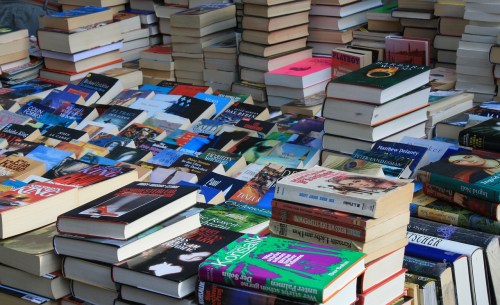 Long-term, this is a possibility. Already, some big-name stores have disappeared from our streets, and others are struggling. Yet some still persist, and are even flourishing. There are stores that have found cracks in the on-line onslaught.
 Your average bookstore will have tables filled with displays of books on promotion, or new titles. These are to tempt potential customers in. There will probably be a chart rack somewhere, clearly displaying which books are popular—because people like to read what others are reading. And then there are the other shelves, the ones further back that are only browsed by the die-hard readers, or those seeking something particular. Here, most of the books are presented spine-out, with only the occasional book face-out. Why? Because more different titles can be shown that way. The only problem is, covers catch the eye far better than book spines.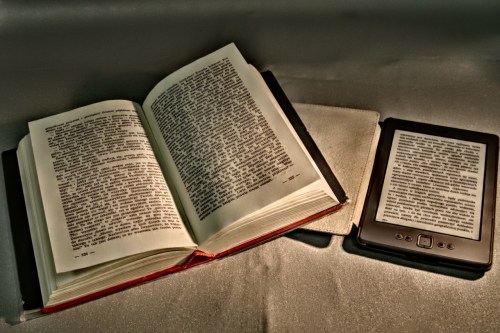


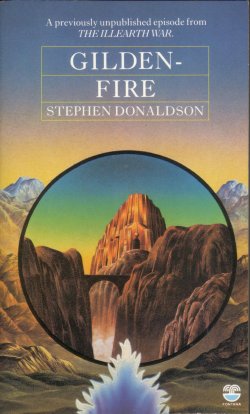 And sometimes, readers want to know this extra information as well. We want to read more about a favourite character, or we want to experience the story world in greater depth.
 And this leads on to another aspect of short stories—they give us a chance to explore.
 And sometimes, a short story can provide an idea for a novel, maybe a whole series. Harry Harrison is an example of this. Way back in 1957, his story The Stainless Steel Rat appeared in a magazine. Three years later, another story based on the same character came out. Then Harrison reworked these stories, with new material, into the novel The Stainless Steel Rat. But the character of Slippery Jim demanded more, and Harrison wrote more novels. And it all started from a short story.
 TW Iain