I suppose it’s inevitable that the way I read is changing as I learn more about storytelling and the craft of writing. Reading’s still one of my favourite things to do, but when something doesn’t feel right in a book or story, I’ll try to analyse the perceived problem. I’m also more likely to reflect on a book in a more analytical way. I’ll attempt to figure out how a writer has impressed me, and also imagine how I’d approach those little things that didn’t work for me.
I thought I’d share one of these moments. It happened when I re-read Dune recently.
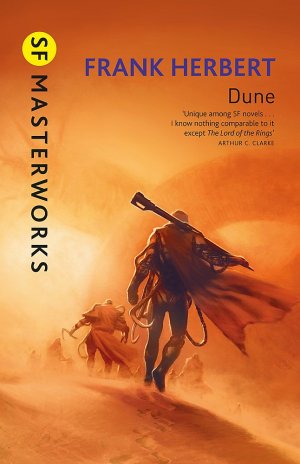 Before I dive in, there’s a couple of things to bear in mind here. Dune was published over ten years after Frank Herbert’s first novel came out, and he’d had years of publishing short stories in magazines before that, so this is a book by an experienced writer. I’m still near the start of my writing life, so I’m in no way holding myself up to be ‘better’ than Herbert (or the numerous editors who would have been involved in the book’s journey).
Dune was written over fifty years ago, and fashions change in writing, just as in everything else. The thing that tripped me up might not have been considered an issue when Herbert was writing it.
But trip me up it did. One sentence pulled me right out of the story.
It happened in the fifth section (they’re not labelled as chapters, but they might as well be), where we finally get to meet Dr Yeuh. We already know that he will betray Duke Leto Atreides, under orders or instruction from the Barron Harkonnen. Such a thing should be impossible, as Dr Yeuh has undergone Imperial Conditioning, but Harkonnen in a previous scene hinted that there are ways around this. So our first scene with Dr Yeah himself is keenly anticipated.
The scene starts with Dr Yeuh entering the room of Paul, the Duke’s son, and we get to hear a number of Yeah’s internal thoughts (a technique Herbert uses often throughout the book.) But almost on the first page we get this thought from the man.
What I do is done to be certain my Wanna no longer can be hurt by the Harkonnen beast.
When I read this, I immediately saw it as an info-dump. The wording sounded clumsy in comparison to Dr Yeuh’s previous thoughts, and it felt that the information—that Harkonnen was breaking the man’s Imperial Conditioning by holding someone Dr Yeuh cared deeply about—had been shoe-horned in.
It does allow us to feel some sympathy for the man—yes, he will betray the Atreides family, but it is not through choice. Rather, he is being forced into this action by the real villain, Harkonnen. But the man comes across as fairly sympathetic over the rest of the scene anyway, in the way he talks to and acts around Paul. So couldn’t this nugget of information be saved until later? Would it not be better to let us, the reader, see the man before learning his secret?
Later in this scene, Dr Yeuh gifts Paul a book, and asks him to turn to a marked page. Paul feels two marks on the pages, and opens at the smaller—but when he starts to read, Dr Yeah yells for him to stop.
“I’m sorry,” Yeuh said. “That was … my … dead wife’s favourite passage.”
I couldn’t help thinking that this should have been the first mention of Wanna. The way Yeuh hesitated, then calls her ‘my…dead wife’ is quite dramatic, and should be enough to start connections in the reader’s mind—maybe this is something to do with his expected betrayal. And if we heard some thought from him here, it could confirm this impression.
So maybe that first info-dump thought should have just hinted at some hold Harkonnen had over the man. I do what I must to keep her safe, or something similar. It gives us enough to know that Yeuh is being forced to betray Duke Leto, and then more details arise naturally.
At least, that’s how I would have written this scene. But maybe I’m missing something, and there’s a reason Herbert did what I saw as an info-dump. Maybe this is my inexperience showing.
In some ways, this doesn’t really matter. It might have pulled me out of the story for a moment, but I still enjoyed the book overall (enough that I’ve made a start on the sequels). And in forcing me to think about ways of handling the imparting of information in a story, it should improve my own writing.
 Looking at this with cold logic, when it’s impossible for a single person to even read a fraction of what already exists, there seems no reason for putting more stories out into the world. Yet many of us continue writing, and continue adding to this immense pile of fiction available to readers.
 Once a reader finds that one book, of course, they often seek out others by the same writer. I know this through experience—it’s why I have every Douglas Adams book, why I’ve still got just about every Terry Pratchett book in paperback, every Iain Banks book. It’s why I get pre-orders of every book Barry Hutchison puts out, be they in the Space Team series or something else. It’s why I’ll look out for new books by the Platt/Truant/Wright team. And, as a writer, I know that, if someone clicks with one of my books, they’re likely to want more—and so I’ll do what I can to provide for them.
 One reason I felt cheated was down to a broken promise. In any book, the writer gives certain promises to the reader. These might not be made explicit, but most readers will pick up on them subconsciously. If a group of characters have been preparing for a big battle, then there is an inherent promise that there will be a battle. When the two main characters meet in a romance, even if they can’t stand each other initially, there is a promise hard-wired into the genre that they will end up in a happily-ever-after.
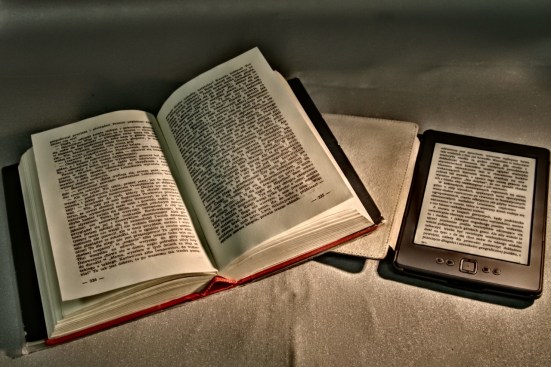 Digital books, too, didn’t become mainstream instantly. Back before smart phones and laptops, ebooks were pdf files, and many people simply didn’t want to read whole books on a bulky computer screen. But new formats were developed, chiefly epub and mobi, and new devices appeared. When Amazon released Kindle, e-reading really took off. Now, with so many people owning smart-phones, ebooks can be downloaded and read through apps, and reading large amounts of text on screens has become relatively normal. And with the rise in popularity of audiobooks, another shift is occurring in the way people read (consume) books.
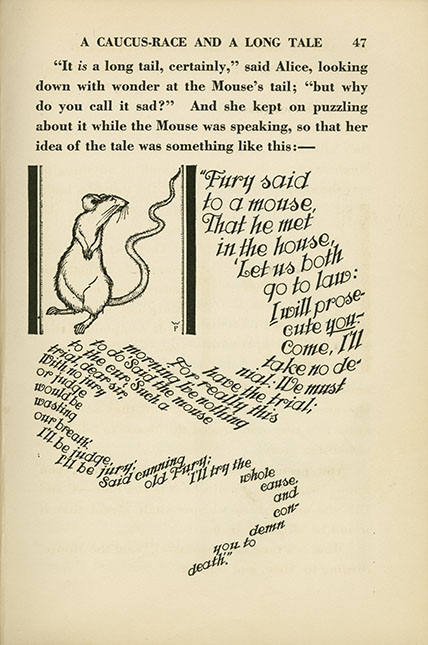


 Stories (in books) pass from writers to readers through the medium of words, but there is always going to be interpretation involved in this. Writers aim to give as much action/emotion/description in as few words as possible. If everything was described in enough detail to convey every single aspect of the story, the action would move at a glacial pace, and all sense of forward momentum would be lost. Stories that describe too much are (for most readers) tiring to read—hence the search for conciseness. Gustave Flaubert talked about finding ‘le mot juste’, the right word.
 Looking back at the list, most of the titles are just names of books. I can’t recall what happened in many of the stories, and I only have a vague idea of my thoughts on them. Yes, some stick in my mind—I enjoyed Joe Abercrombie’s First Law trilogy, and I’m still impressed at how Barry Hutchison can produce such entertaining and well-written Space Team books at such a fast rate. Andy Weir’s Artemis was good (and, more importantly, was definitely different to The Martian, proving that his first book wasn’t a fluke), and I loved China Mieville’s Perdido Street Station, both for the writing and the world-building. Way back at the start of the year I read Marcus Sakey’s Afterlife, and I recall being pleasantly surprised at the twists and turns in the story.
 See, I chose books primarily because I wanted to complete the challenge, and it’s easier to read more books if they are shorter and not too taxing. I veered toward light reads that would only take a couple of days.
 So, for 2019, I have a new reading challenge. Yes, I’m still going to read light, fun stuff (I’ve started the year with Ben Aabronovitch and Mark Dawson—both fine writers who produce great escapism for the reader), but I’m also going to push myself. I’m not going to treat books as a tick-list to get through. I’m going to give myself the time each book deserves.
 A few weeks back, I started reading Joe Abercrombie’s First Law series, but straight away I ran into a problem—the chapters were too long.
 When a child is older, they might move away to university or college. They’re independent(ish) now, free to mix with a far wider variety of people. This means an explosion of new experiences, and the opportunity to see the world from so many different viewpoints. But, in that stage between childhood and true adulthood, our brains are still developing. We’re still discovering who we are and how we fit in, and we’re especially open to all these new stimuli.
 Joe Abercrombie’s First Law books show another way this vicarious experience can broaden our perceptions of others. Many of the characters in these books are morally ambiguous. One example it Sand dan Glokta, a torturer who obtains information through any means necessary. He appears to have no remorse for his actions, even when he knows he is drawing a confession from someone who is innocent.
 We live in a very visual world, so it is no surprise that technology has enabled us to manipulate and create images to such a high standard. Just think of films and games today, and the way they place characters in worlds so fantastically rendered that they leave our own seem flat by comparison. Combine that with state-of-the-art sound design, and place all that within a narrative structure (be that passive or active), and it is no wonder that so many people are drawn to the spectacle and the immersion of films and games.
 It’s also very natural. When children play, their games are filled with imagination—a few scraps of coloured paper get placed in a wooden box, and they become a meal to be shared with friends no adult can see. A few stuffed toys have adventures in far-flung places without ever leaving the four walls of the bedroom. Tiny cars travel a world that is only flat to our eyes—to the child, it is a vast city, filled with people going about their strange and wonderful lives.
 So it is useful to develop our imaginations, and one of the best ways of doing this is through reading. When we watch films we can be passive, letting the story flood over us. But when reading, we have to use our imaginations. Those squiggles on the page need translating into scenes and characters and actions.
 When I worked as a teacher, we were always advised to split lessons into small chunks, because otherwise the attention of the students would start wandering. This seemed to make sense, especially when there was so much being said about how attention spans of today’s youth were so short. And having short activities that changed a lot did help keep students motivated.
 The issue isn’t attention span but concentration. It’s easier to do something fun than something we find boring. It’s also easier to enjoy an activity when it gives instant rewards, and when it engages so many of our senses. This is why many people prefer watching films and TV over reading fiction.
 This is an important skill to learn. In life, we don’t get everything handed to us on a plate (at least, the vast majority of us don’t). Not everything is explained to us in terms we understand. We can’t have what we want the instant we demand it. To get anywhere, we have to work—and that takes effort and concentration.
 TW Iain