Now I need a structure for my series…

So, I know I want to focus on characters in this series. I have ideas for the main thrust of the story (the overarching plot), but before I start writing I want to plan. And for that, I want some kind of framework.

The vast majority of stories (especially successful, memorable ones) conform to a structure. There are many such structures, but one of the most popular is the hero’s journey. This originated from Joseph Campbell’s work on myths and folk-tales. He uncovered certain core similarities between most of these tales. He called this the ‘monomyth’, and it later became known as the hero’s journey.

George Lucas was heavily influenced by Campbell when he wrote Star Wars. Luke Skywalker’s arc in that film is one of the classic hero’s journey retellings.

But not every great story conforms to the hero’s journey. There are other structures.

Back at the start of 2021, one of the many podcasts I listen to, KM Weiland’s Helping Writers Become Authors, ran a whole series on character arcs. Weiland identified six core, sequential arcs, roughly mapping a life from ‘maiden’, then ‘hero’, and through to ‘mage’. Only when a character successfully negotiated one arc, she argued, could they progress to the next.

As I listened ideas started to develop.

Between each of these arcs are ‘resting’ arcs, where the character’s actions are more focused on helping others work through their own arcs. They became supporting characters in stories focused on others.

There are also negative arcs. These happen when a character becomes stuck at the low-point in a positive arc, unable to progress from this dark point. So a potential hero who backs out when the going gets too tough can fall into the negative arc of the cowards. Or if the potential hero doesn’t develop the necessary humility (if they believe too strongly in their own abilities) they can become a bully.

Not many stories focus on negative arcs (because we tend to prefer stories with happy, positive endings) but there are some classic negative arc stories. One that springs to mind is The Godfather, where Michael Corleone, despite never wanting to become like his father, eventually succumbs to a similar ruthlessness to keep his family safe. Or, turning back to Star Wars, consider Anakin Skywalker’s metamorphosis into Darth Vader.

And, in The Return Of The Jedi, Darth Vader gets a moment of redemption. His negative arc is reversed. There is always hope.

One thing that struck me was how a negative arc isn’t about a wilful desire to do bad things. It’s a downward spiral, or a weakness, or a misguided belief. It reminded me of something I’d heard many years ago — the villain is always the hero of their own story.

There are so many examples of this. Consider the minor conflicts between parents and teenagers, the desire to protect on one side and the yearning to experience on the other. Or go large (which I need to if I’m writing space opera). Think of political differences in so many countries. Think of conflicts between countries, between different groups within geographical areas. Each side believes itself to be in the right, their actions justified.

It’s not about simple right or wrong anymore, much as we’d like it to be.

Now consider a leader’s actions.’ Do they act to retain the status quo, or to usher in what they believe to be a much-needed change? Are they being poorly advised, either through malicious intent or through misinformation? Are they struggling with tensions between personal desires and the necessities of their office?

Let’s take a step back and return to my planning. I have a central story idea, a dilemma that has the potential to totally alter the course of humanity’s future. But, at least at the start, the exact nature is ambiguous. Different characters are going to have different views on it, and these views are going to influence their actions. These differences will lead to conflicts.

At the same time, my characters are all going through their individual arcs, battling situations that might only be tangentially related to the central thrust of the series. They’ll be pulled in different directions, forced to make hard decisions and accept compromise — or accept the consequences of rejecting compromise.

As I plan this series, I can use the character arcs Weiland identified. Some will keep to their positive arcs, others will fall into negative arcs (possibly to pull themselves back onto the positive path later on). There won’t be ‘good’ or ‘bad’ characters, only a cast of characters all trying to do the right thing, or at least doing the only thing they believe they can.

So I can construct a framework out of these arcs, giving the series (and individual book) structure. I can build the plot around that structure, confident that the heart of the overarching story will be the characters.

The next stage is getting to know those characters. More on that next time.

And if you’re interested in learning more about KM Weiland’s character arcs, click here.

Looking for spooky books? Check out Kobo’s October Spooky Bundle promotion

Throughout October, in the build-up to Halloween, Kobo are running a special offer‌—‌get three books for only £12/$15. This promotion includes my Complete Shadows Trilogy box-set. Click here for the full list of horror-tinged titles to take you into spooky season (the link takes you to the US store, but you can change country using the flag icon above the Kobo search bar).

ShadowTech Book 5 is out now

The fifth book in the ShadowTech series, Excision Verdict, is now available to buy, ebook from all the usual places, paperback through Amazon. The ebook is at a special low price, but that will increase by the end of the weekend.

Cover of 'Excision Verdict (ShadowTech Book 5) by TW Iain

The Ancients have returned. But are they allies or adversaries?

Piran, captive of the company, plunges into their technology, seeking answers in their code. Deva, with the Heralds, is drawn into Haven’s Deep, unsure if she’ll be accepted as a guest or killed as an enemy. Ryann, sheltering with the Collective as the company close in, fears their sanctuary will become their grave. Keelin seeks answers with Tallia, but the shadows from her past could be her end. And Brice is abducted by the Ancients, to a place unknown, for reasons he can’t fathom.

Alliances will shatter and loyalties will be tested as humanity races towards either salvation or annihilation.

Get all my books for 75% off

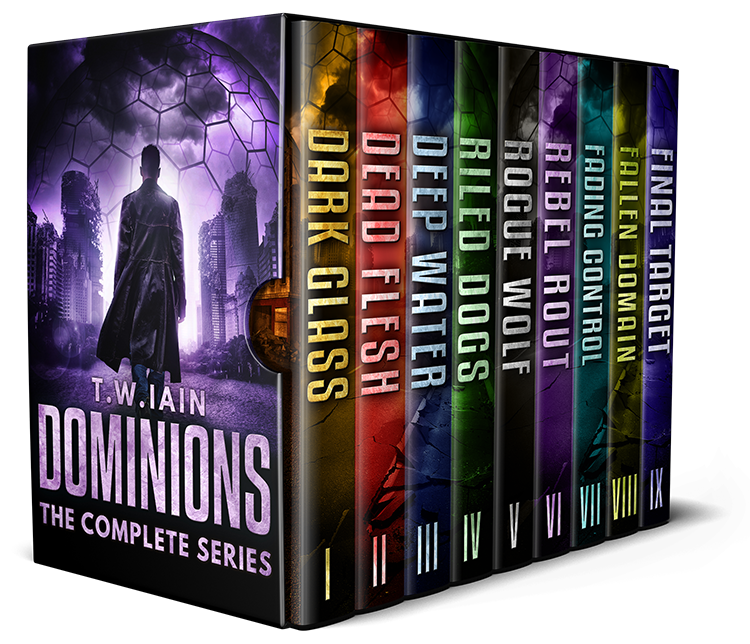
Smashwords are running a Summer/Winter sale throughout July, with loads of books at reduced prices. This includes all of my books at 75% off. This includes the Complete Dominions collection‌—‌all nine novels, as well as various novellas and short stories for roughly the cost of a single novel.

Check out the sale here, or click here to see my books.

Dune, Chris Fox, Star Wars – ways to extend a series

If a story is popular, readers want more. Sometimes pressure from fans forces a writer to produce a sequel, but often a book is written with a series in mind. Some series are finite (they tell an overarching story that concludes at some point), while others are more open-ended.

But both types of series can be extended. Even if the main series story-arc is completed, there can be loose threads that lead to more complications. Isaac Asimov extended his Foundation trilogy, as did Frank Herbert with Dune (initially planned as a trilogy, then extended into six books, and I believe Herbert had plans for a seventh).

The Dune example is more interesting, though. Since his death, others have taken over writing in the Dune universe, taking Herbert’s ideas and expanding in all kinds of directions.

I read one of those ‘new’ books recently‌—‌Brian Herbert & Kevin J Anderson’s The Winds Of Dune. It doesn’t add to the end of the series but fills in (some of) the events between the first and second books.

It’s another way of extending a series‌—‌take events alluded to in the main series, and expand them into their own stories. I think of these series-extensions as ‘side-stories’‌—‌not vital for those wanting to follow the main series story-arc, but fascinating for fans of the series.

And it’s a technique used more and more often. Writers can produce short stories or novellas as ‘bonuses’, either for publication on their own or in anthologies. Stephenie Meyer did this with The Short Second Life Of Bree Tanner, a novella following one of the minor characters from her Twilight series. Stephen Donaldson resurrected a discarded chapter from The Illearth War (his second Thomas Covenant novel) as the (long) short story Gilden Fire. In the Star Wars universe we have Rogue One and Solo, along with the ever-increasing TV shows.

Fans of a series always want more. They want to explore the lives of their favourite characters. They’re intrigued by back-story. They want to know what happens next, and also what happened before.

I’m currently reading Chris Fox’s Void Wraith Origins series. It’s a self-contained trilogy, but it’s also a prequel to his six-book Void Wraith series. He’s done something similar with his Magitech books, writing a six-book Magitech Legacy series to complement the original.

He’s also extended his Deathless series (originally a trilogy), and has tied that to the Magitech world.

Multiple series, all based in the same world, all connected.

The idea is to have a ‘flagship series’, one that is the focus and the most popular, and then build more series around that. Star Wars is a prime example, with the multitude of book series, the animated series such as Clone Wars, and the newer additions like The Mandalorian and the upcoming Obi-Wan Kenobi.

Star Trek has spawned a number of ‘spin-offs’ (Voyager, The Next Generation and so on), as has NCIS (with NCIS: Los Angeles, NCIS: New Orleans, and more reportedly in production). The Harry Potter series has spawned Fantastic Beasts.

In books, romance writers have long exploited this idea (because romance writers are always ahead of the curve). They might have one series following three brothers, then have another series focused on a group of friends, but both series will take place in the same small town. Friends of the love interests in one book or series will spin off into their own stories and series.

It’s great for readers‌—‌they get that holy grail of something fresh (in a new story) with something familiar (a world they know). And it’s a great way to write, because it takes away the need to world-build afresh with each book or series.

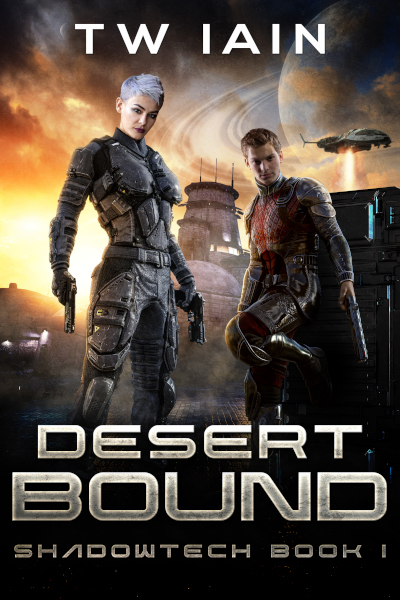
It’s something I’m doing at the moment. I wrote a trilogy a few years ago called Shadows, a sci-fi with horror leanings, and even though I liked the way the three books work together (they feel complete), there were still open loops, and more I wanted to explore. So I’m now working on a new-but-connected series, ShadowTech, following on from the end of Shadows. I’ve pulled back on the horror elements, and this new series has more of a sci-fi adventure feel, with a larger scope, faster pace, more action. It’s different, but still connected.

Hopefully, what readers want — novelty alongside familiarity.

A huge Dominions sale

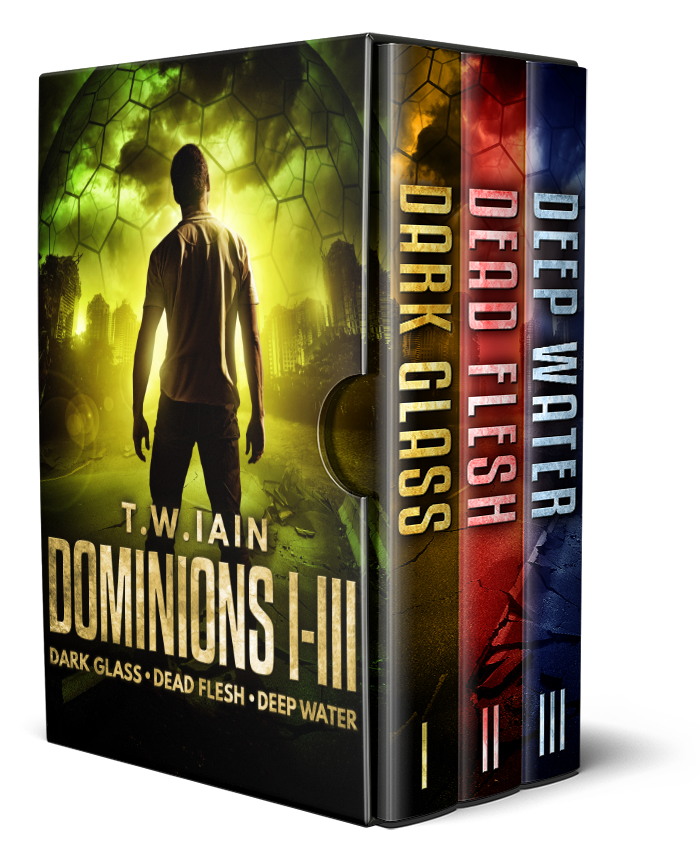
In a few weeks, I’m putting the whole Dominions series into Kindle Unlimited, which means these books will only be available through Amazon. But until that happens, I’m knocking the price of the novels down to 99c (or your local equivalent), including the 3-book box-set. This means it’s possible to get the whole dark Dystopian series (about a million words) for under $7!