Shadowfall, the first book in the sci-fi/horror Shadows trilogy, is now available from all ebook stores for the bargain price of 99c (or your local equivalent), until 27 Oct.
Books
Information without info-dumps in Craig A Hart’s short story ‘Loose Ends’
I’ve read enough free books that I always go into them with low expectations. That way I’m not so disappointed by poor storytelling and writing, and anything half-decent is a bonus. So it’s a pleasant surprise when a freebie makes me sit up and take notice.
This happened recently, with the short story Loose Ends by Craig A. Hart. Not so much for the story itself (which was an enjoyable way to spend half an hour), but for the quality of the writing. One of the things that stood out was how Hart feeds the reader information.

The story is a noir thriller, with a typical wisecracking protagonist. This is set up perfectly in the opening line:
Nothing ruins the benefit of a good night’s sleep like being awakened by the muzzle of a pistol being jammed into one’s ear.
There’s no panic in this phrase, even though such a situation would be terrifying for most people. So the narrator—the man with the gun to his head—is either used to being in scrapes like this or he’s calm under pressure. Or both.
Already, we’re intrigued, and want to read on.
The narrator has been woken up, and it’s only natural that he’s a little disorientated. His thoughts start to wander—specifically to his ‘lady friend’, who he imagines being
thrust into the role of a modern day Sisera, playing the part of Jael by hammering a nail through my temple.
I’ve no idea who Sisera and Jael are, but I assume they’re characters from old stories, possibly biblical or mythological. And this tells me something about the man in the bed—he’s well-read. And, again, the way he’s not focusing on the gun at his head says he’s still calm.
But he’s a detective, so he has an analytical nature. Hart reinforces that in a quick summary.
I was lying in my own bed, in my own hotel room on Key West, and a gun was pressed to my ear.
It’s blunt, a stark reminder of the situation. It also drops clues about the setting—we’re in the man’s hotel room in Key West. His hotel room, so this isn’t a ‘wake up in a stranger’s bed after a wild night’ situation. He hasn’t mentioned anyone else, so we can assume he’s alone—apart from the person holding the gun.
We’re still missing a lot of information, though. Who is this man? We need to know more, and we get that in the next few lines.
“Not a move, Wolfe,” a deep voice growled.
“Wouldn’t dream of it,” I said, quite truthfully.
“You expecting visitors?”
“Yeah. King Jabin’s army. You’d better get out while you have the chance.”
“What the hell you talking about?”
“I take it you’re not a scholar of ancient texts.”
So, we have a name now. We also know that this isn’t a random hit—the gun-man is targeting Wolfe specifically.
We also get another reminder of Wolfe’s intelligence, with the reference to King Jabin’s army (again, not something I’m familiar with). But we also see more of his character. It’s a stressful situation, but he’s calm enough that he’s wise-cracking. This might be a trope of noir thrillers, but it’s a fun one, and it’s something we expect in a story like this.
Hart’s given us so much information here, without forcing it down our throats, and we’re not even off the first page. He’s also set up an intriguing situation. We’re hooked.
A good thriller won’t give us everything straight away, of course—there has to be mystery and intrigue. But we’re still missing information that will help ground us. For instance, when is this story set? We might assume it’s mid-twentieth-century simply because that’s the golden age of noir, but we can’t be sure. That is, until Hart again drops a beautifully placed clue in dialogue.
“I’m just joshing you,” I said. “Trying to lighten the mood.”
“Keep your day job,” the little man growled in his paradoxically deep voice. “You’re no Jack Benny.”
The only thing I know off the top of my head about Jack Benny is that he was an entertainer or comedian around the mid-twentieth-century. It’s unlikely that the gun-man would reference someone who wasn’t contemporary to the story’s settings, so our original assumption of time seems to be correct.
But there’s more in this little exchange. The gun-man’s reference of another person mirrors Wolfe’s mention of King Jabin, but also highlights their differences—one contemporary and popular, the other older and more esoteric. It also hints at cracks in the gun-man’s confidence—he’s trying to beat Wolfe’s wise-cracks, but it doesn’t quite work. Even though he’s the one with the gun, it already feels like Wolfe is in control of the situation.
It’s a wonderful demonstration of how the craft of writing is as important as story itself. It’s a fantastic lesson in how to give information without resorting to info-dumps. It shows how phrases can do double-duty (providing information and giving insight into character while moving the story forward.)
And it’s definitely encouraged me to read more of Hart’s work.
It’s worth reading these freebies. Every so often, you come across a gem.
Ready Player Two and the problems with sequels
I’ve just finished reading Ernest Cline’s Ready Player Two. I enjoyed Ready Payer One—fun, action-packed story, with loads of eighties references that reminded me of my childhood. But I wasn’t sure I wanted to read the sequel. The first book felt complete. I wasn’t sure it needed a sequel.

See, I’ve read and seen too many sequels that failed to live up to the promise of the original. Too often, they feel driven by commercial considerations rather than a desire to tell a good story.
Before I go any further, I should stress that I’m not talking about stories in a series. I don’t see The Empire Strikes Back as a sequel, but as the continuation of the Star Wars series. Also, I’m not thinking about series like James Bond or Jack Reacher, where a recurring character goes through a number of separate adventures.
I’m thinking of those cases where a second story was created after the success (or non-success) of the original. Often, the original is a self-contained story, with no real need for any kind of follow up.
Of course, sequels aren’t necessarily inferior to their originals. The Godfather Part II is widely viewed as a better film than The Godfather, paying respect to the original while also expanding the story’s range. When James Cameron took the helm of Aliens, he built on the claustrophobic horror of Alien but took it in a new direction, producing a film that is both different and also a worthy sequel to the original. Sometimes a sequel can feel more like an improved reboot or retelling—think Evil Dead / Evil Dead II or El Mariachi / Desperado.
Toy Story is an interesting example. The second film was expected to be a straight-to-DVD release, but when it turned out better than expected it was given a full theatrical release. Many people consider it as good as, if not better than the original. The series has evolved over two more well-received sequels, proving that it is possible, even for a financially-motivated major film studio, to produce sequels that are artistic as well as commercial successes.
Unfortunately, there are many examples where this isn’t the case. Take Jaws. The original is widely regarded as a classic, with nuanced characters pushed to their limits as the tension increases. But the sequels fall short of that original standard, and by the time we reach Jaws: The Revenge we’re pretty much into (unintentional?) parody territory. Even those involved, such as Michael Caine, don’t think much of it. When asked about the film, he’s quoted as saying ‘I have never seen it, but by all accounts it is terrible. However, I have seen the house that it built, and it is terrific.’
Sometimes, sequels can be lost in the glow of the original. There are probably more examples of this in books, such as Joseph Heller’s Closing Time, sequel to his famous Catch 22, or Dodie Smith’s sequels to 101 Dalmatians, The Starlight Barking. Many people know of Robert M Pirsig’s Zen And The Art Of Motorcycle Maintenance (even if they haven’t read it), but fewer know he wrote a sequel, Lila: An Inquiry Into Morals.
The desire to produce a sequel is understandable. There’s the aforementioned commercial/financial draw (the sequel will already have an audience in those who enjoyed the original), but there might be more to the original story that the writer wants to explore. Heller’s Closing Time catches up with the characters of Catch 22 years later, and imagines how their earlier experiences have changed their lives (and it’s worth noting that these stories also pretty much book-mark Heller’s own writing career). After dealing with the question of ‘value’ in Zen…, Pirsig used his sequel to look at morals. Since writing Trainspotting, Irvine Welsh has returned to that novel’s characters a number of times to explore how they’ve changed. After completing his Foundation trilogy (yes, I know it’s a series, but it’s possible to view it as a single story, ending with the location reveal for the Second Foundation), Isaac Asimov decided there was more to tell in the universe he’d created, writing Foundation’s Edge and a number of other sequels and prequels.
So there are varied reasons for producing sequels. But sometimes it’s better to resist. So far, Andy Weir has not written a sequel to The Martian, although from listening to interviews I get the impression that he considered it. He didn’t follow through because the ideas he came up with were either increasingly unrealistic (’Oh, look, Mark Watney’s got himself stranded on a distant planet again’) or would involve him telling a far-too-similar story but with a different main character.
It’s worth taking a moment here to consider how sequels attempt to ‘improve’ on the original. In essence, they attempt to take what was successful in the original and increase that aspect. For instance, in Alien the crew of the Nostromo battle a single alien, but in Aliens there are far more, as well as a mother-alien. The stakes are usually higher in a sequel, too. Sticking with the Alien example, the first movie pits the alien against a small crew, but in the second the aliens have already destroyed a whole settlement, indicating that the single beast in the first film was not an anomaly, and that the aliens now represent a serious threat to humans.
Sometimes these attempts to make sequels ‘better’ backfire, or produce something totally different. In the first John Rambo film and book (First Blood) he doesn’t actively kill anyone (although his actions in self-defence do result in one death). But the sequels have higher and higher body-counts. In the Jaws sequels the shark attacks become larger (including a helicopter in Jaws 3 and a sea-plane in the fourth film), and also less realistic.
So how does Cline’s sequel to Ready Player One hold up? (Note: there will be spoilers ahead, for both books.)
He does increase the stakes. In …One, there is a real threat to the lives of the main characters, but in …Two the fate of millions hang in the balance. The original focuses on the ownership of the Oasis, but in the sequel the whole world is at stake.
Cline also doubles down on the task/nostalgia elements from the original. The game-quests in …Two are more specialised and more detailed. The quest is more personal, too—it’s made clear early on that Wade is the only one (apart from Og) who can actually complete these tasks. This does take away some of the fun of the original, where much of the excitement was in Wade struggling to complete each task before others.
The technology’s evolved, too. Rather than relying on gloves and goggles, players can now access the Oasis pretty much directly through their brains (it’s explained better in the book). And one thing I liked was how this new access method was also important to the plot.
So is the sequel a success?
That depends. On its release it received a poor reception, but looking at Amazon reviews suggests that a lot of people love the book (a 4.3 average, compared to the original’s 4.7).
For me, it doesn’t work. There’s a great deal of potential in the (over-long) set-up, but I don’t think the rest of the book delivered. I found myself skimming much of the action, especially in the quests. Where the original relied on a combination of obscure 80s trivia and Wade’s thoughts and actions, the sequel too often has Wade simply following another character around or being directed to complete the quest. I found Wade too passive to be an interesting main character.
There are sections that I could imagine looking great on-screen, though.
And it’s not a bad book. But, like many other sequels, it’s simply not as good as the original.
Always have variety in scenes? Agatha Christie and repetition.
Repetition leads to boredom. Even high-adrenaline action can become draining if we don’t have time to slow down occasionally.
One common piece of writing advice is to mix up scene types. If one scene has two characters talking in an office, the next scene should have more action. If one scene concentrates on a single character, the next should focus on a group. Scenes should move between different, varying locations.
Then there is ‘scene and sequel’—after a burst of action, the next scene should involve the characters processing what they’ve just been through. There should be a mixture of movement and dialogue, of open reflection and private musing.
In short, readers appreciate variety.
So how come Agatha Christie, in Murder On The Orient Express, has over half the book consisting of Poirot asking characters questions in the dining car of a train?

After the set-up and crime, we’re presented with a whole series of chapters all titled ‘The Evidence Of…’, followed by a character’s name or title. In these, Poirot asks each character similar questions to ones he’s asked others. Even when the action moves to various other carriages and rooms in the second half of the book, it soon returns to Poirot’s interviews in the dining car.
Despite this repetition—of setting and of action—the story keeps moving forward. As I read the book, I never felt bored. In fact, I was eager to hear how the next character would respond to Poirot, and how they’d answer his repeated questions.
How does Christie pull this off?
There are a couple of considerations here. The first is genre. Murder On The Orient Express is a mystery, and mysteries are puzzles. The enjoyment in these books comes from trying to solve the case before the detective does—and when we fail to do this, there’s the enjoyment of finally seeing how all the pieces fit together anyway. In order to solve the puzzle, we as readers need information. We need to learn as much about the case as we can. So as Poirot asks similar questions to each character, we’re looking at their responses, trying to decipher their unsaid meanings, trying to see what others have missed. We live these scenes through the detective, wanting to beat them at their own game.
The second consideration is this—mysteries like this are about people, not fast-paced action. We don’t read a Poirot story to experience a high-speed chase, or to have the sedate Belgian detective fight for his life. Yes, there’s action in Murder On The Orient Express, but it’s ‘soft’ action, very downplayed. The train grinds to a halt because of snow. There’s a murder, but it happens off-page—we only see the aftermath. There might be conflict between the characters, but rather than show fights Christie will give hints—subtle clues that Poirot (and the observant reader) will pick up on.
The ‘action’ is small stuff—a stumble when answering a question, a glance to one side before answering another. And by keeping so much of each scene the same (or similar), Christie allows readers to focus (if they can) on these tiny clues, just as Poirot does. The repetition highlights differences. And it is these differences that keep the reader engaged.
Christie knows exactly what she’s doing. The mystery is a ‘closed-room’ one, so the limited settings pull us tighter into the real story—who the characters are, their motives and their actions. The variety here isn’t in action or setting. It’s more intimate than that. Too much variety in setting and action would drown out the important stuff.
And Christie pulls it off like the master she was. As with all skilled storytellers, she knows the rules of writing and—more importantly—knows exactly how and when to apply them.
Play safe or take risks? John Scalzi’s Old Man’s War series
There are, very roughly, two types of series. First, there’s the on-going arc, where the end of one story feeds into the start of the next and it’s necessary to experience the individual books in order. Examples of this would be The Hunger Games or The Wheel Of Time. Then there’s the ‘adventure of the week’ series, where a character (or cast of characters) take part in a new adventure in each story. Lots of mystery and detective series have this format—think Inspector Morse, Miss Marple, Jack Reacher. Series like these don’t need to be experienced in order, because each story is a stand-alone.
Of course, there are variations. An ‘adventure of the week’ series might include character arcs and story arcs that slowly develop over several stories (an example might be The X-FIles). An on-going arc series might include side-stories that exist as their own thing (think of the relationship between Rogue One and Solo, and the rest of the Star Wars films).
But in any series, there is usually some kind of continuity, in character, story and style.
Style? Yes. It’s important. Expectations set in one book shouldn’t be cast aside in the next.
Let’s take Star Wars as an example. The first film is full of action. If the sequel had focused on political machinations within the rebellion, with action played out predominantly off-screen, fans of the first would feel betrayed. Another example—imagine how readers would feel if a new Jack Reacher book turned out to be a slapstick farce, or had Reacher battling aliens. Or what if a new Hercule Poirot story portrayed him as an action hero fighting terrorists?
For a series to satisfy fans, it can’t afford to stray too far from the promises and expectations set in the opening.
Of course, there are always story-tellers who take risks. Think of the Alien franchise—the original film was a claustrophobic horror, whereas the second was a military action film. But there were enough similarities—enough continuity—for fans of the first to accept and enjoy the second.
I was reminded of this when reading John Scalzi’s Old Man’s War series. If I understand things correctly, this started off as a stand-alone book (Old Man’s War), became a trilogy, and then grew into a six-book series. What I find fascinating is how Scalzi makes each book different yet still managed to tell an over-riding story.

The first book is a military adventure, following the 75-year-old John Perry as he is given a new body and becomes a soldier for the Colonial Defense Force. But the second book, The Ghost Brigades, is a mystery story, and only mentions Perry a couple of times. It still follows on from events in the first book, and is still written in a similar style, but there are many differences between the two books.
Scalzi took a big risk here. If readers of the first book wanted more of Perry, they’d be disappointed. A fan of the military aspects of Old Man’s War could feel let down by the change of focus in The Ghost Brigades.
And in the third book, The Last Colony, Scalzi changes things up again. Perry returns as the main character, but now he’s leading a new colony, and the story focuses on the politics involved in his new role. Again, same story universe, different type of story.
But it works. There’s an over-riding arc to this trilogy, a through-story that binds them together.
Scalzi, from his notes at the end of the third book, intended to stop the series at this point. But he received questions about certain aspects of The Last Colony, and he wrote a fourth book. This is Zoe’s Tale. Again, he took a fresh approach. Zoe’s Tale is a retelling of The Last Colony, but from the point of view of Perry’s adopted daughter.
While I admire Scalzi for pushing himself here, I have to admit that this book didn’t work for me. Reading it straight after The Last Colony, the repetition of events bored me. Yes, there are a couple of new sequences, both important to the overall story, but that only covers about fifty pages. I also wasn’t convinced by his portrayal of the teenage girl.
This is only my personal opinion. Reviews suggest that others love Zoe’s Tale. But it was with trepidation that I started on the next book, The Human Division.
And I think this might be my favourite of the series.
Once again, Scalzi takes a different approach. By now, the overarching story has grown from that initial old man’s tale, and it now encompasses many planets and hundreds of alien species. The story is epic. But rather than write an ‘epic’, Scalzi focuses in on tiny details.
He does this by using short stories. Yes, the fifth book in the series is a collection of shorts. But they’re all tightly connected. They’re chronological, and they fit together like a jigsaw.
Scalzi could have combined all these stories into a single multi-faceted narrative, but I don’t think it would have worked. Some of the slighter arcs would have become lost. And the sheer fun in some of these tales would have been lost if they’d been mixed in with all the serious stuff.
The final book, The End Of All Things, uses a similar idea, but this time the book consists of four connected novellas. And it works very well—the novellas are long enough to sink into, and when taken together they give a fitting conclusion to the larger story.
Could Scalzi have written Old Man’s War as a straight-forward narrative? Possibly. Would it have been better or worse that way? I don’t know. Even in his serious moments, there’s a playfulness about Scalzi’s writing, and the changes in story style throughout this series are another aspect of that playfulness. He’s one of those authors whose willingness to try new things is a part of the appeal. Fans pick up a new book unsure what to expect. If it’s too similar to something he’s done before, they’re likely to be disappointed.
Which means this approach to writing a series wouldn’t work for every author. But it works for Scalzi. And it serves as an example that writers don’t have to stick to what is expected. Yes, experimentation doesn’t always work—but when it does, it gives something far more memorable than anything ‘safe’.
Fading Control (Dominions VII) is out now
The start of the end is here! Fading Control is now available to purchase, through all the usual places. Grab it now for 99c (or your local equivalent), but be quick – the price goes up in a few days.

They might have won the battle, but the war is only just starting.
Rodin heads west, into a fractured district, on the verge of collapse unless he can pull disparate forces together, once more putting his life on the line.
Cat, to the north, walks a tightrope deep within Authority, where those above him surely know of his betrayal, where he can trust nobody and nothing, where any wrong move may be his last.
And behind it all Authority moves, bringing pieces into play, dividing their enemies and preparing for victory.
The end of Dominions is almost here
The final three novels in the Dominions series are now available for pre-order, at the special low price of 99c (or your local equivalent), from all the usual ebook stores.
released April 7th

released April 21st

released May 5th
Impact is out now

Rodin has the contract under control, drawing the target in, ready for the removal. Not a simple job, but nothing too complicated.
But nothing happens in isolation, and Rodin has no idea how this contract will impact others—or himself.
Impact is a new release in the Dominions series, a set of four connected stories. It’s available from all the usual ebook stores, and is currently free*.
*If you come across a store charging for this book, please let me know (twiain@yahoo.com) and I’ll sort out a free copy for you.
Series starters for only 99c
One of the great things about publishing independently is having control over pricing. I’ve run promotions for books before, and have experimented with free (all my short stories and novellas in my Dominions series are still free—click here to check them out). And now, until the end of the year, I’m trying something else.
I’m offering the first novel in each of my two series for only 99c (or your local equivalent). Both books are available from all the usual ebook retailers (if you can’t find it on your favourite, contact me and I’ll see what I can sort out). So if you want to start a new series for a bargain price, take a look at these two.
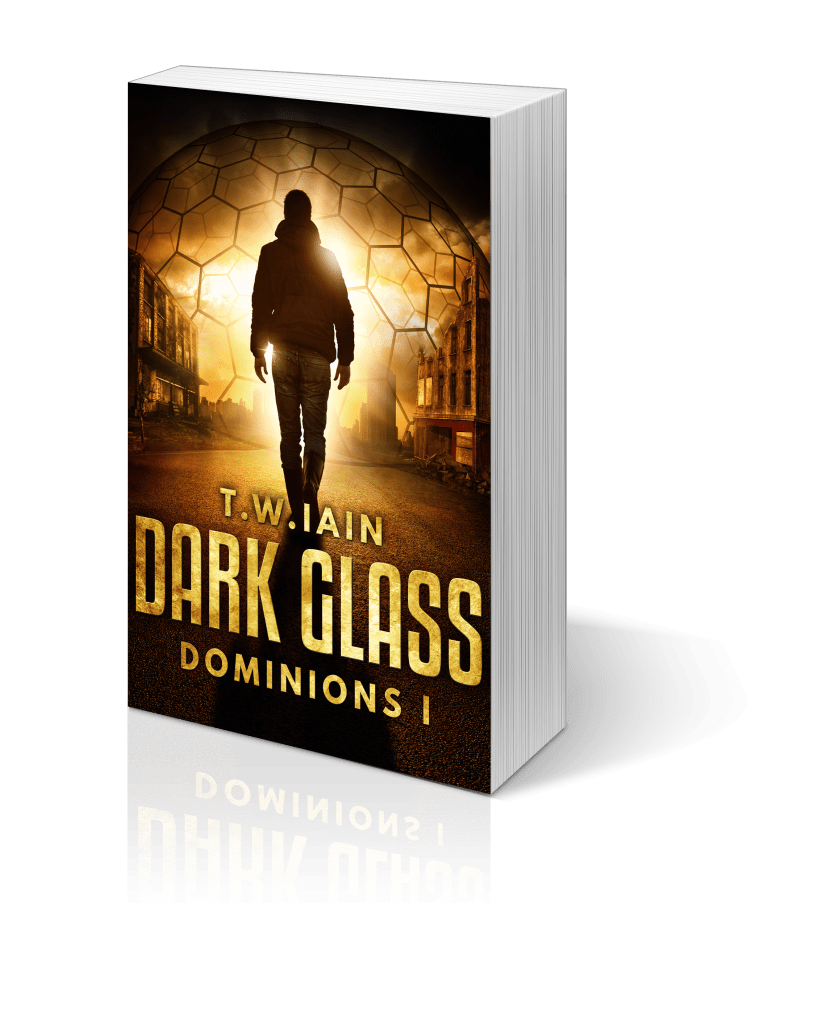
The start of a dark Dystopian thriller series.
A professional killer forced to take a contract in a perfect society—and becomes his own worst enemy.

The start of a sci-fi/horror trilogy.
The company trained Brice for many things. But nothing can prepare him for what he must face when the shadows fall.
Shadows: The Complete Trilogy is now available
…and for a couple of days you can get it for only 99c (or your local equivalent).
Shadows: The Complete Trilogy
What hides in the shadows?
It started with a routine mission, but when faulty tech and a worsening storm force Brice and the rest of the crew to abandon their craft, they have no idea they’ll become the prey for a group of blood-hungry beasts.
And this is only the start of their problems. These creatures have a terrible secret, one the company will do anything to keep in the dark—even if it means the deaths of Brice and his colleagues.
This set contains the complete trilogy of Shadowfall, Shadowsiege and Shadowstrike, horror-infused science fiction where the stakes grow as the nightmare deepens.
 TW Iain