The Books That Don’t Fit

light-bulbs-1125016_1280There are two types of fiction books‌—‌literary and genre. At least, that is what perceived wisdom seems to say. There are the ‘deep’ novels that win awards, and then there are the exciting, throwaway stories that are pure entertainment. And within the genre field, there are many subcategories, each with its own rules and guidelines, its own expectations and fan-bases.

To make it as a successful author, independent or traditionally published, many say it is best to stick to these rules and expectations. They say you should give the audience what they want. The phrase ‘write to market’ is bandied about. Some use it as a guide to success (if such a thing exists), and others decry it as an affront to artistic integrity. Most people sit somewhere between these two extremes.

But it does seem that more formulaic books find more success. I’ll mention again the Sterling and Stone team (Johnny B Truant, Sean Platt and David Wright). Their most successful project is the seven-book Invasion series, written specifically to appeal to alien invasion fans. Likewise, when Chris Fox very openly wrote his Void Wraith series to fit the space opera market, he enjoyed far more success than he had done with his earlier books.

I don’t write this in any negative way. This kind of success does not mean the book were poorly written. I’ve read both Invasion and Void Wraith, and enjoyed them both.

But I far prefer their other work. Platt and Truant’s Unicorn Western is a lighthearted fantasy/cowboy mashup (although it grows more serious as it goes along), and I love it. Fox’ earlier Deathless books (Vampires Don’t Sparkle, No Mere Zombie and No Such Thing As Werewolves) manage to combine horror creatures, Egyptian mythology and sci-fi in a way I found extremely inventive and entertaining.

Yet the sales figures would suggest that I am in a minority. The more straightforward books sell more, suggesting they have a broader appeal, but I prefer those that push at the boundaries. I like stuff that takes chances. If an author is told a book won’t work, but they write it anyway, I’ll want to read it.

One of my favourite authors is the late Iain Banks. He produced books under two brands — Iain Banks for his ‘literary’ books, and Iain M Banks for sci-fi. But two of his ‘literary’ books were strong on the sci-fi, most noticeably Transition, with characters jumping between alternative realities. And his sci-fi, while being big on ideas, worked so well because of his writing. I’d rate the M Banks books as some of his finest work.

Yet, as I start on my own author journey, I am constantly receiving advice to stick with a particular genre, or a particular style of writing. I should study what works in that field, and apply it to what I’m working on. I should follow the tropes, because otherwise I will upset readers.

There are loads of these tropes. In romance, the couple have to meet at the start of the book. There should be no infidelity, and there should definitely be a happy ending.

And yet, I like Wuthering Heights, a story that has no happy ending. And look at Romeo & Juliet, one of the greatest love stories ever‌—‌it ends with the couple killing themselves, each believing the other is dead. There is no happy-ever-after.

Of course, these are love stories, not romances, and I know that if I wanted to write a romance, I would need to have a happy ending. If the story worked better with a tragic close, I’d have to rebrand it.

If I write, and I want readers, popular reasoning says I have to stay within the confines of my chosen genre.

But what of the stuff that falls between the gaps? What of the books that don’t fit squarely in one particular genre?

I think these are the more important books. Yes, many of them will not be ‘popular’, and they will not sell as well as those that meet reader expectations. But, over time, these are the books that may well mean more.

Clownfellas_CarltonMellickIIIA couple of years ago I read a book called Clownfellas, by Carlton Mellick III, in which the mafia consisted of clowns, who were a different species (I think). The book was funny and violent, and definitely strange. It didn’t fit in any one category, and I thoroughly enjoyed it.

I recently read Mr Ruins by Michael John Grist. I thought I was going to be reading a sci-fi thriller, but the story delved into mysteries of the mind, and left me with more questions than it answered. And I loved it.

As another example, look at Mervyn Peake’s Gormenghast books. They seem to be fantasy, but there are none of the usual range of creatures, and there is no quest. They also seem to veer from deadly serious to comedic. And yet, they are incredible (I have my reservations about the third book, but I definitely recommend the first two).

Think of Robert Prisig’s Zen And The Art Of Motorcycle Maintenance. Is it a story or a text-book? Is it fact or fiction? It’s both and neither, but it’s a fantastic book. I’ve read it a number of times, and on each re-reading it opens up a little more. It might not be a ‘story’, but it’s a wonderfully involving piece of writing.

Think of Bret Easton Ellis’ American Psycho. There is very little ‘story’ in this book, and the descriptions (and the language used) are as important as anything that ‘happens’, maybe more so. To some people it’s horrific, but to others it’s a comedy. Ellis seems to have something to say, but he doesn’t make this obvious, and again it is a book that repays repeated readings.

And I realise, as I’m writing this, that there will be people who look at that list of books and see only ones they don’t like. They will find Zen boring, and won’t see the point of American Psycho.

That’s fine. I don’t think these books were written for everyone. The authors had a particular story to tell, and a particular way they needed to write. I think they were simply writing what they wanted (or needed) to write, regardless of audience.

So, of course, these books struggle to find a place. Of course they won’t appeal to many, at least not initially. The fact that all these books are well-known is down to how well they are written (although savvy marketing no doubt played a part, and I’m sure the subject matter of American Psycho helped it achieve a certain notoriety).

They are different. They don’t give the reader exactly what might be expected. They don’t fit neatly into a particular box.

And that is why, for some of us, these books are so successful, and have become firm favourites. The very fact that they don’t fit is a part of their appeal. Because, for all this talk of writing to market and of giving the reader what he or she wants and expects, there are many of us who want the unexpected. There are many of us who don’t want a repeat of what we’ve read before. There are many of us who simply want a good read, regardless of genre or tropes or any other standards.

Many books can be entertaining. They can thrill us and excite us, or make us hold our breaths as the characters come up against all manner of difficulties. They can draw us in with their language. But the books that stick are the ones that go beyond. The books that last are the ones that are written because they have to be.

The books that follow all the rules can be entertaining, and can be wonderful reads. But the ones that stick are the ones that go beyond expectations.

A few book recommendations

There are so many good books out there. I’m reading more now than I ever was, and my to-be-read pile keeps on growing. Loads of these books are by new authors, too‌—‌people who are publishing independently, without the backing of big-name publishers, and many of them deserve far more recognition. Every time I finish a great book, I tell myself I should review it. It’s a way of spreading the word, and of doing what I can to help these fantastic authors.

Problem is, by that time I’m already onto the next book. And when I turn on my computer, I’m distracted (if that’s the right word) by stories I’m working on, or finding things to write about on this site. Somehow, I never get around to these reviews.

But I intend to. And, as a start, I’m going to let you know about books that have impressed me. Every couple of months, I’ll pick a few great reads and write about them.
So here goes.


spaceteam_barryjhutchinsonSpace Team (Barry J Hutchinson)

Comedy books are hard to pull off. It’s tempting to simply run from one joke to the next, leaving the plot to fend for itself. Yes, Douglas Adams got away with this in his earlier stuff, but his writing could carry it. Other authors who use comedy, like Terry Pratchett, work just as hard (harder?) on the things that make a story great‌—‌plot and characters. The comedy comes out of the situations and how the characters react.

Barry J Hutchinson does this with Space Team. It tells the story of Cal, a wise-cracking petty criminal who is imprisoned in a cell with a cannibal. And things get worse when he’s abducted by aliens and forced to join a gang of reprobates on a mission to save the galaxy. And, of course, things don’t run smoothly.

It could have been a mediocre story, but there are enough turns to keep things interesting, as well as a feeling that things are not quite what they seem. The start promises intrigue, and it is clear that there is more to this simple mission than meets the eye. See, Hutchinson has a plot that could work for a serious book. The humour just adds an extra layer.

The fact that he has a main character who reverts to insults and comedy as a defence mechanism helps. So too does the way Hutchinson doesn’t over-explain things. Just like Pratchett, much of the comedy lies in what isn’t on the page. He also uses running gags, but again, by putting them in the mouth of a character who is trying to wind others up, they don’t become annoying.

I really enjoyed this book, and bought the next two in the series as soon as I’d finished it. I hope they carry on the same high standards.


Mr Ruins (Michael John Grist)mrruins_michaeljohngrist

I’ll start by saying that this book isn’t for everyone. Looking at reviews on Amazon, a couple mention that it is confusing, and I can see this. From the very first page, we’re thrust into an incredibly strange world, where the main character goes diving in the minds of others, and little is explained outright (in fact, much is left unexplained throughout the book). The main character (Ritry Goligh) is being chased, or something, but then there is a secondary story, with a group of marines (possibly) battling across this world that feels like something out of Lewis Carroll, only with deadlier intentions. Who these marines actually are, and how they connect to Ritry’s story, is left hanging for much of the book.

But there are hints, and I think I picked up on these fairly quickly. And the strange terms that are thrown in with no explanation, such as ‘lag’‌—‌it is possible to understand them in context. Besides, I’d far rather read a book like this than one that slows down with paragraphs of exposition every few pages. The fact that there is no explanation shows how confident Grist is in his writing, and because of this, as a reader I trust him. I might not quite get what’s happening, but I’ll follow, because I trust he’ll deliver in the end.

Another facet of this book that many will find off-putting is the tense‌—‌it’s written in first person present (so we have things like ‘I walk into the room’ rather than ‘I walked into the room’). That did jar with me initially, but I soon grew accustomed to it, and I can see how it works in the book’s favour. It makes things seem both more intimate and more distant (and I’ve no idea how Michael John Grist pulls this off), which suits the character perfectly. Add the lack of explanations, and it does feel like you’re in Ritry’s head (or maybe someone else’s).

Mr Ruins himself is a shadowy character, and at the end I was a little disappointed‌—‌I felt he wasn’t developed as well as he could have been. And I’m still not sure I totally understand what happened to him (even after reading the second book‌—‌hopefully the final part of the trilogy will help me there). But that’s only a small negative. With this book I enjoyed the ride (even if, like a decent roller coaster, it sometimes felt like I couldn’t follow what was happening), and as with Space Team, I bought the rest of the trilogy immediately I’d finished it.

So, not for everyone, but if you’re looking for a mind-bender, and are prepared to try something difference, check it out.


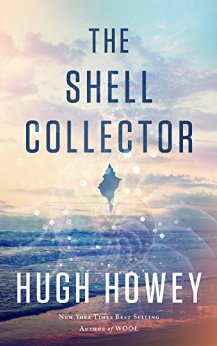
shellcollector_hughhoweyThe Shell Collector (Hugh Howey)

I’ve come to Hugh Howey a bit late. I read Beacon 23 last year, but I still haven’t got round to reading Wool. I really should, though.

Judging from reviews, this book is different to the rest of Howey’s work. That’s mainly down to it being a romance. And before you switch off, let me say that this isn’t a genre I’m familiar with, or one that particularly appeals. I’ve read a few, and I’ve been unimpressed.

But The Shell Collector is different.

To start with, the prologue is one of the best pieces of writing I have read in a long time. It would stand up as a short story on its own, and I was almost tempted to stop when I reached the end, as I couldn’t imagine how Howey could top it. There is so much emotion and back-story conveyed in a short time, and it’s a fine indication of how good a writer he is.

But I carried on, and the book became intriguing. I didn’t know I was reading a romance, because the build-up to the relationship is slow, and evolves around a mystery, as journalist Maya Walsh gets an invitation to interview Ness Wilde, one of those responsible for the destruction of the oceans (at least, as she sees it). The story’s set in the near future, and shows the effects of environmental change without resorting to ‘end of the world’ catastrophes, and without beating us over the head with ‘look after the planet’ stuff. Instead, the world is what it is, and Maya (and the other characters) just have to cope with it. It’s like a real-world dystopia, if that makes sense.

The characters are very believable, as are their interactions. And the mystery element really keeps things moving, as Maya finds out more about the real Ness Wilde (and his grandfather). I don’t know if I totally like either character, but they are interesting and real enough that I wanted to find out more, especially about Ness’ secret.

And this was one let-down in the book. When this secret is finally revealed at the end, it felt rushed. Maybe Howey thought that giving it more time would have impacted on the romance, or maybe it was never supposed to be the driving force of the book. I don’t know. But I would have preferred a little more meat to the mystery side of the story.

But it’s still a very good book, written by someone who definitely deserves the success he’s enjoyed since Wool got so much interest. Where Beacon 23 hides its seriousness behind a playful exterior, The Shell Collector is earnest throughout. It shows how Howey can change his writing to suit the story he’s telling. It’s a fine example of character-driven story. I’ll definitely be reading more of his books.


So, three books that have impressed me over the last month or so. I know they won’t appeal to everyone (a comedy, a book that seems to purposely make reading difficult, and a romance), but the writing itself is great in all of them, and I’d recommend all three.

And now I’ve got more books to read. Some promise to be cracking stories, others are things I’m not sure about but I’ll give them a go anyway. Some will leave me unimpressed. But others will blow me away.

I’ll let you know which ones do that for me in a couple of months.

A Perfectly-Sized Story: The Resurgence Of The Novella

With the growth of e-books, something interesting has been happening with story and book length. With the ease of putting out ‘books’, many people have tested the waters with short stories, but others have gone for something longer‌—‌not quite a novel, but more than a short. And it’s not only independently published authors who are getting in on this. James Patterson is now releasing his ‘bookshots’, billed as ‘stories at the speed of life’, and I’m sure other big names will follow soon.

This is nothing new, but maybe now it’s time is right.

Why now? Let’s take a step back.

Books for saleA few decades ago, when dinosaurs roamed the plain, there were places known as bookstores, where these strange physical objects called ‘books’ could be bought. Often, these bookstores stocked nothing but books, and many didn’t even sell coffee. If you wanted to read, you’d enter one of these establishments, browse the shelves, select what you wanted, then pay at the till, handing over these strange notes and scraps of metal that were called ‘money.’
It took time to choose the right book. Those in charge of these establishments would place titles they wanted to shift face-out, or even on separate displays. The reader would look for authors they knew and trusted, or maybe they’d be drawn in by an interesting-looking cover. They might pick up a book and read the back, or may even open the book (very carefully, making sure they didn’t damage the spine, because these were delicate, precious artifacts) and read a section.

And usually there were multiple books that looked promising. So how was one to choose, especially when they might all be available for the same price?

There was one fall-back position‌—‌look at the size of the book, either physically, or (if you were slightly more canny) at the page numbers and print size. And then you’d go for the largest book, because you got more for your money that way.

Maybe that’s being a little blunt, but the size of a book was one way publishers tempted readers, and it was rare to find a short book for sale. Yes, there were exceptions, but they tended to be classics like Of Mice And Men or Animal Farm, or one-offs by big-name authors that publishers were confident would sell.

Apart from these oddities, you were limited to novels or collections of short stories.

Fast-forward to today, when so much reading material is digital. How long is a book now? However long it needs to be. And I think this is great.

I like novels. I like having a story I can get my teeth into. But there are times when I want something else.

Short stories are great for reading while having a coffee. They are wonderful ways to fill ten minutes while waiting at the dentist (because, if your dentist is anything like mine, the time of your appointment and the time you are seen are never the same, and you don’t want to sit there doing nothing).

Then there are continuing stories. Look at any e-book retailer, and you will find series after series. This is, of course, nothing new, but it’s far more prevalent now. You can read a novel, then continue with another about the same characters, in the same world. You can be immersed in that world for far longer. If the series is good, your commitment will be rewarded with twists and turns you never saw coming. And independent authors, who can bring out new volumes at a fast rate (because they don’t have to deal with printing presses, or ensuring a good position in book stores), can keep readers of these ongoing sagas happy with multiple releases over the year.

But there’s one book length that, I feel, has benefited most from the e-book revolution, and that’s the novella. Technically, both ‘short books’ mentioned before fit into this category, as do things like The Old Man And The Sea. Publishers generally haven’t been too keen on novellas, mainly because they take almost as many resources as novels, but readers aren’t generally prepared to pay the same price for such a short book (why spend the best part of £10 or $10 or whatever on something barely over 100 pages when you can get a 500-page epic for the same price?). But with e-books, this problem goes away.

I’ve noticed myself reading more and more novellas over recent years, as I’ve switched from print to e-ink.

BookI’m one of those strange people who would rather read than watch TV. I do enjoy the occasional film, but I’d still prefer to relax with a book at the end of the day. And a novella is the perfect length for an evening of escapism. 25000 words, or just over 100 pages, normally takes a couple of hours to read, the same time as the average film. It’s a great length of time for an escape, and when I put the book down (okay, turn off the e-reader), I feel satisfied‌—‌I’ve had a complete story. I feel like I’ve been watching a film in my head, and now I’m emerging into daylight, my eyes adjusting after the dark of the cinema, sad to have to return to reality, but happy for the couple of hours I’ve been entranced by the story.

The comparison between novellas and films goes deeper. Many successful films have been based not on novels but on novellas (and short stories). In most cases, a novel contains too much to condense into a couple of hours on screen, and huge chunks have to be abandoned, or characters and events merged. But a novella is just right. Think of films like The Shawshank Redemption and Stand By Me, both of which came from Stephen King novellas. In fact, King’s written quite a few novellas, although they tend to turn up in collections like Four Past Midnight and Full Dark, No Stars, rather than being available on their own.

Also, some stories simply work better as novellas. I’ve read quite a few novels that have contained obvious padding, simply to make them fit a certain length. I’ve read short stories that felt rushed, and needed more time and space than they had been given.

Of course, there are other lengths of stories, from flash fiction to ongoing epics that never seem to end (and I realise that statement could be negative or positive, depending on preferences and the content itself). And with digital reading, they are all equally available.

So, if I want to escape for a couple of minutes while I wait for an appointment, I can grab a bit of flash fiction. I can have a coffee and take twenty minutes over a short story. I can spend an evening with a novella, or a few evenings with a novel. Or I could dedicate a few weeks to a series, delving deep into a new world.

Story length is no longer defined by physical parameters, or limited by cost and return-on-investment. Stories can truly be as long as they need to be.

And that has to be a good thing.