Escape Holiday Stress with Free Fantasy and Sci-Fi Reads

If you’re in need of a break from holiday festivities, books are perfect. Escape into a new world, experience exciting adventures, all from the comfort of your sofa. Or bed. Or wherever else you read (the bath?).

This promotion brings together over 80 free science fiction and fantasy books, all centered around friendship. Some are uplifting‌—‌found family, or friends helping one another to get through tough situations. Others could be darker, involving betrayals and ‘friends’ who are anything but.

There’s something for everyone. So click here and escape into a free book today.

Taking a break doesn’t mean stopping

I’ve done it! After what feels like far too long, I now have a finished first draft.

It feels good to reach this point but this is only the start. Editing is vital to writing, and this draft needs a great deal of editing. This book and series are more ambitious than anything I’ve previously written, with multiple points of view spread over multiple story arcs that all need to weave together seamlessly for the series to work.

I’ve been reticent about sharing too many details about the story itself (because so much can change), but I’ll give you a brief overview of the story strands in this first book. One involves a generation ship, a craft the size of a city travelling between the stars and seeding new colonies. On this ship is a kind-of detective who starts investigating what seems to be a straightforward case, but it soon develops into something that threatens the whole ship, and might involve strange signals the ship is picking up.

Another strand follows a rag-tag crew of a courier, running less-than-legal jobs across the various star systems. Their current job throws them into tensions in a particular system, where they’re forced to choose sides if they’re to remain at liberty.

The final strand involves a new member of Unity (a sort of galactic government), someone with lots of promise but who’s still naive about the way things work. She’s fighting for recognition against the backdrop of potentially alien signals emerging across the galaxy.

These strands will interact as the series progresses (and more strands will be added), but for the first book to work there has to be some kind of cohesion between them. But at the moment they feel too much like separate stories.

There’s also the matter of this first draft’s length. I normally aim for my novels to be no more than 100,000 words, with first drafts normally clocking in at around 125,000 (I tend to waffle as I find my way into the story). But this draft is a ridiculous 230,000. Each strand could easily be a book on its own.
This is something I considered — and then rejected. I doubt I could pull that off. The overall story would feel far too fragmented.

So I have a great deal of work ahead in wrangling this draft into something that resembles a coherent book (and that’s before I deal with the words themselves). It’s a huge task. And it’s not one I feel up to at the moment.

I won’t dwell on possible reasons for this (tired, busy day job, holiday season approaching?). Instead, I need to come up with a solution.

And I think I’ve found one.

Back when I wrote my first series, Dominions, I’d have multiple stories on the go at the same time. I’d finish a first draft of one novel, then jump to editing a previously drafted novel. Then I might plan and draft a short story or novella. And when I reached the mid-point of the series I took a short break in order to plan and write what became the first book in my Shadows trilogy.

And I felt very productive. If one particular project (novel, short story or whatever) was becoming too much I could jump to something else. I’d get energised by working on something different, and the problems in the original project would be churning around in my subconscious, running through all kinds of potential solutions.

This stopped when I reached the end of both Shadows and Dominions. I wrote my next series, ShadowTech, one book after the other, with very little in the way of ‘filler’ projects (a few short stories but not much else). And now, since the summer, I’ve been immersed in this new space-opera series.

So I need to have a secondary project. I need to have something else I can work on when the primary project starts dragging.

And I have just the thing.

I believe I mentioned in a previous post that, as I’ve been planning this series, I’ve had all kinds of adjacent ideas. Things have cropped up that fit in with the story-world (story-galaxy?) but won’t work directly in the main story arc. And I’ve had thoughts of different side-stories, even whole side-series.

So I’m going to work on one of them for a bit. I’m taking the captain of the courier ship, Kane, and exploring his back-story. In the main series he has a strong connection to his ship, Seraph. But how did he come to be Seraph’s captain? And how did he pull together his crew of misfits?

This will be a far more linear tale. In writing Kane’s back-story I’m following one character, one strand. The story itself won’t be galaxy-spanning (although there’s plenty of scope for travel to other worlds and other stars). Rather than being a complex story told over a complete series and following multiple point-of-view characters, Kane’s tale will be primarily a series of individual adventures.

I’ve started work on this, and I’m enjoying it. I have a rough outline, but I’m letting the story develop a lot as I go. I’m having fun exploring Kane’s character, and that means I understand him more. When I return to editing that original novel I’ll have a far better grasp on his character, which will enable me to ensure he’s acting as he should and not doing things that are wildly out of character. Also, as I explore the galaxy through Kane’s adventures, I’m developing my understanding of the setting and the technology, as well as how the people in this galaxy function.

Just as this side-story (and others that I’m sure I’ll write in the future) provide more information on the story-world for those who want it, they also help me create a more lived-in and realistic story-world.

So I’m not really taking a break. This is research. This is development.

It’s all part of that spiral of writing, circling around and around but always building. Is it easy? No. But nobody ever said writing a decent book, let alone a decent series, was easy.

If it was easy, there’d be no fun in it. If writing was simple, there would be no challenge.


This post first appeared on my Substack. If you’d like to receive these ongoing updates on my new series as they’re posted, please consider subscribing to my Substack for free by clicking here.

I have box-sets for sale on Kobo

Looking for an escape over the holiday season? Want to dive into a sci-fi box-set? I have a few in sales on Kobo at the moment.

Get Shadows: The Complete Trilogy, a sci-fi shot through with a dark vein of horror, for 30% off.

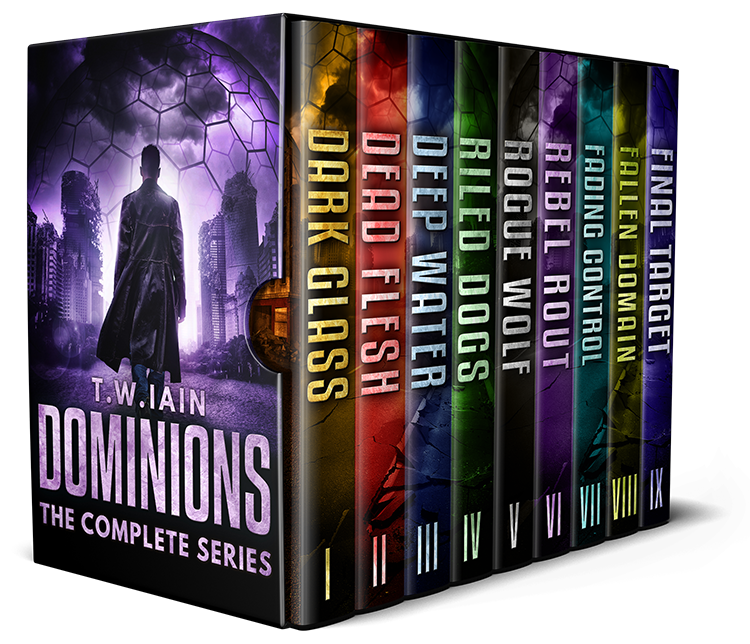
Get Dominions: The Complete Series for 30% off too‌—‌nine novels (and a few novellas and short stories) of Dystopian thrillers.

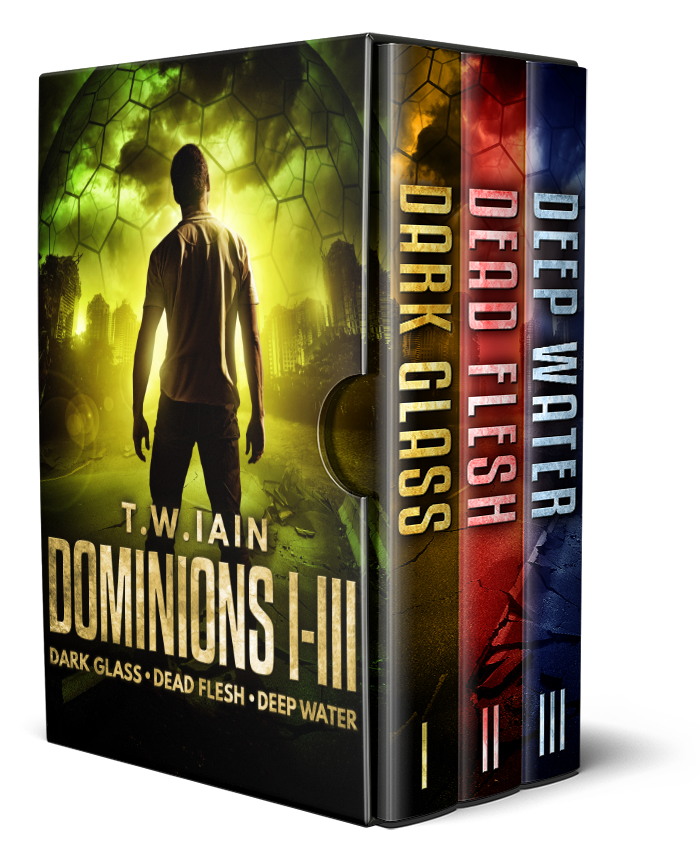
And if you’re a Kobo VIP reader, you can get my Dominions Box-Set (the first three novels in the series, along with the prologue short story, for 40% off.

Massive Discounts on Ebooks: Smashwords End-Of-Year Sale 2024

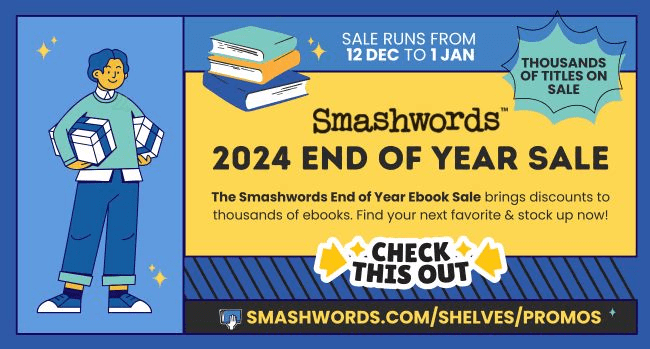
Smashwords is running a massive End Of Year sale, with books anywhere from 25% off to totally free. There are hundreds of titles to browse, across every genre you can imagine. And if you want any of my books, they’re all 75% off (which means the novellas and shorts are effectively free). Check them out here.

The sale runs until 1st Jan.

Why consider getting books from Smashwords? Apart from sales like this, Smashwords aren’t connected to any particular ebook ecosystem. Download the books you buy (or get free), and read them on whatever device you prefer.

Click here to start browsing the complete list of bargain books, or click here for my books.

This free book promotion is ending soon!

A quick reminder about the hundred-plus sci-fi and fantasy titles in this promotion. Some books are full novels, others are novellas or short stories. There are even a few collections‌—‌multiple novels in one volume. But what they all have in common is that they’re free.

This promotion finishes soon (16th December), so click here to browse the full list of titles and pick up some free reads‌—‌ideal for escaping over the upcoming holiday season!.

Free Fantasy & Sci-Fi promotion image of a female and a robot dog

The consequences of wormholes and generation ships (maybe)

Science fiction. What does that term actually mean?

Let’s take the last part first. Fiction. That means it’s made up, a story that never happened (or hasn’t happened yet). In theory, no options are off the table. The writer has total freedom, can make up whatever they want.

But good fiction needs to feel real. The characters have to behave in ways that, even if not predictable, are human. When things happen, there has to be some kind of logical reason. When characters use objects, those objects have to behave in reasonable ways.

So what about the ‘science’ part of the name? Science fiction is (usually) centred on some kind of science or technology, or exists in a world where science and technology are important. And that science, no matter how outlandish, needs to make some kind of sense. If it doesn’t, we’re in the realm of magic.

There’s a thin line, though. Take the force in Star Wars. There might have been some attempts to explain this with science, but it acts very much like a magic system. Then consider one of Arthur C Clarke’s ‘laws’ — that any sufficiently advanced technology is indistinguishable from magic. Current Internet technology would seem like magic to someone from a few hundred years ago. So if I’m writing a space opera series set hundreds or thousands of years in the future, there will most likely be technologies that seem like magic, as well as technologies I can’t even begin to imagine.

But I’m writing fiction, and I want readers to enjoy and engage with it. So these technologies need to feel plausible. If the technologies don’t yet exist, I need to write about them in a way that makes them at least seem possible.

This limits that freedom I mentioned earlier. But when it comes to writing, limits can be (are?) important. Have too much freedom, and there are too many possibilities. Setting limits helps focus the mind.

One thing I need to consider in my new series is space travel. I have humanity spreading across the galaxy. That means people need to travel vast distances. Our current understanding says that nothing can travel faster than light, so travel to even the nearest stars would take years, even lifetimes.

There are various ways to deal with this. One is to have passengers on space-going vessels hibernation, with the ship waking them when they near their destination. Another alternative is to have some kind of way of ‘skipping’ through space — hyperspace travel, wormholes, and so on.

I’m going to use the second alternative. I don’t want hyper-drives that can throw craft around the galaxy as easily as they can travel from a moon to its parent planet. That almost feels like cheating. Instead, I’m going to have ‘gates’ in various locations, with the ability (the technology and the science) for anything entering one gate to emerge at another almost instantly, even though the gates are light years apart.

But how did these gates get there? If these gates are some kind of hyper-space doorways, who set the doors in place?

My solution is to have vast generation ships travelling to distant stars. These city-sized ships take lifetimes to make their journeys, and there’s no hibernation. Those who board the ship when it sets off will never see the destination, dying out long before the ship arrives.

As these generation ships cross the void between stars they create and drop off gates, enabling those in their wake to skip across the vast distances.

But what about those who live on these ships? For them, the journey is their life. For them, the ship isn’t a means to an end but a home.

The more I considered this, the more involved the whole thing grew.

If conditions on these generations ships were perfect, then the passengers (or those who call the ship home) wouldn’t want for anything. But is that a good thing? If the purpose of these ships is to seed distant planets, and these planets are going to need work (terraforming) before they can independently sustain human life, then those who colonise these new worlds will need to be tough. They’ll need to be adaptable and strong — physically, mentally and emotionally. People who have existed in an environment that provides all they need would most likely be weak. They’d expect things to work out. They wouldn’t be used to struggle.

So in my series, life on these generation ships will be tough. Some will have it easy, but others will struggle. While the ships won’t want to kill off their passengers (the ‘seeds’ for the new worlds), they won’t make things easy. There will be crime, and pain, and death. The ships will contain environments that force the occupants to push themselves, to adapt and grow.

Which leads to more thoughts. Imagine a generation ship travelling for thousands of years. Now think of how much has changed on Earth in the last millennia. There have been wars and unrest, along with periods of peace. There has been turmoil. How much of this would (could) these generation ships endure?

So it makes sense to have an overseer. But who? Is this a group of people — and if so, would they have the same problems the rest of the passengers have? Or is the controlling force some kind of machine sentience?

And what about the gates? Who controls them? If a gate fails, what happens? Every possible solution to these questions leads to more alternatives.

But I have to think about these things. If I have this gate technology in my series, and if I have these generation ships, then I have to make sure they seem real. I have to consider how their existence would effect people, as individuals and as societies.

And isn’t that one of the fascinating things about science fiction? It enables us to play with possibilities. It enables us to posit these questions, even if we can’t settle on any firm answers.

This is science fiction. It isn’t about fact, but about asking ‘what if…?’ It’s about extrapolating what we currently know and seeing where it might end up.


If you’d like to receive these updates as I work on my new series, please consider subscribing to my Substack. You’ll get these posts early, delivered straight to your in-box.